


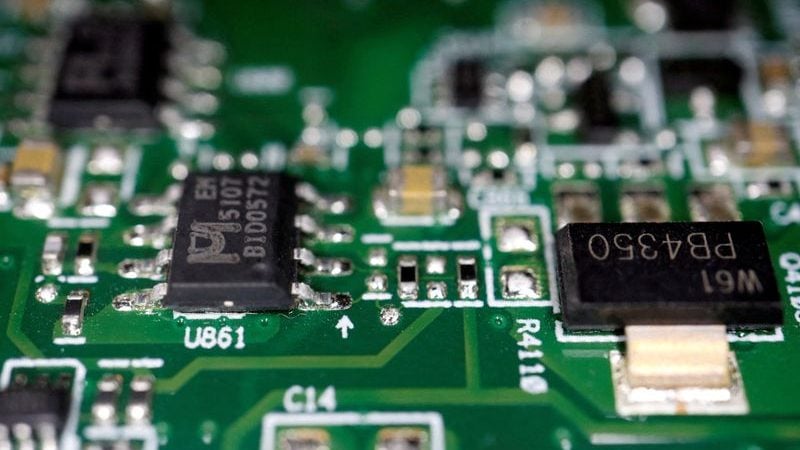
India is emerging as a semiconductor hub, developing indigenous chips like VIKRAM 3201, DHRUV64 to boost self-reliance. The market is growing and expected to reach $100 billion by 2030. In a major boost, the Union Budget 2026–27 announced India Semiconductor Mission 2.0 (ISM 2.0) with a provision of Rs 1,000 crore, reinforcing India’s ambition to emerge as a global semiconductor hub.
Semiconductors are materials which have a conductivity between that of conductors and insulators. They can either be pure elements, like silicon or germanium or compounds, like arsenide or cadmium selenide. They have less resistivity than insulators and more than conductors. The resistance of the semiconductor decreases with an increase in temperature and vice versa. Semiconductor chips are the heart and brain of all modern electronics and communications technology products, contemporary automobiles, household gadgets such as refrigerators, and essential medical devices such as ECG machines. The development of emerging technologies like AI, 5G or driverless cars is dependent upon a fast and cheap semiconductor industry. Semiconductors are globally the most-traded products after petroleum and cars, with an annual turnover of $500 billion. It makes the devices more compact and less expensive. Semiconductor chips have enhanced the features of smartphones with powerful processing and continue to enable the world’s greatest breakthroughs and transformation in industries, ranging from aerospace and consumer electronics to energy and medicine.
Semiconductor manufacturing comprises the front-end fab (fabrication plant) manufacturing and the back-end assembly, including packaging and testing. However, the front-end fab manufacturing is a complex process, with only a handful of companies involved. It is a complex process requiring at least 300 different high-technology inputs. Globally, the entire semiconductor value chain has seeped in the interdependence between a handful of countries like the US, Taiwan, Japan, China, and some European nations. Within this chain, there’s an extraordinary degree of specialisation that makes it vulnerable to shocks. All of the world’s most advanced (below 10 nanometres) semiconductor manufacturing facilities are located in just two countries—Taiwan and South Korea. The semiconductor product development requires the largest investment on both research & development (R&D) and manufacturing. It is estimated that over the next decade, about $3 trillion in investment will be needed. The top three companies in each stage of the semiconductor supply chain take in about 80–90 percent of the revenue.
Semiconductor manufacturing status in India
India has an existing base for design and verification for the semiconductor industry. Most of the global semiconductor companies have an R&D footprint in India. India has two fabs—SITAR, a unit of the Defence Research and Development Organisation (DRDO) in Bengaluru, and a semiconductor laboratory in Chandigarh. These build silicon chips for strategic purposes like defence and space, and not for commercial use. India remains heavily dependent on imports for semiconductor chips, memory components and display panels, with at least 95 percent of its requirements met through overseas suppliers. In 2020, India spent $15 billion on electronic imports, with 37 percent coming from China. As of December 2025, 10 projects worth Rs 1.6 lakh crore have been approved across six states, covering silicon fabs, silicon carbide fabs and advanced packaging facilities.
Global race to diversify semiconductor supply chains
Semiconductor chip manufacturing is concentrated in a few countries, as Taiwan produces over 60 percent of the world’s semiconductors and along with South Korea makes 100 percent of the most advanced chips (below 10 nanometers). The semiconductor industry experienced significant supply shortages during the Covid-19 pandemic due to disruptions in China’s production. The ongoing Russia-Ukraine conflict has also resulted in shortages of raw materials for domestic industries as Ukraine is a key supplier of neon, which is an essential input in semiconductor manufacturing. Even the European Union and the US have refused to sell advanced manufacturing equipment to China. In retaliation, China imposed export controls on crucial inputs such as gallium and germanium. This has led to another round of shortages in the semiconductor industry. Therefore, many countries are looking to diversify their supply chain. India seeks to take advantage of countries eyeing for diversification of supply chains.
Development of indigenous semiconductor industry in India
The pandemic and the subsequent lockdowns impacted the supply of chips to India and automobile manufacturers like Mahindra & Mahindra and Tata Group were compelled to reduce their production due to the shortage. In the post-pandemic world, there is a greater inclination towards work from home culture, which warrants an enhanced demand for servers, internet connectivity and cloud usage.
In addition, an estimated 50 crore people will join the internet in the next decade, which will increase the demand for phones and laptops.
Hence, indigenous semiconductor industry is needed in India to meet the rising demands of the industry. There is a huge domestic market for semiconductors which could exceed $60 billion by the end of 2026. Indigenous manufacturing of semiconductor chips will help in building the smartphone assembly industry and strengthen India’s electronics supply chain, which will create employment opportunities for the nation’s youth. Indigenous capacity would further attract local taxes and boost export potential. Further, India would be required to import fewer semiconductor chips, which would decrease the import bill. Chips made locally will be designated as “trusted locally” and can be used in products ranging from CCTV cameras to 5G equipment, which would improve the national cybersecurity profile. Once India has sufficient supply of chips indigenously, it would be in a better position to mould the future course of geopolitics, driven by data and the digital revolution. Further self-sufficiency will decrease reliance on Chinese chip imports, especially during conflicts like the 2020 Galwan clash and Operation Sindoor last year.
Govt efforts towards development of semiconductor industry
National Policy on Electronics, 2019 envisions positioning India as a global hub for Electronics System Design and Manufacturing (ESDM) sector and aims to encourage the development of core components including chipsets and create an enabling environment for the industry to compete globally. The government has also approved the Semicon India programme with a total outlay of Rs 76,000 crore for the development of semiconductor and display manufacturing ecosystem in the country. ‘Modified Scheme for setting up of Semiconductor Fabs in India’ aims to attract large investments for setting up semiconductor wafer fabrication facilities in the country. The scheme provides fiscal support covering 50 percent of the project cost on an equal-footing basis for setting up silicon-based complementary metal-oxide-semiconductor (CMOS) semiconductor fabrication facilities in India. The Government has also allowed 100 percent Foreign Direct Investment under the automatic route in the Electronics Systems Design & Manufacturing sector. The Union Budget 2026–27 launched India Semiconductor Mission 2.0 with Rs 1,000 crore to boost domestic chip capabilities through local equipment and material production, full-stack IP design and industry-led R&D and skilling.
Challenges in India’s semiconductor industry
The high cost of establishing semiconductor manufacturing facilities is a major deterrent, with a fabrication plant in India typically requiring an investment of over $5 billion. The bureaucratic inefficiency also poses a serious problem, as the process of establishing an indigenous semiconductor facility requires clearances and approvals from multiple government departments, which takes a lot of time and creates a hurdle. Further, there exists a considerable degree of bureaucratic delays at each stage that discourages the establishment of manufacturing units. Uninterrupted regular power supply is an essential requirement for smooth production of semiconductors, which is not available in many parts of India, and thus restricts production to very few locations. The indigenous manufacturing of semiconductors requires the use of high-end technologies. These technologies are licensed from patent holders at a very high price. There is a dearth of skilled labour in this sector and delays in land acquisition and the uncertain tax regime further deter the manufacturers in taking the lead.
Way Forward
R&D-intensive activities like electronic design automation, core intellectual property and chip design should be the core focus areas. The US is the leader in this segment and India can get part of the business by supporting its existing chip-design experts and funding technology and innovation centres, where focus should be on setting up of semiconductor fabrication facilities for making of advanced chips. Assembly, testing and packaging segment captures 10 percent of the value and China is the current leader. With low-cost skilled technical manpower, India is a natural choice to take some part of the business. Adequate funding must be provided to augment the R&D potential of technical institutes. To ensure market viability and economics, manufacturers need to be given an assurance of minimum domestic procurement by the government and the private sector. The focus should be on manufacturing economical and technically viable options like 28 nanometer chips. The government should also support businesses in the acquisition of semiconductor manufacturing units in other countries. This is easier than setting up a domestic facility and can be done swiftly to ensure a continuous supply of chips. Hand-holding startups of entrepreneurial engineers can also produce large payoffs. Areas like stable power, large quantities of pure water and land are state subjects, and the state governments should also create the right climate for easy implementation of semiconductor projects.
This is an era of digital revolution, which signifies an increased use of mobile phones and computer devices. This enhanced usage can be met only with a robust availability of semiconductor chips that sustains their functioning. Therefore, India needs to focus on the indigenous development of semiconductors in order to realise its digital potential and emerge as a strong power in the present era.
Prem Mehta is a student of SM Joshi college, Pune. Views are personal.
Also Read: Make in India must move beyond assembly to research and innovation