





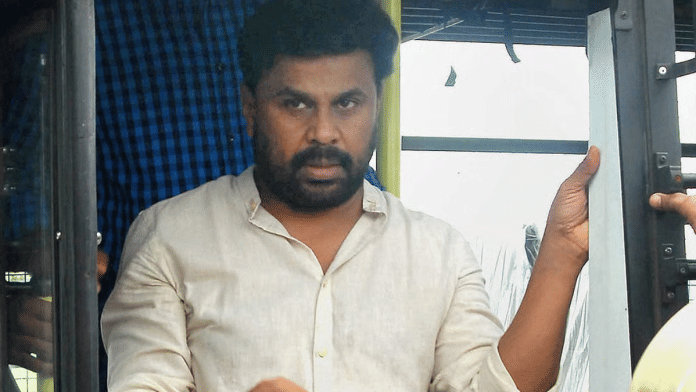



Thiruvananthapuram: On a night in February 2017, a leading Malayalam female actor was abducted and sexually abused in a moving car in Ernakulam by six men, who also video-recorded the act to blackmail her later. The survivor approached the police the next day, and the case soon led to the arrest of the alleged mastermind and actor-producer, Dileep.
After over eight years of legal battle, allegations of tampering with evidence, and claims of bias by the court, the case will finally see closure when the Principal District and Sessions Court in Ernakulam pronounces its verdict on Monday.
Dileep is the eighth accused in the case, and his associate, Sunil NS alias Pulsar Suni, is the first accused. Both of them are out on bail. All the 12 accused are charged under sections including 120(A) (criminal conspiracy), 109 (abetment of an offence), 342 (wrongful confinement), 366 (kidnap), 354 (assault), and 376(D) (rape) of the erstwhile Indian Penal Code (IPC).
The case, which would have otherwise remained a lone sexual-abuse incident, has since then historically changed the Malayalam film industry, leading to the Women in Cinema Collective (WCC), a first-of-its-kind all-woman outfit in the Indian cinema, in November 2017.
The case also led to the formation of the three-member Justice Hema Committee in the same year, which revealed rampant sexual abuse in the Malayalam film industry. The report, which was released in July 2024, revealed that female actors were subjected to unnecessary advances even before they entered the industry. The ripple effect was seen in many other language film industries too, with similar issues being reported from other industries following the release of the report.
The case & timeline
According to records accessed from Kerala courts and the Supreme Court, the survivor was abducted on the night of 17 February, 2017, when she was travelling from Thrissur to Kochi by car on the National Highway, by the first six accused in the case. The group sexually assaulted her in the moving vehicle, and the first accused, Suni, also captured this on a mobile phone, after which she was abandoned.
Police arrested Suni on 23 February and recovered the memory card containing the visuals. Soon, the probe led to Gopalakrishnan Padmanabhan, who goes by the stage name Dileep, a powerful figure in the industry. The probe revealed that the actor maintained enmity towards the survivor.
“It is alleged that the petitioner herein maintained enmity towards the de facto complainant, believing her to be responsible for the breakdown of his matrimonial relationship. To retaliate, he allegedly conspired with the first accused to abduct the victim, to sexually abuse her, to record the acts of sexual abuse, and to blackmail her using the video-graphed materials,” the Kerala High Court noted in August 2018.
Dileep is a Kerala State Film Award winner and a Malayalam superstar. Starting out as a mimicry artist in the early ’90s, the actor is mostly remembered for his action-comedy roles and family dramas in hit films.
After 2010, he ventured into film production and also opened his restaurant ‘Dhe Puttu’ in multiple cities, including one in Bahrain. The actor also opened the multiplex theatre complex ‘D Cinemaas’ in Thrissur’s Chalakudy and founded the Film Exhibitors United Organisation of Kerala in 2017, after a rift in the existing association. Dileep was arrested in July 2017 and was remanded in custody for nearly three months.
In 2018, Dileep approached an Ernakulam lower court, the Kerala High Court, and later the Supreme Court for access to the clone copy of the memory card which contained the visuals, with all courts denying the request. Dileep argued that the video was fabricated evidence that underwent tampering, while the courts asserted that the electronic evidence was crucial to uphold the “esteem, decency, chastity, dignity and reputation of the victim” and was in the “public interest.” The court noted that when there is a conflict between Fundamental Rights of a person and statutory rights of another person, Fundamental Rights will prevail.”
The trial began in 2020, and the survivor in 2022 moved the Kerala High Court and Supreme Court seeking to change the trial to another court, alleging bias from the judge. However, this plea was dismissed.
Suni was granted bail in September 2024 after he had been in jail for seven years, considering the long trial. The same year, the High Court dismissed another plea by the survivor seeking an Special Investigation Team (SIT) probe into the unauthorised access of the memory card while in court custody. On 26 November, the Sessions Court completed the proceedings and reserved its verdict for 8 December.
Also Read: Congress expels Palakkad MLA Rahul Mamkootathil as anticipatory bail plea in rape case rejected
Ripple effects
While the legal battle proceeded in the courtrooms, the case had also led to a reformation in the Malayalam film industry.
Soon after the incident, a section of film actors and technicians openly came in support of the survivor and highlighted the gender disparity prevailing in the industry. The group, including actors Rima Kallingal and Parvathy Thiruvothu, formed the WCC in May 2017, and met Chief Minister Pinarayi Vijayan seeking government intervention for a fair probe. They also highlighted that AMMA was supporting the accused actor, and he was expelled only after a huge backlash after his arrest.
In July 2017, the Justice Hema Committee was formed by the state government in response to the WCC petition to study the plight of women in the Malayalam film industry. After hearing from many of the women in two years, the committee submitted its report in 2019. However, the state government was faced with criticism as well as RTI requests, as the report was delayed. Finally, in July 2024, the State Information Commission ruled that the report must be made public, opening a can of worms.
The 235-page report noted that “many in the industry are made to believe that all women in the industry get into the industry or are retained only because they have sex with men in the industry.”
“It has come out in evidence that about ten to fifteen individuals in cinema who are in the forefront of the Malayalam film industry constitute a power group, controlling the Malayalam film industry.”
Following the release, many women came forward openly making allegations against leading figures like Mukesh, Jayasurya, Sudheesh, Riyas Khan, Maniyanpilla Raju, and former AMMA general secretary Edavela Babu, after which the government formed an SIT to look into these cases. However, a year later, the SIT informed the Kerala High Court that all the 35 cases it registered were dropped as they failed to get victims’ statements.
In the aftermath of the report, all 17 members of its executive committee, including its president Mohanlal, submitted their resignations from AMMA in 2024. This year, the association elected actor Shweta Menon as its chief, electing its first woman chief.
(Edited by Tony Rai)