



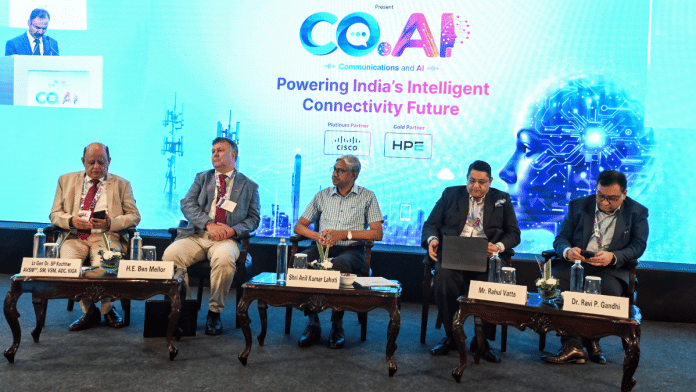

New Delhi: Telecom Regulatory Authority of India (TRAI) Chairman Anil Kumar Lahoti on Monday said that Artificial Intelligence (AI) has created opportunity, but also requires the right governance approach.
He also said that the regulator’s recommendations on satellite communications (SATCOM) are now with the central government and awaiting a decision.
Speaking on the sidelines of a telecom and artificial intelligence forum in the Capital, Lahoti said TRAI had underlined the importance of SATCOM in its recommendations, saying it would serve a complementary role in delivering services to remote and difficult-to-reach areas. The recommendations had already been submitted, he said, and SATCOM’s role would follow once the government takes a decision.
The comments come as the allocation of satellite spectrum remains a contested issue in the sector, with terrestrial operators and satellite players differing over how airwaves should be assigned.
Lahoti was the chief guest at CO.AI 2026, organised by the Cellular Operators Association of India (COAI) with the British High Commission. At the event, COAI and the commission signed a memorandum of understanding on cooperation in AI, digital connectivity, digital trust and technology-led innovation.
On AI governance, Lahoti referred to the framework set out by Prime Minister Narendra Modi at the AI Summit 2026, which he described as a useful basis for keeping AI development aligned with the public interest. Under the framework—covering ethical systems, accountable governance, national sovereignty, inclusion and legitimacy—AI should augment rather than diminish human agency, he said.
Lahoti said AI was not merely another network generation or application layer but a capability that could shape how networks are managed, how services are designed and how decisions are made.
He said regulation would have to balance competing objectives—encouraging investment, promoting competition, enabling innovation, ensuring quality and protecting consumers. Problems such as cyber threats, scam networks, standards and technology supply chains crossed national boundaries, he added, and there was value in learning from other jurisdictions.
The forum was structured around three themes: AI for autonomous networks; AI for security, trust and resilience; and AI for citizens and public services. Discussions covered the use of AI in combating digital fraud, strengthening consumer protection and improving network efficiency.
Acting British High Commissioner Ben Mellor said governments had a responsibility to ensure innovation advanced alongside security and accountability, particularly as criminals were using AI in scams. He said AI was also part of the solution, helping institutions recognise patterns of harm early rather than reacting to individual incidents. The MoU, he said, began with a defined public interest problem rather than a broad statement of intent.
Rahul Vatts, Chairperson of COAI and Group CRO and Director, Corporate Affairs at Bharti Airtel, said AI and telecom should be treated as a single continuum, with AI central to building more intelligent and anticipatory networks while strengthening consumer safety. He cited the industry’s use of AI to counter spam.
Ravi P. Gandhi, Vice Chairman of COAI and President and Chief Public Policy and Regulatory Officer at Reliance Jio Infocomm, said COAI members accounted for close to 95 per cent of the market. He said the UK brought experience in fraud prevention and tackling organised crime, and that the partnership marked the start of sustained cooperation on fraud and scam prevention rather than a one-time engagement.
COAI Director General Lt. Gen. S.P. Kochhar said telecom networks would not only support AI workloads but would themselves become AI-enabled systems capable of optimising performance, strengthening security and protecting consumers from emerging risks.
The forum noted AI’s potential in predictive network management, energy optimisation, cybersecurity and fraud detection, while participants flagged the need for safeguards, accountability and clear lines of responsibility. COAI represents the leading telecom service providers and equipment vendors in the country.
(Edited by Nardeep Singh Dahiya)
Also Read: India’s satellite communication ambitions are facing regulatory uncertainty