





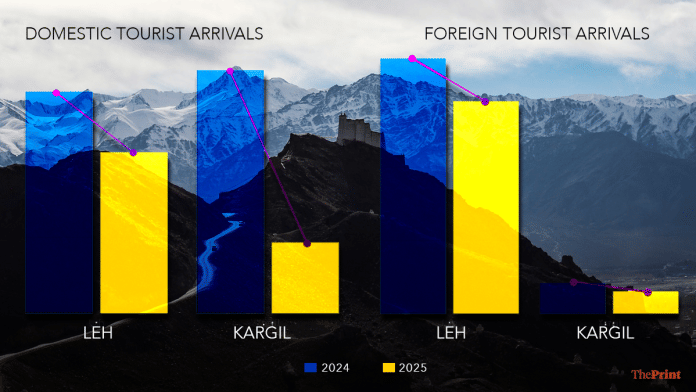



New Delhi: Tourist arrivals in Ladakh fell sharply in 2025 from 2024, with Kargil recording a drop of over 70 percent in domestic visitors, amid security concerns and travel advisories post-Pahalgam attack, and weather-related disruptions that cut short the region’s tourism season.
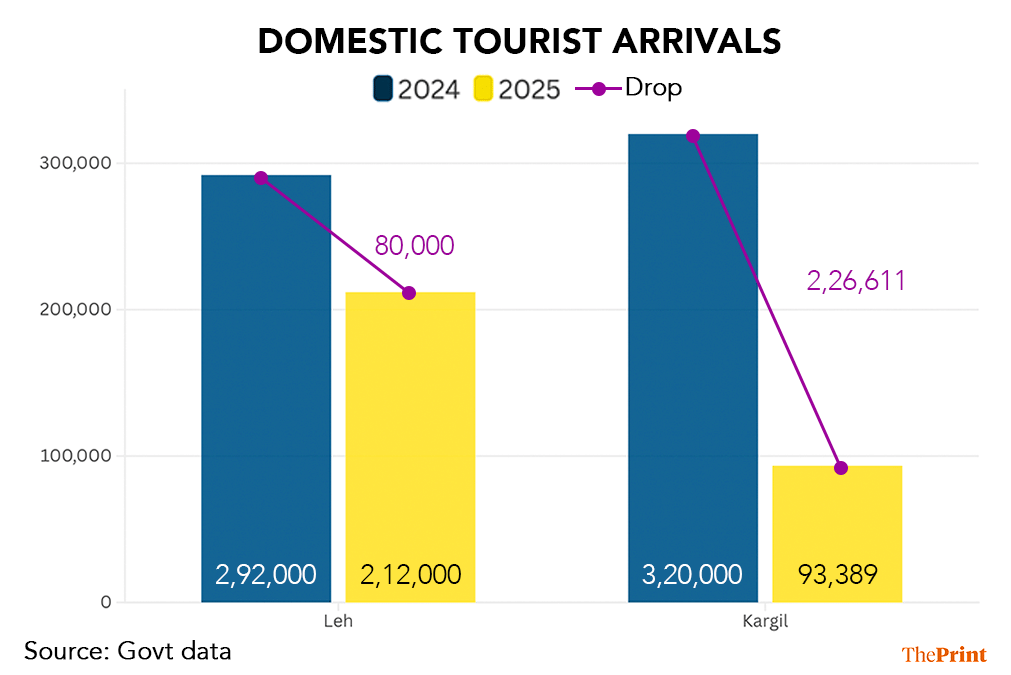
Data shared Monday by the Union government in Lok Sabha shows domestic tourist arrivals in Leh declined from 2.92 lakh in 2024 to 2.12 lakh in 2025, a fall of 27.3 per cent. The drop was far steeper in Kargil, where domestic arrivals fell from 3.20 lakh to 93,389, a decline of 70.9 per cent.
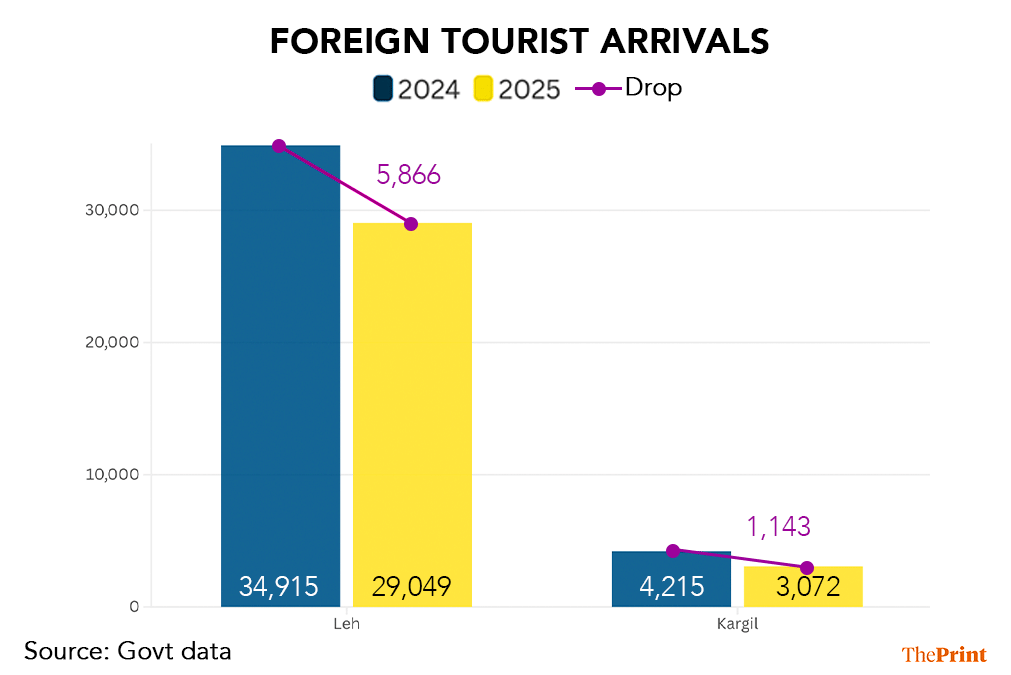
Foreign tourist arrivals also declined. Leh recorded 29,049 foreign visitors in 2025 compared with 34,915 the previous year, a fall of 16.8 per cent. In Kargil, foreign arrivals fell from 4,215 to 3,072 — a decline of 27.12 per cent.
The figures were shared by Union Tourism Minister Gajendra Singh Shekhawat in response to a question in Lok Sabha on whether the government was aware of financial distress among tourism stakeholders in the Union Territory.
The downturn comes after a turbulent year for Ladakh’s tourism sector, which is heavily dependent on a short summer travel window due to extreme winter conditions in the high-altitude region.
In April 2025, terrorists opened fire on tourists in the Baisaran Valley near Pahalgam, killing 26 people and injuring several others, in one of the deadliest attacks on civilians in the region in recent years.
The attack heightened security concerns. India responded to the terrorist attack by Pakistan-based Lashkar-e-Taiba, launching a military action—Operation Sindoor—targeting terror infrastructure across the border.
In the aftermath of the tension, several countries including the US, UK and Australia issued travel advisories for parts of Jammu and Kashmir and Ladakh, contributing to tour cancellations and a decline in foreign tourist arrivals.
At the same time, heavy monsoon-related disruptions damaged key access routes to the region, affecting connectivity during peak travel months. Ladakh’s tourism sector is particularly vulnerable to such disruptions as most road access routes remain closed for large parts of winter due to snowfall.
Also Read: Foreign tourists spooked by India-Pakistan tensions. Changing plans, ditching north
Industry hopeful
Industry representatives say the decline reflects these extraordinary circumstances rather than a long-term trend.
“Ladakh will come back on its own because it is very unique,” said Anil Kalsi, vice-president of the Travel Agents Federation of India.
“This year the season was cut short — first because of Operation Sindoor and then the severe winter started. So the figures we are looking at for this year are quite lopsided,” he said.
According to Kalsi, security concerns and geopolitical tensions often discourage travel to border regions, particularly among foreign tourists.
“If there is a defence or security issue, nobody wants to wander out and get into trouble. Even now the geopolitical scenario affects travel. Airfares are high and availability is limited, so people don’t feel comfortable travelling,” he said.
He added that foreign tourist numbers remain subdued partly because some international travel advisories issued during the security situation have not yet been fully withdrawn.
Despite the slump, the industry expects travel demand to recover as the security situation stabilises and connectivity improves.
“Even for an Indian it is a dream to go to Ladakh,” Kalsi said, pointing to the region’s distinctive landscape and attractions such as high-altitude lakes, monasteries and dark-sky locations like Hanle that have recently drawn attention for astro-tourism.
Govt measures
Responding to concerns raised in Parliament about relief for the tourism sector, the government said the Union Territory administration issued a notification in September 2025 enabling banks in Ladakh to extend relief under the Reserve Bank of India’s framework for areas affected by natural calamities.
Following this, a committee comprising representatives from the State Bank of India, Punjab National Bank and Jammu & Kashmir Bank prepared a rehabilitation plan for borrowers affected by disturbances after the Pahalgam incident, including those in the tourism sector.
The measures include extension of loan repayment periods, moratoriums on repayments, conversion of accrued interest into Funded Interest Term Loans (FITL), and additional working capital loans of up to 15 per cent of existing limits.
The Centre also pointed to broader schemes aimed at boosting tourism-linked livelihoods. Under the Pradhan Mantri Janjatiya Unnat Gram Abhiyan, the government plans to support the development of 1,000 homestays to improve the socio-economic conditions of tribal communities.
States and Union Territories, including Ladakh, can receive assistance of up to ₹5 crore to develop clusters of 5–10 homestays across villages. In addition, the Union Budget 2025–26 announced collateral-free institutional credit through Pradhan Mantri Mudra Yojana loans to encourage homestay businesses across the country.
However, the government did not announce a separate financial package specifically for Ladakh’s tourism sector.
(Edited by Ajeet Tiwari)
Also Read: What Budget 2026 has in store for India’s tourism sector—Ladakh to Tamil Nadu
Oh no, common sense should be left and people should flock to places where gun wielding madmen ask religion before slaughtering ! How dare the tourists commit such blasphemy !