





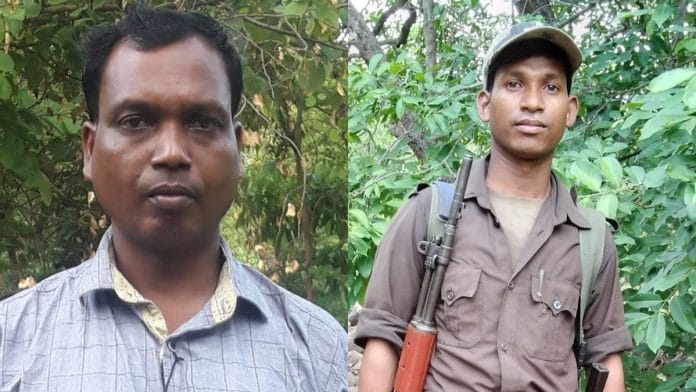



New Delhi: For years, Maoist commander Anwesh had been navigating the dense jungles of Odisha with his weapons slung over his shoulder. Of late, the Left-wing guerrilla from Bastar in Chhattisgarh wanted to join his comrades who had laid down their arms.
But his idea of surrender put him on a collision course with the seniormost Maoist commander in Odisha: Sukru. The two had a series of confrontations, and police sources said Anwesh was subsequently killed by special zonal committee member (SZCM) Sukru, along with other commanders in Odisha, on 29 January.
His body was exhumed Tuesday after the Kandhamal district police confirmed the intelligence inputs related to Anwesh’s murder and burial inside Pakari reserve forest area.
Additional Director General of Police (Anti-Maoist Operations) Sanjeeb Panda said Anwesh, along with a dozen Maoist cadres, wanted to surrender, but group of Maoist cadres led by Sukru wanted to carry on with their armed operations.
“Anwesh was the platoon commander and number two to Sukru. Anwesh, along with his group of 12 cadres, wanted to surrender, but the Sukru group did not want that to happen. Hence, the Sukru group killed Anwesh and buried his body,” Panda told ThePrint.
Anwesh belonged to the Sukma area in Chhattisgarh’s Bastar division. He was a divisional committee member/commander of the military platoon of 8th company under the Communist Party of India (Maoist)’s Kandhamal-Kalahandi-Boudh-
Sukru hailed from Odisha’s Malkangiri district and carried a bounty of Rs 55 lakh.
Sources in the Odisha Police said the murder was a result of an internal rift between Maoist leaders in Odisha and cadres from neighbouring Chhattisgarh.
“The murder is a result of a widening crack among the Maoist ranks on the ground. The particular case is suspected to have originated because of the difference in opinion between Maoist cadres from Chhattisgarh who were working in Odisha under the leadership of an Odisha-based commander. It is an internal rift between the Odia and Chhattisgarh leadership,” said an Odisha Police official.
Kandhamal Superintendent of Police Harisha B.C. said Sukru killed Anwesh with the help of other Maoist commanders, such as divisional committee member (DVCM) Sila and area committee member (ACM) Jagesh. He added that Jagesh was killed in an exchange of fire last week between Maoists and security forces in the Nandabali reserve forest area.
“Preliminary findings indicate that Anwesh was allegedly murdered by his own associates. Intelligence suggests Anwesh had expressed a desire to leave the outfit and surrender to the police. This move was violently opposed by the leadership. The murder is believed to have been executed by SZCM Sukru, with the assistance of DVCM Sila and ACM Jagesh,” the Kandhamal SP said in a statement.
Also Read: India’s long war with Maoists has a huge void — no number of dead bodies can fill it
Revised surrender policy
Officials said Anwesh wanted to surrender before police, following the recent revision in Odisha government’s surrender and rehabilitation policy for Maoists.
In November last year, the Mohan Charan Majhi-led BJP government updated the policy for the surrender and rehabilitation of Maoist cadres in the state.
Maoist cadres were divided into two broad categories: higher Category A, or ranked surrendered cadres, and middle Category B, or and lower-ranked surrendered cadres.
Under the revised terms, the government increased the rehabilitation reward to up to Rs 1 crore for senior leaders, including central committee members. There is also an additional fixed deposit of Rs 10 lakh for other Maoist cadres from lower ranks.
Since the policy revision, 54 Left-wing guerrillas have surrendered in the state since the beginning of this year, and Anwesh wanted to join the ranks of those who had laid down their arms, intelligence officials said. “Anwesh, by definition, was eligible for the revised and upgraded rehabilitation package,” a senior state government official said.
Earlier this month, the government revised its policy again, adding a condition that Maoist cadres from outside the state would be eligible for financial rehabilitation only if their area of operation was in Odisha.
However, as internal arguments followed, Anwesh was allegedly killed in January, police said. Odisha Police officials declined to comment on how he was killed, citing the absence of confirmed inputs and a pending postmortem examination report.
Sources said police officials had received information about the incident, but added that the inputs about the location and timeline were “vague”. These details were confirmed by the surrendered cadres of the banned outfit, officials said.
According to the FIR filed by the Odisha Police, a copy of which ThePrint has seen, the Kandhamal Police received a tip-off from a “credible source” that an unknown Maoist cadre had killed another and buried the body in Pakari reserve forest area.
An Odisha Police official recorded that an unknown decomposed body was recovered after digging around two to three metres below the ground.
The Kandhamal SP said that a case was registered at the Daringbadi police station under sections of the Bharatiya Nyaya Sanhita, 2023 related to murder and destruction of evidence. “The Kandhamal Police are currently in communication with the deceased’s family members in Chhattisgarh to facilitate the necessary legal formalities and the handing over of the remains. Further investigation into the case is ongoing,” he added.
(Edited by Sugita Katyal)
Also Read: Maoism became irrelevant to India’s working class much before Basavaraju’s death