





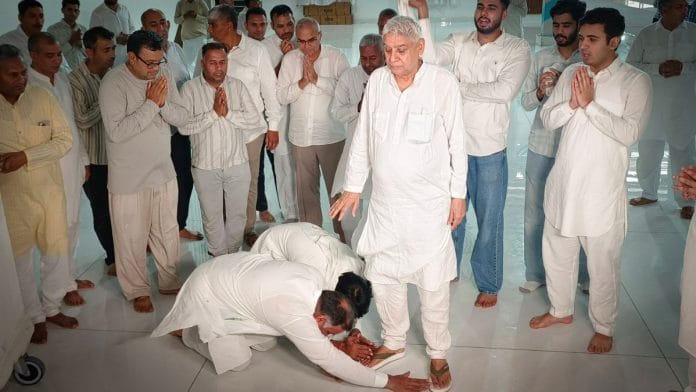


Gurugram: Six weeks after convicted murderer and self-styled godman Rampal was released on bail, politicians from across parties have been making their way to Satlok Ashram in Dhanana, Sonipat.
Congress MP from Hisar Jai Prakash came first. He was followed by Congress MLA from Uklana Naresh Selwal, BJP MLA from Nalwa Randhir Panihar, and former BJP MP Sunita Duggal, accompanied by her husband, serving IPS officer Rajesh Duggal. Village leaders, sarpanches, sportspersons and government officials have also visited.
The latest visit was by Navjot Kaur Sidhu, former MLA and wife of Punjab Congress leader Navjot Singh Sidhu. A video uploaded to the ashram’s official Facebook page this week shows her standing before Rampal, hands folded, seeking his blessings; a second clip shows her touching his feet. “Meeting him boosted my morale and gave me mental strength,” Navjot Kaur said after the meeting.
The visits are not incidental.
Satlok Ashram’s follower base—concentrated among lower-OBC and Dalit communities—spans constituencies across Hisar, Sirsa, Rohtak, Bhiwani, and Sonipat districts, all competitive districts where the Congress, BJP, and smaller Haryana parties contest spiritedly.
The Punjab and Haryana High Court released Rampal on bail this April, citing prolonged incarceration and slow trial progress. He is also a murder convict whose life sentence was suspended, not set aside.
Who is Rampal?
Born Rampal Singh Jatain in 1951 in Dhanana— the village where he now lives—Rampal grew up in a Jat farming family, studied civil engineering, and joined the Haryana Irrigation Department as a junior engineer. He pursued spiritual interests alongside government service through the 1980s and into the early 1990s.
In 1988, he took naam updesh, or guidance, from Swami Ramdevanand, an aged Kabir Panthi saint from the Garib Das sect in Bhiwani district. By the early 1990s, Rampal was conducting satsangs. He effectively stopped attending his government posting around 1995, though his resignation was formally accepted only in May 2000 with retrospective effect.
In 1999, Rampal established the first Satlok Ashram at Karontha village of Rohtak, rechristened himself Satguru Rampal Ji Maharaj, and built a following of Kabir Panthis—a stream rooted in the teachings of the 15th-century poet Kabir who rejected caste distinctions and idol worship and preached equality before a formless God.
Rampal would later claim to be a descendant of Kabir and the only true living exponent of his philosophy.
His following grew first in the rural hinterland of Rohtak and Hisar, drawing largely from OBC and Dalit communities, small farmers, and landless labourers, before spreading to Rajasthan, Uttar Pradesh, Madhya Pradesh, Chhattisgarh and parts of Nepal. He later shifted his primary base to a larger ashram in Barwala, Hisar.
By the time of his arrest in 2014, his organisation ran ashrams across several states, a YouTube channel called SA News, an active social media presence, and a network of Naam Daan centres offering free initiation to newcomers.
He claimed miracles; followers testified to illnesses cured and family fortunes restored after coming into contact with him, or after consuming kheer prepared from milk used during his ritual bathing. His organisation also published books containing his interpretations of the Gita, the Vedas and Kabir’s verses.
The teachings
Rampal’s theology sits within the Kabir Panthi tradition but makes claims that set it apart. He taught that Kabir was not merely a saint, but the supreme God, creator of the universe who manifested in human form. He grounded this reading in the Vedas, the Gita, and the Quran, arguing that all religious scriptures, when correctly interpreted, point to the same Supreme Creator – Kabir.
Rampal prohibited idol worship, animal sacrifice, dowry, alcohol, meat and intoxicants. He preached against caste discrimination and organised mass ‘dowry-free marriages’ at no cost to participants. Naam Updesh was given free, in contrast to the paid rituals of many established religious institutions.
Critics within Arya Samaj for long objected to his statements against Swami Dayanand Saraswati, the 19th-century reformer who founded the organisation. Remarks that Rampal made at a 2006 satsang at the Karontha ashram triggered violent confrontations with Arya Samaj followers, leaving one person dead and several injured.
It was this violence that led to his first arrest and, ultimately, to the 2014 siege.
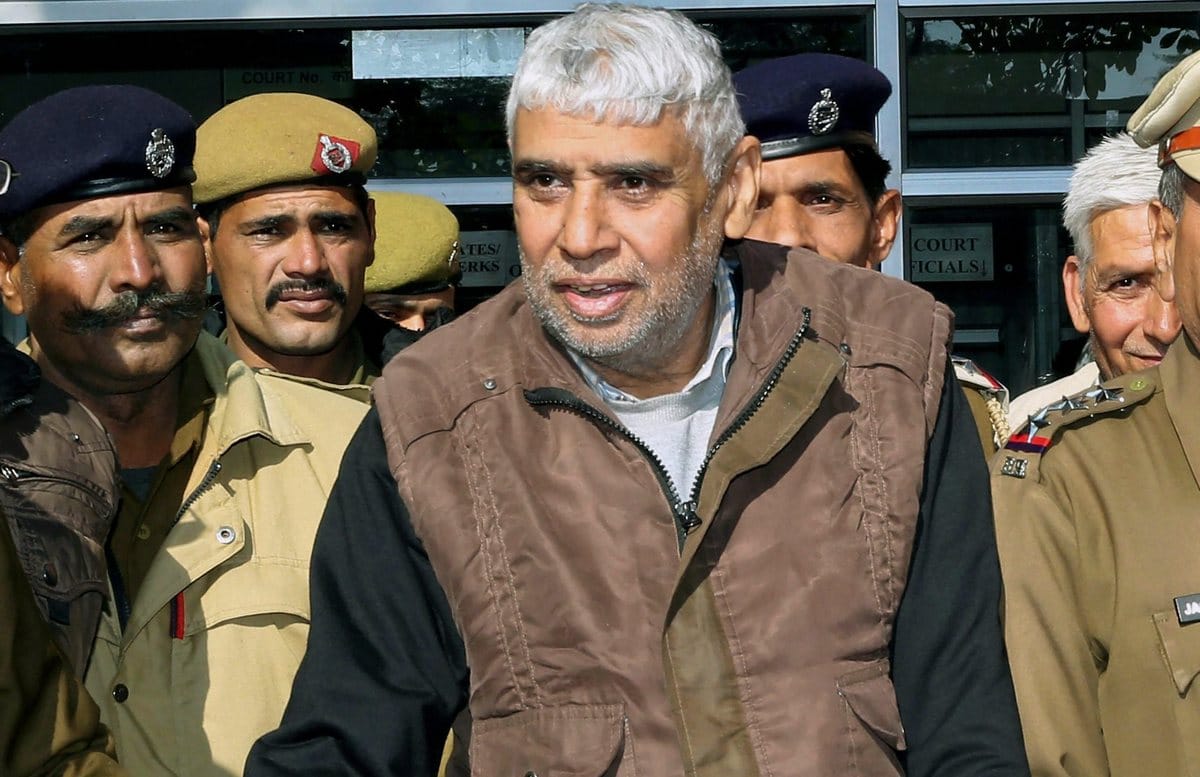
The 2014 standoff
After the Karontha confrontation, Rampal was arrested and charged with murder. He spent 21 months in jail before securing bail in April 2008. His base shifted to the larger ashram in Hisar at this time.
The Punjab and Haryana High Court initiated contempt proceedings against Rampal for his persistent failure to appear before it. He ignored more than 40 court summons, with his lawyers citing medical issues.
By November 2014, a non-bailable warrant had been issued.
Over a lakh followers gathered at and around the Barwala ashram in Hisar over the following fortnight to prevent his arrest. The Haryana government deployed 15 battalions of the CRPF, five companies of the Rapid Action Force, and nearly 10,000 state police personnel. The Hisar-Chandigarh highway was blocked too.
When police moved in on 18 and 19 November, they met with brickbats, petrol bombs and acid thrown from rooftops. Six people—five women and an infant—were found dead inside the ashram when forces entered the premises, in circumstances the subsequent trial would examine at length. Hundreds were injured, among them over 105 police personnel and approximately 70 journalists.
Produced before the High Court on 20 November, Rampal claimed he had been “held in captivity” by his own followers and had been unable to appear earlier. The court remanded him to custody.
Five FIRs were registered against him. A makeshift courtroom was set up inside Hisar District Jail, given the scale of follower gatherings near any regular courthouse.
In October 2018, a sessions court convicted Rampal and 28 followers; he and 14 of the accused were sentenced to life imprisonment “without any remission” in the first murder case, with separate sentences in the second.
Rampal was subsequently acquitted in two other cases, and secured bail in the remaining one.
In August 2025, the High Court suspended his life sentence in both murder cases, citing his age, prolonged incarceration and contested medical evidence regarding the deaths.
On 10 April this year, after 11 years, 4 months and 24 days in jail, he walked out.
How the movement survived
Rampal’s imprisonment did not dismantle his organisation. Ashrams across the states where his following had spread remained open throughout; Naam Daan centres continued performing initiations in his name; the SA News channel and associated social media accounts kept publishing. Followers ran coordinated online campaigns—Twitter trends, petitions, regular video uploads—across the years of his incarceration.
In 2017, three years into his imprisonment, followers organised a Kabir Jayanti event at Rohtak that organisers claimed drew 20 lakh devotees. Some 3,000 quintals of sweets were prepared, followers arrived from across states and the Hisar-Chandigarh highway had to be diverted to manage traffic.
Jyoti Mishra, a political analyst and assistant professor of political science at Amity University-Mohali, told ThePrint that politicians have a long history of seeking out controversial religious figures in Haryana and Punjab for a simple reason: their followers.
“We have seen how political leaders across the political spectrum have been visiting Dera Sacha Sauda chief Gurmeet Ram Rahim Singh in Sirsa ever since he took over, despite him being accused of rape and murder. Even after his conviction in 2017 and subsequent verdicts, the visits have not stopped. They go there not out of any reverence for him but to reach voters among his supporters. Similarly, Rampal commands a large following among OBC community and poor families, and political leaders are seeking his blessings to woo them,” she said.
Rampal, now 74, has been living at the Satlok Ashram in Dhanana since his release. Satsangs remain prohibited under his bail conditions. His lawyers have maintained throughout that the cases against him were motivated and that he is innocent. The murder convictions stand suspended, not set aside. The trial in the remaining case continues.
Also Read: Haryana’s Rs 645-crore IDFC bank fraud probe reaches the IAS, 8 officers in CBI crosshairs