








New Delhi: 2025 was supposed to be a good year for Punjab’s rice farmers. The area under paddy cultivation hit an all-time high, offering hope of higher yields and increased income. But things did not go as planned.
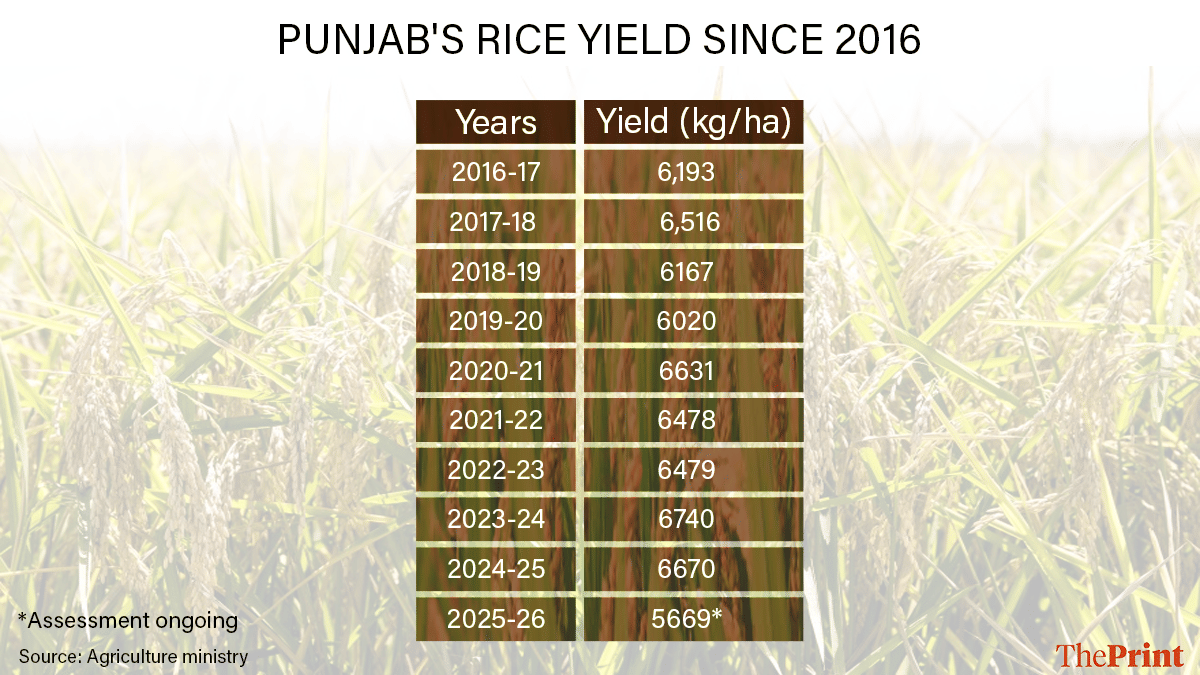
Data from the government’s Department of Agriculture and Farmers Welfare show that this season, Punjab’s average paddy yield—based on crop-cutting experiments—stood at 5,669 kg/hectare. This is significantly lower than last year’s 6,670 kg/ha, and 6,740 kg/ha in 2023.
Floods, prolonged monsoon, and unprecedented crop diseases have led to the lowest paddy yield in a decade in Punjab, India’s rice bowl.
“The assessment is still ongoing. But it seems like this is the lowest recorded paddy yield in Punjab since 2016,” a senior official from the state’s agriculture department told ThePrint.
Monsoon mayhem
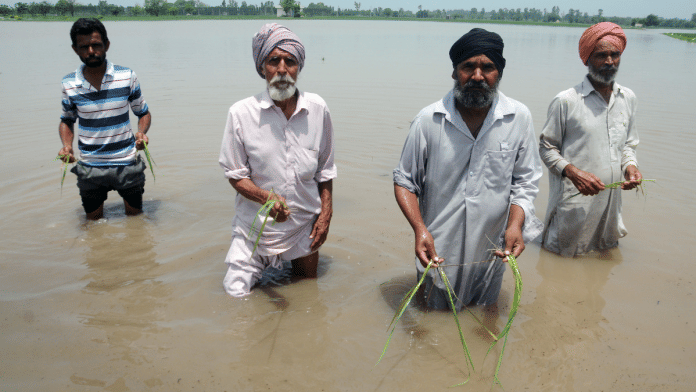
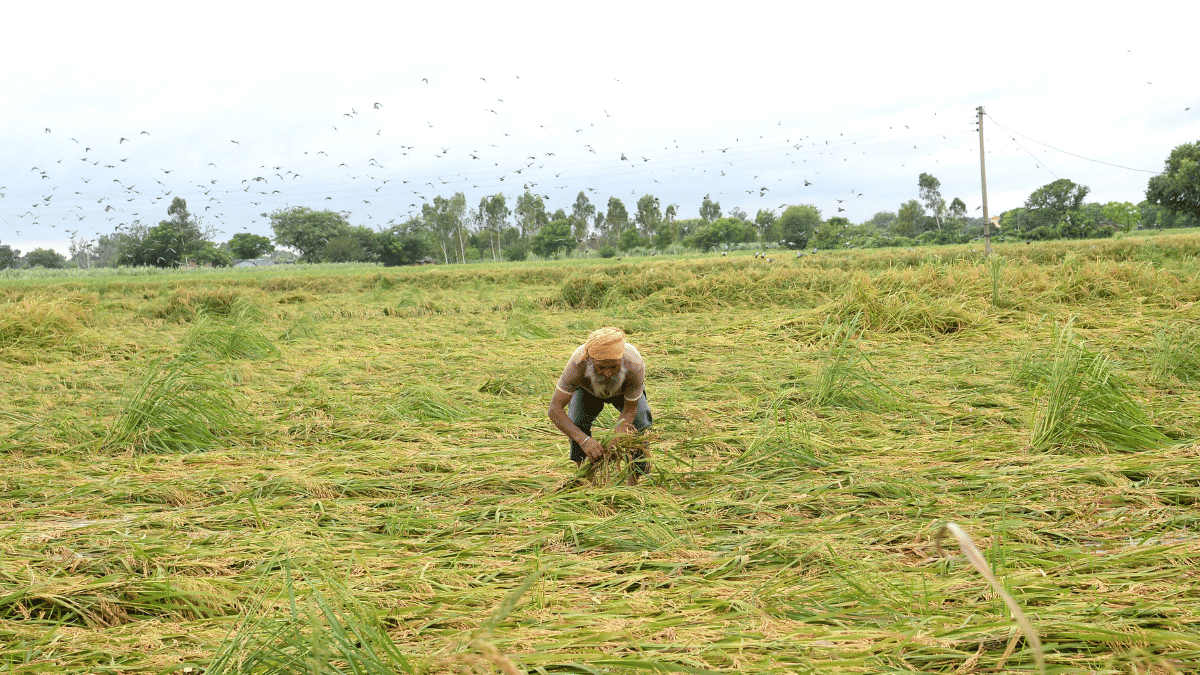
This year, Punjab suffered through one of its worst floods since 1988, which washed away a large swathe of paddy fields in Punjab. It is the primary reason behind this shortfall. State government estimates show that nearly 3 lakh acres of paddy crop were affected, as fields remained inundated for weeks.
According to the India Meteorological Department (IMD) data, the state recorded 620.0 mm rainfall this monsoon—41 percent above what is considered normal for the season.
Rivers running through the state swelled up, destroying homes, inundating farmlands, and displacing people and livestock. Government records indicate that nearly 1,900 villages were hit and more than 3.5 lakh people affected.
But the misfortune for Punjab farmers did not end there.
This season, farmlands were also struck by the False Smut disease, a fungal infection caused by Ustilaginoidea virens, which leads to significant yield losses, poor grain quality, and food safety risks due to mycotoxin production—a process in which certain fungi produce toxic compounds.
In certain districts, agricultural lands were also hit by the Southern Rice Black-Streaked Dwarf Virus, also known as the Fiji virus. This virus was detected in Punjab after three years. The virus could cause dwarfism, stunted growth, and premature death in paddy crops, resulting in significant yield losses
“The last time we reported the virus was in 2022. At the time, around eight districts were impacted, but this time it was more localised,” the Punjab official said.
Worrying trends
The Agriculture ministry data shows that this season, the area under rice cultivation in Punjab reached a record high of 32.46 lakh hectares, surpassing the 32.43 lakh hectares reported last year. This season’s numbers also included 6.80 lakh hectares of Basmati.
While the increase might seem good news, experts say this trend of paddy dependence in Punjab would be harmful in the long run. In fact, over the last few decades, successive state governments have also been pushing farmers to cultivate alternative crops—cotton, maize, pulses and sugarcane—that are less water-intensive.
This year, the government launched a pilot scheme to divert around 12,000 hectares of paddy land to maize cultivation and also increased cotton cultivation by around 15 percent.
Mukhtiyar Singh, who is associated with the Bharatiya Kisan Union (BKU) in Sangrur district, said farmers prefer paddy cultivation because it is covered by the government’s minimum support price (MSP).
“The guaranteed paddy procurement at MSP makes it a preferred choice. Other crops do not give that kind of market support,” Singh said.
Experts also point to Punjab’s unhealthy dependence on paddy.
Retired IAS officer and former special chief secretary of Punjab, KBS Sidhu, explained that the state’s “paddy problem” is not limited to lower yields and a depleting water table.
Talking about what he called Punjab’s “paddy problem”, Retired IAS officer and former special chief secretary of the state, KBS Sidhu, said the issue is limited not only to lower yields and a depleting water table. The entire paddy cultivation ecosystem—from the storage to fiscal managment—is flawed and needs a comprehensive fix.
“The heavy dependence of paddy in Punjab is unsustainable. The governments need to come up with a comprehensive solution to switch farmers from paddy to alternative cultivations,” Sidhu said.
“This year might have been an anomaly for Punjab because of the floods, but if you look at data from the last few years, paddy yield has plateaued. Scientific crop diversification is the only way forward.”
(Edited by Ajeet Tiwari)
Also Read: Punjab floods are a test for parties. They must act together and fast