





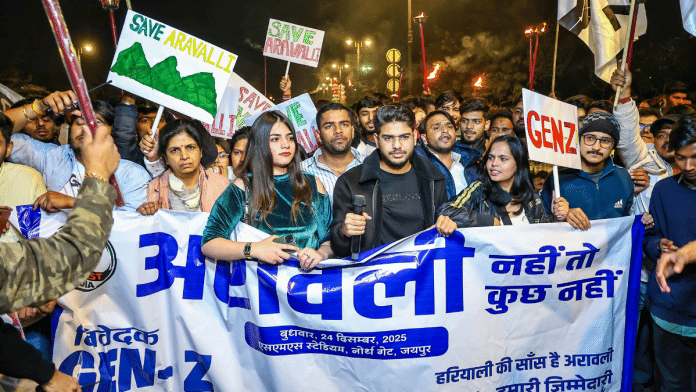



New Delhi: A collective of former civil servants has written to the Supreme Court urging it to prioritise the health and right to life of citizens over “the waste of money of corporates”, and to uphold its principles of ‘polluter pays’.
They went on to warn that the court’s decisions on ex-post facto environmental clearances and the redefinition of the Aravalli Hills undermine citizens’ fundamental right to a clean and healthy environment.Another instance highlighted in the letter is the order that “weakens” the functioning of the Central Empowered Committee (CEC).
These orders, they feared, weaken India’s environmental safeguards.
Former Delhi Lieutenant Governor Najeeb Jung, former National Security Adviser Shivshankar Menon, former Election Commissioner Ashok Lavasa, former RAW chief A.S. Dulat, and former Punjab DGP Julio Ribeiro were among the 79 signatories from the Constitutional Conduct Group (CCG) in the letter released 28 December.
After the Supreme Court order limiting the definition of Aravalli range amid row, activists, academics and common people are raising their voices against the ‘100 metres’ definition. Later, the top court reversed the verdict through a 2:1 decision.
The former civil servants have written to the court, saying that such orders are “against the interests of the Indian citizen”.
“These three orders of the Supreme Court, passed in such quick succession, are against the interests of the Indian citizen and the conservation of nature in our country. Our fervent plea to the Court is to prioritise the health and right to life of its citizens over the waste of money of corporates, and to uphold its own principles of ‘polluter pays’, ‘precautionary principle’ and ‘intergenerational equity’,” read the letter.
The group has given detailed reasoning on what could go wrong if the redefinition of the Aravallis was carried out.
“The Aravalli range, most of which is below 100 m in height, is estimated to be around 670 million years old and acts as a natural barrier slowing the spread of the Thar Desert, stabilising micro-climates and recharging aquifers,” the letter said.
“The new definition will potentially exclude over 90 percent of the Aravalli range from environmental protection, opening it up to mining and construction and practically removing its ability to be a dust barrier for the Delhi-NCR region,” the group said, adding that it would actively allow the advance of desertification into Delhi-National Capital Region (NCR)
Regarding the Central Empowered Committee order, the collective asserted that the CEC was losing its independence and acting in alignment with the environment ministry, instead of functioning as an independent monitor of forest and wildlife protections.
These orders weaken long-standing environmental jurisprudence and the safeguards that were created to protect forests and hills, the former civil servants said.
“These decisions set back sound environmental jurisprudence and reward violations, instead of upholding the constitutional mandate to protect forests, wildlife and ecologically sensitive landscapes,” they said.
“The recall of earlier safeguards rewards violators and reverses decades of environmental jurisprudence meant to protect forests, hills and the right to a healthy environment.”
The collective said that the orders come at a time when extreme climate events and record air pollution levels demand stronger environmental safeguards. It added that if mining begins in the Aravallis, it will increase the AQI in Delhi-NCR, a region that is already choking.
“The impact of such mining on the Air Quality Index in Delhi-NCR, a region that is already choking due to a lack of breathable air, can only be imagined. It will amount to state-driven carnage, which will predominantly impact the most marginalised people of Delhi-NCR who do not have the luxury of air purifiers and have to work outdoors in such noxious conditions,” the letter said.
(Edited by Tony Rai)