





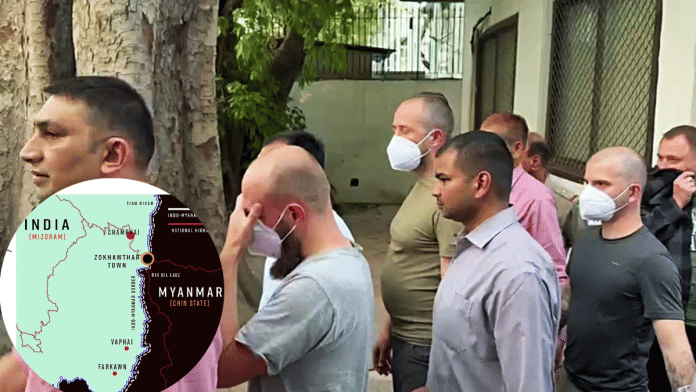



New Delhi: A network of internal roads, multiple unmanned entry points, and limited enforcement capacity. These are some of the gaps many, including foreign nationals, exploit to enter Mizoram without the requisite documents, such as the Protected Area Permit (PAP), sources in the security establishment told ThePrint.
This was also evident in the case of six Ukrainians and one US national, arrested by the National Investigation Agency last week, who allegedly entered the state and then crossed over to Myanmar without being flagged. The foreign nationals first reached Guwahati and then travelled to Mizoram.
According to the sources, this has remained a challenge. Even though PAP was reinstated after over a decade, after the February 2021 military coup in Myanmar and the influx of undocumented migrants, there is still no mechanism to ensure its effective enforcement on the ground.
While checks are conducted at airports and along some major highways leading towards the Myanmar border, these remain limited.
They are difficult to implement across the extensive network of smaller roads and village-level entry points, where monitoring is logistically challenging and, in many cases, impossible, multiple sources told ThePrint.
“It is a significant challenge to verify whether every tourist—Indians, who require an Inner Line Permit (ILP), and foreigners, who need a Protected Area Permit (PAP), are carrying the necessary documents before entering the state,” said a source.
“There are numerous internal routes through which one can enter Mizoram from Assam, Manipur, and Nagaland. If someone intends to evade scrutiny, as appears to be the case in this incident, it is fairly easy to do so. All they need is to hire a vehicle with a local driver familiar with these internal roads, many of which have no checkpoints,” the source added.
While there is a checkpoint on the main highway, it is impossible to monitor every route, he said.
The source added that PAP compliance is typically checked for those arriving by air. However, individuals entering by road, or even by train, can often bypass these checks altogether.
The sources said this needs to be strengthened, especially in the current scenario. “With the arrest of these foreigners, certain changes will have to be brought about to ensure the system is enforced effectively,” the source said.
The NIA has alleged that the foreign nationals travelled to Mizoram without the requisite documents and entered Myanmar illegally, where they conducted training for Ethnic Armed Groups, in addition to illegally importing huge consignments of drones from Europe to Myanmar via India for the use of EAGs.
The NIA told the court that these EAGs are also known to be supporting some proscribed insurgent groups in India by way of supplying weapons and other terrorist hardware and training them, thus affecting India’s national security and interests.
The seven foreign nationals have been booked under the Unlawful Activities Prevention Act (UAPA).
‘Not having PAP attracts, at most, a penalty’
Earlier, if a foreign national arrived in Mizoram without a Protected Area Permit (PAP), the rule was to send him or her back on the same flight to their point of origin. This was later relaxed, allowing foreigners to apply for a PAP from within Mizoram itself.
Once granted, they were permitted to travel within the state.
“FRRO (Foreigner Regional Registration Offices) Kolkata is the nodal agency for issuing PAPs. The permit is required for all three states—Manipur, Nagaland and Mizoram,” the source cited above said.
Officials clarified that the absence of a PAP is a compoundable offence, attracting monetary penalties. “If a person is found without a PAP for up to 30 days, the fine is Rs 50,000; for 60–90 days, it increases to Rs 75,000, and so on,” a second police officer said.
“At present, if a foreigner is found without a PAP, they are asked to apply for it immediately. The process is online. They are allowed to stay while the application is processed, and once approved, they can move freely,” the officer added.
“Meanwhile, their details, including their place of stay, are recorded for follow-up.”
However, citizens of Afghanistan, China, and Pakistan, as well as foreign nationals of origin from these countries, require prior approval from the Ministry of Home Affairs, the officer explained.
PAPs can be obtained through Indian missions abroad, the MHA, district magistrates, state resident commissioners, home commissioners, or the FRRO.
The PAP regime
The PAP regime was introduced in 1958 through an order mandating that no foreigner may enter or remain in a protected area without a permit issued by the Central government or its authorised representatives. The permit specifies the place of entry, duration of stay, and other passport details.
For foreign nationals, entering Mizoram without a PAP violates the 1958 Order—punishable under Section 14 of the Foreigners Act, which entails a jail term. But no arrest has been made for such a violation in Mizoram till now.
The requirement was relaxed for Manipur, Mizoram, and Nagaland on 30 December 2010, following an improvement in the security situation, and to promote tourism.
However, the relaxation was withdrawn on 17 December 2024 because of evolving security concerns, particularly developments in Myanmar and the ethnic clashes in Manipur.
“Manipur reported ethnic violence from 3 May 2023. At the time, Chief Minister N. Biren Singh had pointed to possible foreign involvement, including groups based in Myanmar. There were also intelligence inputs about individuals, including foreigners, crossing into Myanmar for training with ethnic armed groups. It was in this context that the PAP regime was reinstated,” the source said.
‘Even easier entry to Myanmar’
It is not just relatively easy to enter Mizoram without the requisite permits, but also crossing over into Myanmar with a highly porous border, limited deployment, and no fencing.
India shares a 1,643-km-long border with Myanmar, running through Arunachal Pradesh, Nagaland, Manipur, and Mizoram. While the MHA has repeatedly spoken about fencing the border, only about 43 km has been completed so far, according to data submitted by the MHA to a Parliamentary Standing Committee. Another 346.64 km is currently under construction.
“It is very easy to cross into Myanmar because the border is vast and communities on both sides share the same ethnicity. In many stretches, it is not clearly demarcated. Efforts to fence the border have also faced resistance from local populations, as people have relatives across the border and share deep ethnic ties,” a third police officer said.
For instance, the Kuki-Chin-Zo ethnic group shares close ties with communities in both Mizoram and Manipur.
Additionally, the Free Movement Regime (FMR) between India and Myanmar has historically allowed people living within 16 km of the border to travel across for trade, to meet.
Although the MHA moved to suspend the FMR in January, it has just been restricted, not entirely scrapped. The movement now is permitted up to 10 km on either side.
“This poses a major challenge as it can facilitate illegal migration and insurgent activity. When there is such movement, it becomes difficult to track who is crossing for what purpose,” the officer said.
“While foreigners may be easier to identify, there are numerous unguarded routes from Mizoram into Myanmar. Despite some deployment of Assam Rifles, large stretches of the border remain inadequately guarded. It is, effectively, a cakewalk,” the officer said.
(Edited by Ajeet Tiwari)