





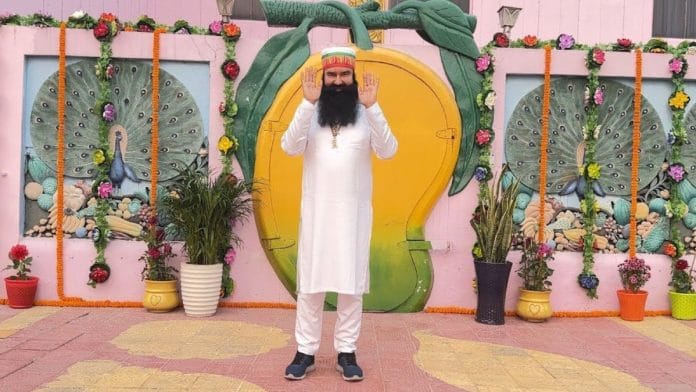



Gurugram: When the Punjab and Haryana High Court set aside the life sentence awarded to Dera Sacha Sauda chief Gurmeet Ram Rahim Singh in the murder of journalist Ram Chander Chhatrapati, it wasn’t because the court found him innocent. But because the prosecution had simply not proved his guilt.
The three other accused—Kuldeep Singh alias Kala, who fired the shots; Nirmal Singh, who accompanied him; and Krishan Lal, the Dera’s manager, who allegedly supplied his licenced revolver and a walkie-talkie set—had their convictions upheld by the same judgment pronounced on March 7.
According to the judgment uploaded to the Punjab and Haryana High Court website Monday, the court found clinching evidence against them, but none against Ram Rahim that could withstand scrutiny.
Ram Chander Chhatrapati was the editor of the evening daily Poora Sach at Sirsa. He was the first to publish an anonymous letter from a sadhvi (disciple) on 31 May 2002 that detailed the sexual exploitation at the Dera. He was shot outside his home on 24 October 2002 and died a month later on 21 November 2002.
On 11 January 2019, the Special CBI Court in Panchkula convicted Ram Rahim and three others of murder and criminal conspiracy, and sentenced them to imprisonment for life.
The charge against the Dera chief was criminal conspiracy under Section 120-B IPC, that he had directed his followers to eliminate the journalist.
The charge rested almost entirely on one man.
Also Read: Dera Sacha Sauda has a new campaign. It shows Ram Rahim as a saviour of widows
Khatta Singh’s flip-flops
Khatta Singh, described by the CBI as Ram Rahim’s driver and the sole eyewitness to the alleged conspiracy, was supposed to be the linchpin of the case.
What he turned out to be, in the high court’s words, was a witness who “kept on tossing from one side to the other like a ping pong ball”.
When the CBI finally recorded his statement in June 2007, nearly five years after Chhatrapati was shot, Khatta Singh claimed that on the evening of 23 October 2002, he had accompanied Ram Rahim to a satsang (congregation) in Jalandhar.
On their return to the Dera at Sirsa, the other accused showed Ram Rahim that day’s edition of Poora Sach. Khatta Singh said this provoked the Dera chief into directing them to “eliminate” the journalist and the murder took place the following evening.
The CBI recorded this statement under Section 164 of Criminal Procedure Code (CrPC). Such statements are recorded only when the police or agency fear a person can turn hostile.
However, even before giving this statement to the CBI, Khatta Singh had told the courts a different story.
In March 2007, he filed an application before a judicial magistrate in Ambala alleging that CBI officers were threatening to implicate him in murder cases unless he made a false statement against Ram Rahim. He followed this with similar complaints to the additional sessions judge at Ambala and to the superintendent of police in Sirsa.
When he appeared as a prosecution witness in the trial, he turned hostile, resiling from his CBI statement and repeating his allegations of coercion. His examination stretched across nearly a year, from May 2012 to April 2013.
The final twist came in September 2017, after Ram Rahim had been convicted in the separate case involving the sexual exploitation of Sadhvis.
Khatta Singh filed an application saying the conviction had given him the “courage” to now tell the truth, and asked to be recalled as a witness.
The Special CBI court initially rejected this, but a single bench of the high court allowed it. A challenge to the order was dismissed by the Supreme Court. He was recalled and this time deposed in support of the CBI.
The division bench found this entire arc of conduct fatal to his credibility. Applying the settled legal position that a witness who completely changes his version on all aspects cannot be believed on any part of his evidence, the court held that his testimony was simply unreliable.
If Khatta Singh was indeed under threat from the Dera and that was why he had stayed silent for years, why did he open up in the Ranjit Singh murder case on 26 December 2006, naming Ram Rahim there, but say nothing about his involvement in the Chhatrapati case on the same occasion? “It is not understood as to why he was under threat only in this case and not in Ranjit Singh case,” the bench noted.
The court went further. It said that the pattern of his conduct pointed not to a man suppressed by the Dera’s fear, but to one who had been worked on by the investigating agency. “It appears that he was coerced by CBI into making a statement as CBI was under pressure to conclude the investigation,” the bench held. “It is a matter of grave concern that a premier investigating agency adopted this kind of methodology.”
Satsang CBI never verified
The high court found the very foundation of his story to be unverified and demonstrably wrong. The entire conspiracy, as narrated by Khatta Singh, had its trigger at a satsang in Jalandhar on 23 October, the evening before the murder. The court said that the visit to Jalandhar, the satsang, the return journey to Sirsa on the same day, and Khatta Singh’s own visit to Delhi on 24 October, weren’t verified by the CBI during the investigation.
M. Narayanan, the head of the CBI investigation, admitted as much in cross-examination.
What the court did find on record was the 27 October 2002 edition of Poora Sach, the newspaper Ram Chander Chhatrapati ran, which reported that a satsang had been held at Zira, not Jalandhar. Zira is some 150 km from Jalandhar.
At the Zira satsang, the paper reported, some cows died after eating leftover food from the congregation. The CBI’s star witness had placed his entire account in the wrong town, and the investigating agency had never bothered to check.
The trial court’s finding that Khatta Singh’s statement was corroborated by his Section 164 CrPC statement before a magistrate was also rejected by the high court.
Section 164 of the CrPC empowers a judicial magistrate to record confessions or statements during an investigation before the trial begins.
A statement under Section 164 is not substantive evidence, the court noted, and cannot corroborate another statement made by the same witness.
Moreover, at the time the magistrate recorded that Section 164 statement in June 2007, Khatta Singh’s revision petition before the Sessions Court at Ambala, in which he alleged CBI coercion, was still pending.
Also Read: 15 times since 2020: Timeline of paroles, furloughs granted to Dera Sacha Sauda chief
Cop who wasn’t called
Perhaps the most pointed criticism in the judgment is directed at the CBI’s decision not to examine Sub-Inspector Ram Chander, the police officer who recorded the dying declaration of Ram Chander Chhatrapati at PGI Rohtak on 26 October 2002, two days after the shooting.
This statement sits at the heart of the conspiracy charge. The family of the deceased had always maintained that Chhatrapati named Ram Rahim in that statement, and that Ram Chander had deliberately omitted the name under pressure.
The defence, with equal vehemence, argued that Ram Rahim’s name had simply never featured in the statement, which was why the CBI chose not to produce it. The CBI gave up Ram Chander as a witness with the bland notation that he was “unnecessary”.
The high court found this inexplicable. It noted that Chhatrapati’s medical records, produced during the trial, showed he had been conscious, stable and oriented from 26 October right through to at least 1 November, when his condition temporarily dipped, and again from 6 November onward until his transfer to Apollo Hospital on 8 November.
In all that time, no effort was made to record a further statement from him or seek the treating doctor’s opinion on his fitness to depose.
“He was the most important witness,” the high court said of Ram Chander. “In so far as A1 is concerned, since the charge is only that of criminal conspiracy, the version of SI Ram Chander would be of extreme importance on either side.”
The high court was careful to add that it was not concluding anything either way; it was not saying the police officer shielded Ram Rahim, nor that the CBI suppressed his statement to avoid exposing a gap. “In any case, a doubt is created in the mind of the court, once such an important statement is not brought on record and such an important witness is not examined. The benefit of the doubt necessarily has to go to the accused,” it said.
Trial court’s findings
The trial court had accepted Khatta Singh’s recalled testimony, treated his Section 164 statement as corroboration, did not probe the failure to verify the Jalandhar satsang, and did not pause over the prosecution’s choice to drop SI Ram Chander as a witness.
The trial court drew support from the motive, Ram Rahim’s documented reason to resent Chhatrapati’s reporting, and from the broader circumstantial picture of followers acting at a powerful leader’s behest.
The high court accepted the motive. It also acknowledged that the Dera had rival groups, that followers of such organisations often act with fanatical zeal, and that it was entirely possible the three convicted accused had themselves decided to silence the journalist.
But motive and possibility, the court held, are not proof. “The prosecution was not able to prove its case against A1 beyond a reasonable doubt,” it concluded.
Ram Rahim remains in jail, serving a 20-year sentence in the Sadhvi rape case. His acquittal in the Chhatrapati murder case does not affect that sentence.
Chhatrapati’s son, Anshul, told The Print Saturday that he was disappointed with the verdict and would appeal in the Supreme Court.
Advocate Jitender Khurana, counsel for Ram Rahim, and a dera follower, said that the Dera chief’s followers had “complete faith in the Hon’ble High Court; we have it, and we will continue to have it”.
“Revered Guru Gurmeet Ram Rahim Singh has been acquitted by the Hon’ble High Court. Truth has prevailed. We have always maintained that the revered Guru Ji is innocent and has had no involvement of any kind in any case. The Hon’ble High Court has also acknowledged this and acquitted Guru Ji. We welcome the decision of the Hon’ble High Court,” he added.
(Edited by Sugita Katyal)
Also Read: Out on parole, Ram Rahim launches dera’s global e-commerce site. ‘Each product with Guru ji’s image’