





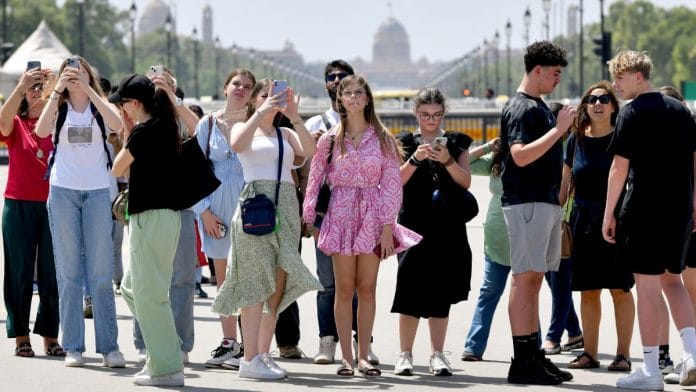


New Delhi: India allows visa-free or visa-on-arrival entry to just five countries, against 21 to 169 for its Asian rivals, according to a report by government think-tank NITI Aayog released Tuesday. This “near-shut door” is the reason the country draws fewer than 10 million foreign tourists a year despite “some of the world’s richest tourism assets”, the report adds.
Titled ‘Unlocking Growth in Tourism and Hospitality Sector’, the report was prepared by the tourism ministry and launched at Hotel Ashok in New Delhi by Union Tourism and Culture Minister Gajendra Singh Shekhawat. It pushes for tourist visa-on-arrival, longer multiple-entry visas and a faster e-visa system, plus a broad clean-up of licences across hotels, restaurants, homestays, transport and tour operators.
NITI Aayog member Rajiv Gauba said licensing returned “by proxy” even after India scrapped the industrial version decades ago. “Every commission required before establishing a business is a licence by other name,” he said. The clearances a hotel or tour operator must obtain, he said, amount to “an obstacle race” and serve no public purpose. Most of them, he pointed out, sit with the states.
“Why are our own people choosing to go to Vietnam and Laos rather than Goa?” Gauba asked.
Also Read: Why have Indian tourists become so unpopular abroad? We need to look into the mirror
Visa gap
India scores 38.14 on the UN Tourism Visa Openness Index, below the world average of 40 and behind several developing country counterparts such as Malaysia (80.48), Sri Lanka (67.07) and Thailand (58.66). Visa-free entry covers only Nepal, Bhutan and the Maldives, and visa-on-arrival is only for a few nationalities, such as Japanese, South Korean and Emirati.
Indonesia, Thailand and Turkey, on the other hand, hand visa-on-arrival to nationals of 97, 31 and 27 countries respectively. This gap “reduces India’s competitiveness”, the report says, and adds that restrictive visa regimes can cut inbound travel by roughly 70 percent, while easing them can lift arrivals by as much as 25 percent.
The report flags a late-November 2025 post by an American investor mocking India’s e-visa portal, which drew over a million views and set off complaints about rejected foreign credit cards and irrelevant content inside the form. The form “asks for far more information than is proportionate for a standard tourist e-Visa”, it says, and “makes India’s e-Visa process feel more intrusive than competing systems”.
Though India ranks 6th in the world on natural resources and 9th on cultural resources, but gets only 39th position out of 119 on the World Economic Forum’s Travel & Tourism Development Index, the report notes. India logged about 20.6 million international arrivals in 2024, but foreign tourist arrivals, leaving out Non-Resident Indians, came to just 9.95 million. Travel and tourism made up roughly a tenth of global GDP and one in 10 jobs worldwide that year; in India, it contributed 5.22 percent, or Rs 15.73 lakh crore (about $170 billion), and supported an estimated 84.6 million jobs.
50 approvals for a hotel
Hotels need about 50 approvals across their lifecycle, while a food and beverage outlet typically requires about 30, the report says.
A typical hotel takes 36 to 48 months from approval to opening in India, against 12 to 18 months in Association of Southeast Asian Nations (ASEAN) destinations, and at lending rates of 11 to 14 per cent, each extra year of delay can sink an otherwise viable project.
According to the report, a hotel holding a valid bar licence still cannot serve drinks anywhere else on the same premises without buying another. A 3-star hotel in Delhi pays Rs 18,04,598 a year for the licence to serve liquor in its bar or restaurant for up to 75 seats, and buys a separate licence to serve guests in their rooms. In Rajasthan, a bar licence costs between Rs 1 lakh and Rs 16 lakh a year and needs renewal every 12 months. The report calls for “a single liquor licence for hotels for service areas within the same premises”.
Much of this flows from hotel star ratings, voluntary on paper. Yet, the report says, “what began as a voluntary process, has de facto” become mandatory once excise and other clearances get tied to it, “counter to the voluntary intent of the star-rating scheme”.
Recommendations
Room caps on homestays “function as a quantity restriction”, the report says, and it wants the ceiling raised from six to 9 rooms. It also asks states to scrap the police-issued eating house licence, extend the All India Tourist Permit validity from 90 days to a year with state entry taxes dropped, and remove the “minimum capital requirement to register as a Tour Operator or Travel Agency”.
Most of these changes fall to states and local bodies, Gauba said, and he urged them to act on the vision of Viksit Bharat 2047.
(Edited by Nardeep Singh Dahiya)
Also Read: Goa, Kerala lose sheen as more foreign tourists pick Maharashtra & Bengal, shows RBI data
Undeveloped, corrupt India restricts foreign tourists so that they don’t come to know that our country is undeveloped and corrupt to the power of infinity.