







New Delhi: As policymakers in New Delhi put their heads together to deal with the long-term impact on India’s economy from a prolonged Iran war, they should stare deep into their teacups. The leaves at the bottom may hold the clue to a simple but powerful mitigating strategy: Respect the sun.
In 1906, the subcontinent’s British administrators forced clocks to chime in sync; Greenwich Mean Time plus 5:30 hours became the local standard. It was a poor compromise that squandered the morning light in the east and forced the west to extend its workday long into an expensive, energy-intensive evening. Colonial trading hubs — Calcutta in the east, and Bombay in the west— tried to retain their own separate times. But after India’s 1947 independence, they, too, fell in line for the sake of nation-building.
Only Assam’s verdant tea gardens have continued to informally operate an hour ahead of the rest of the country, out of sheer practicality. The sun rises and sets especially early in the northeast, and it made sense to pluck tea leaves in natural light.
The longer the Strait of Hormuz remains closed, the harder New Delhi may have to lean on such common-sense solutions. The key to energy sovereignty in a country that relies heavily on imported oil and gas is to harness the power of the sun as much as possible. That makes the policy choice quite clear: Now that the nation-building project is concluded, the east and the west must be free to set their own day.
“One Nation, One Time” is well past its sell-by date. Let West Bengal, Assam and other eastern and northeastern states move to GMT+6:00 hours, the time in Bangladesh and Bhutan, while Maharashtra and Gujarat on the west coast shift to GMT+5:00 hours, the same as Pakistan and parts of central Asia. Depending on their relative distances from the two seaboards, the rest of the country will follow one or the other.
Scientists who looked at the connection between time zones and power usage in the early 2010s concluded that forcing all Indians to wake up half an hour earlier would deliver the most benefit. Back then there were hardly any EVs, but today, their estimate of 2 billion kilowatt-hours a year in energy saving would accommodate the charging needs of all Indian electric cars even if their numbers were to suddenly triple.
By contrast, gains from two time zones would largely be concentrated in the lower-energy-consuming east. However, that’s just what is needed in 2026, if people in these less-developed areas have to be weaned off fossil fuels in their kitchens and cars.
Here’s a snapshot of the nationwide electricity market over a 24-hour period. At 8 a.m., when it starts to get sunny in western and northwestern states like Gujarat and Rajasthan — the big hubs of utility-scale solar production — the price of power starts to collapse.
It starts to get expensive after 6 p.m. That is when shops and restaurants switch on their bright lights to attract shoppers, while commuters are turning on their air-conditioners after reaching home. An hour later, electricity distributors are hungry for power, especially during the brutally hot summer months. But that’s when generation companies have little to sell.
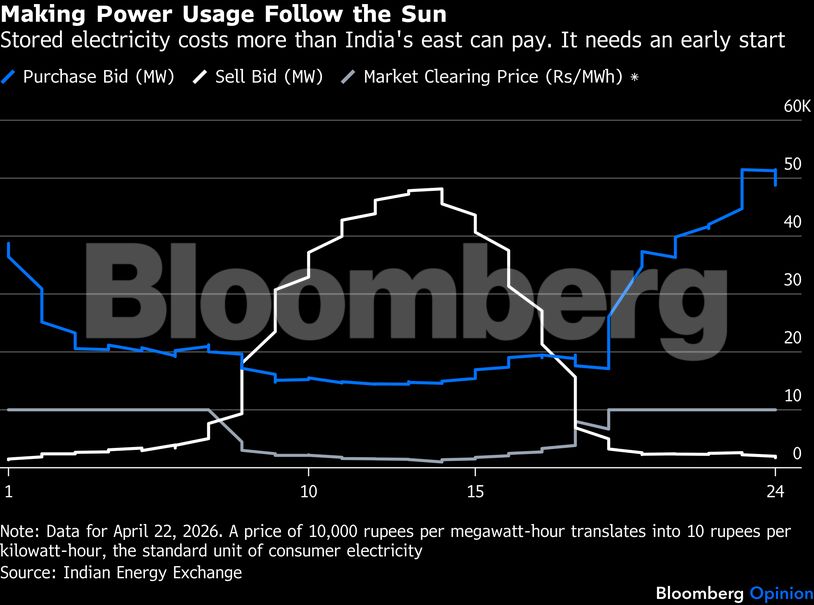
This puts central and eastern areas at a disadvantage. The annual per-capita income in Bihar is less than 70,000 rupees ($750). Maharashtra, home to India’s commercial capital of Mumbai, is five times richer — as are Telangana, Tamil Nadu and Karnataka in the south. Not every consumer can afford to pay 10 rupees for a unit of utility power.
If morning alarms in the eastern region go off half an hour earlier than now, its factories and offices could start and finish while large solar farms in the west are still pumping cheap electricity into the grid. Beyond boosting the east’s lagging industrial competitiveness, it would also allow workers to get home early and cook a fish curry on an electric stove — without having to rely on liquefied petroleum gas from the Middle East, or burning a hole in the household budget by competing against more affluent power customers in the west and south.
Meanwhile, when it’s 8 p.m. in Kolkata, it would be 7 p.m. in Mumbai, still too early to fire up electric cookers. Any extra time in the evening would be a welcome relief to Mumbai’s women commuters who often start chopping vegetables during their long suburban-train journeys home.
The load on the national grid would get less spiky if the entire nation doesn’t simultaneously ramp up electric stoves, EV chargers, and high-intensity cooling in factories and data centers.
Mao Zedong mandated a single Beijing Time in 1949 to symbolize unity, but it came at a cost: In Xinjiang, the sun doesn’t rise until 10 a.m. in the winter months. The western provinces have to keep high-intensity streetlights and industrial heaters on much longer to simulate daylight for workers starting their shifts in what is physically the middle of the night. Conversely, Indonesia maintains three time zones across its sprawling archipelago. By keeping Sumatra and Papua two hours apart, planners prevent 285 million citizens from straining the grid simultaneously.
With an hour’s gap, 1.4 billion people scrambling for energy can become a more orderly relay race. For more than 100 years, the Brahmaputra River valley in Assam has preserved the common sense of following the sun instead of the clock. An energy crisis offers the rest of the country a reason to start reading the same tea leaves.
Interesting, never thought renewable peak cycles will have impact on this, but won’t it be better for everyone if entire evening peak shifts closer to day time for entire india, i.e +6 for everyone