





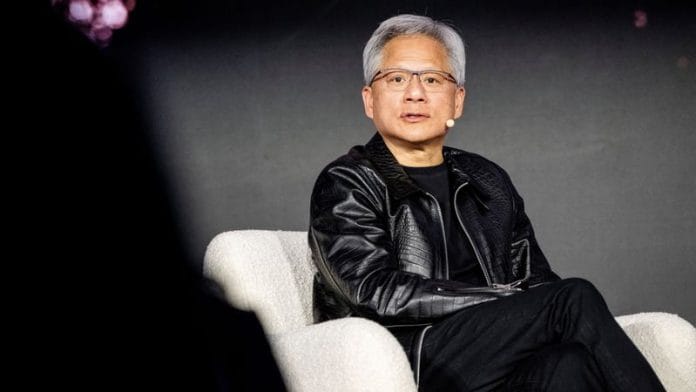


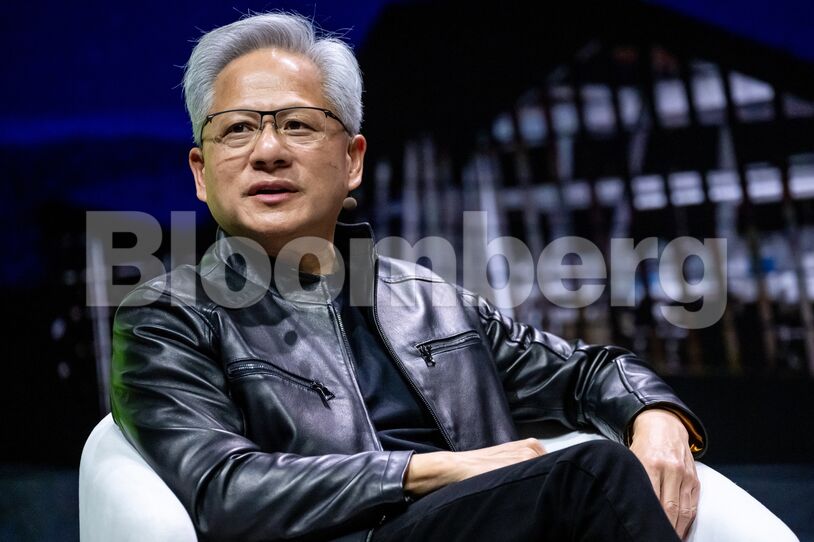
Washington: Nvidia Corp. co-founder Jensen Huang joined US President Donald Trump on his visit to China as a last-minute addition, thrusting AI and technology into the spotlight before a high-stakes Beijing summit.
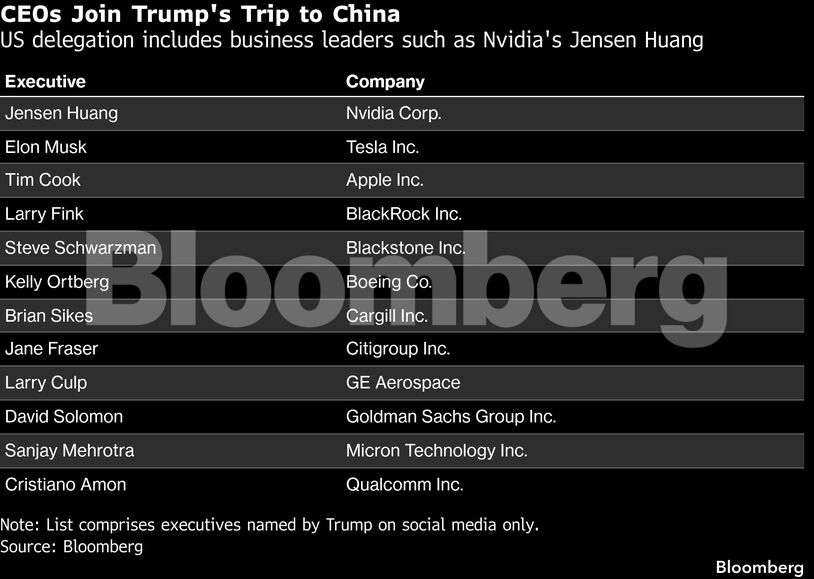
Huang is among several US business leaders including Apple Inc.’s Tim Cook and Tesla Inc.’s Elon Musk on Trump’s first overseas trip since waging war in the Middle East — a 36-hour pow-wow with Xi Jinping that’s expected to encompass the war, tariffs and the self-ruled island of Taiwan. The list of attendees until Tuesday had not included Huang, whose company makes the chips at the heart of the AI boom and has been pushing for greater leeway in a market he’s identified as a $50 billion opportunity.
The Nvidia chief executive officer was spotted on the tarmac boarding the presidential plane and Trump later confirmed his attendance in a social media post, saying it was an honor to have Huang and other business leaders as part of the US delegation. Trump will also be joined by Boeing Co.’s Kelly Ortberg and Goldman Sachs Group Inc.’s David Solomon, among others.
“I will be asking President Xi, a Leader of extraordinary distinction, to ‘open up’ China so that these brilliant people can work their magic, and help bring the People’s Republic to an even higher level!” Trump said in the post. “In fact, I promise, that when we are together, which will be in a matter of hours, I will make that my very first request.”
It’s unclear whether Trump will raise with Xi any concerns that relate specifically to Nvidia, whose shares extended gains to more than 3% in after-hours Blue Ocean trading.
The big-ticket item would be seeking Beijing’s approval for Chinese customers to buy Nvidia’s advanced H200 AI chips. Those products, which are used to train and run models like OpenAI’s ChatGPT, have always required Washington’s permission for export to China due to US concerns that the technology could boost the Asian country’s military.
The media could not be loaded, either because the server or network failed or because the format is not supported.
Trump’s team granted H200 licenses several months ago in a major reversal of US policy and huge win for Nvidia’s Huang — but Beijing remains a holdup. While China’s central government has for years complained about US export controls on advanced technology, Beijing also wants to achieve self-sufficiency in semiconductors and boost domestic champions like Huawei Technologies Co. Last year, China rejected imports of less-advanced Nvidia AI chips called H20s.
It’s been a long road on H200 sales, which emerged as a possibility after China’s H20 import block. Nvidia secured Trump’s support for H200 exports in December and some initial US licenses in early 2026. Then in March, Huang said that Nvidia had received Washington’s permission for shipments to “many customers” in China and was firing up H200 production accordingly. That was also in response to receiving official purchase orders from firms in the Asian country — an indication that Beijing had approved the sales.
But those Chinese companies later informed Nvidia that they could not actually fulfill the purchases, according to a person familiar with the matter. And in April, Commerce Secretary Howard Lutnick said that no H200s had been shipped to Chinese firms because the “Chinese central government has not let them, as of yet, buy the chips, because they’re trying to keep their investment focused on their own domestic industry.” It’s unclear how much new inventory Nvidia is now sitting on.
Read: GLOBAL INSIGHT: AI Chip Breakthrough Unlikely at Trump-Xi Summit
White House spokesman Steven Cheung, asked about why Nvidia’s Huang was now joining Trump’s trip, said Huang’s schedule changed and “it just happened to work out.” Trump called Huang this morning and asked him to come, and the Nvidia leader flew to Anchorage to meet Air Force One on its planned layover, according to a person familiar with the matter. Cheung said he wasn’t aware of Trump calling Huang before the schedule change.
“Jensen is attending the summit at the invitation of President Trump to support America and the administration’s goals,” Nvidia said in a statement.
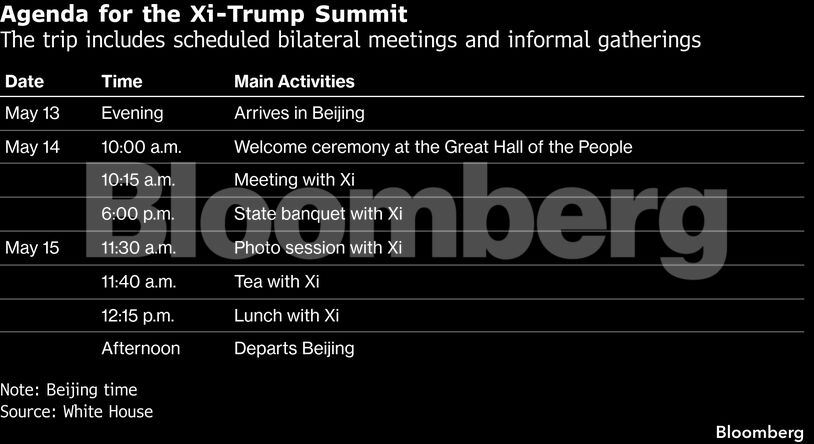
The executives joining Trump are all from companies with significant existing China exposure and represent sectors expected to be part of the trip’s commercial agenda, according to another person familiar with the matter.
US export controls have long been a sticking point in trade discussions between Washington and Beijing. Limits on China’s ability to acquire American technology fueled a standoff last year between the world’s largest economies that saw Beijing impose curbs on shipments of rare earths to US customers.
Just last Thursday, Huang had expressed his willingness to join Trump on the highly anticipated trip to China, where the president is scheduled to meet his Chinese counterpart, Xi Jinping. “If invited, it would be a privilege — it would be a great honor to represent the United States and to go to China with President Trump,” Huang told CNBC.