





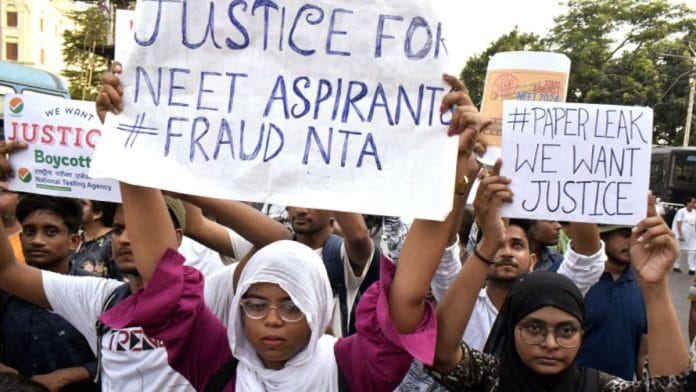


New Delhi: The National Testing Agency (NTA), announced in 2017 after years of discussions, was given an ambitious mandate to make India’s entrance examinations “more efficient, transparent and of international standards”. Nine years later, it faces scrutiny over irregularities and operational lapses in conducting high-stakes exams involving millions of students, with the NEET-UG 2026 paper leak marking its latest crisis.
It conducted its first exam, the Joint Entrance Examination (JEE-Main), in January 2019, followed later that year by the National Eligibility cum Entrance Test for undergraduate medical admissions (NEET-UG). Since then, the NTA has gradually expanded its portfolio to include the University Grants Commission-National Eligibility Test (UGC-NET), the Common University Entrance Test (CUET) and several other national-level entrance and eligibility examinations.
However, as its portfolio expanded, building adequate institutional capacity remained a challenge, and the agency has faced controversies and operational issues since its very first examination.
ThePrint traces the journey of an agency that has become the country’s main testing body, but remains caught in an unending cycle of crisis and attempts to reform.
The origin
The idea of NTA dates back to 2013 when it was originally discussed during the Central Advisory Board for Education (CABE) meeting held in April that year. The Ministry of Education, earlier known as the Human Resource Development Ministry, subsequently set up a seven-member Task Force with representatives from CBSE, UGC, NCERT, and AICTE to prepare a blueprint to move the agency forward.
Later, in 2015, another Committee of Eminent Persons (CEP) constituted by the IIT Council recommended a National Testing Service to conduct an aptitude test that would test scientific aptitude and innovative thinking abilities.
The establishment of the NTA was finally announced on 1 February 2017. The then Finance Minister Arun Jaitley proposed to establish the NTA to conduct all entrance examinations for higher education institutions in his budget speech. It was registered as a society under the Indian Societies Registration Act, 1860, in May 2018.
The agency is an autonomous body under the Union Ministry of Education.
The mandate
According to NTA’s mandate document, the agency was envisioned as a professional and self-sustained testing body that would ensure the “right set of candidates” enter the best institutions. Its mission was to improve the quality and equity in education by conducting research-based, transparent and fair exams at international standards.
The agency was envisioned to develop a strong pool of experts in different areas of testing. Its mandate also included developing a “state-of-the-art culture” of testing in India by using domestic and international expertise.
But concerns were raised over the proposal from the outset. Educationists and academicians questioned the feasibility of entrusting a single agency with conducting several of the country’s biggest examinations.
A 2017 report quoted educationists as saying that one agency handling multiple examinations across different domains “may not bring the desired result”, given the diverse nature of India’s examination system.
During a Lok Sabha debate in March 2017, former AIADMK MP G. Hari said the party was “seriously concerned” about the implications of the proposal for the National Testing Agency to conduct nationwide entrance examinations.
In March 2018, the government appointed former CBSE chairperson and IAS officer Vineet Joshi as NTA’s first director general. He later served as Secretary of Higher Education before being transferred in July amid the NEET-UG paper leak controversy.
NTA gradually expanded its portfolio to include the University Grants Commission-National Eligibility Test (UGC-NET), the Common University Entrance Test (CUET) and several other national-level entrance and eligibility examinations.
Foundation built on skeleton workforce
The agency is headed by a governing body, currently chaired by former UPSC chairperson Pradeep Kumar Joshi, while the director general is the chief executive responsible for its day-to-day functioning.
The governing body comprises three directors of IITs, two directors of NITs, two directors of IIMs, a vice-chancellor of a central university and the chairman of the National Assessment and Accreditation Council (NAAC), among others.
Since 2018, the NTA has conducted more than 270 examinations, covering over 6.6 crore candidate registrations. In 2026 alone, it conducted 12 examinations involving more than 65 lakh registrations.
The agency functions on self sustained revenue it generates through registration and application fees paid by candidates. The Centre informed Parliament that NTA’s income had increased significantly over the years, from Rs 504.16 crore in 2019-20 to Rs 1,116.84 crore in 2023-24.
A Parliamentary committee, in its report in December 2025, flagged that the NTA collected a total of Rs 3,512.98 crore but spent only Rs 3,064.77 crore on conducting exams, thereby creating a surplus of Rs 448 crore in the last six years. The committee recommended that this corpus should be used to build the agency’s capabilities to conduct tests itself, or to strengthen regulatory and monitoring capabilities for its vendors.
Despite the surplus amount, the agency is heavily reliant on contractual and outsourced personnel. In its response submitted to Parliament in July, the Centre said the NTA had 39 permanent posts, all filled through deputation, alongside 73 contractual personnel and 124 outsourced staff.
What went wrong?
The agency started facing criticism during very first exam, with students complaining of technical glitches at certain locations during JEE (Main) 2019. The crisis deepened when the agency conducted the first Common University Entrance Test for undergraduate admissions or CUET-UG in 2022.
The exam was plagued by technical issues, last-minute centre changes, and the abrupt cancellation of exams at various locations. The exam which was supposed to be held in two phases was eventually held in six phases due to cancellations.
The problem escalated into a full-blown crisis in 2024 when the NEET-UG exam was marred by paper leak allegations. The Centre handed the matter to the Central Bureau of Investigation (CBI) and set up a seven-member high-level committee headed by former ISRO chairman K. Radhakrishnan to recommend reforms in the agency and examination system.
The seven-member Radhakrishnan panel submitted its report to the Ministry of Education in October 2024, making 101 recommendations aimed at making NTA examinations “error free” and “tamper free”.
Its recommendations included restructuring the agency, strengthening its permanent manpower, reducing dependency on outsourcing, gradually moving to computer-based exams, a structured format for assigning centres for examinations, and using the ‘Digi Exam’ system—similar to ‘Digi Yatra’—for biometrics, among others. The government had also formed a steering committee to oversee the implementation of these recommendations.
Following the 2024 controversy, the agency also saw a churn at the top level. It has seen three director generals in the last two years: Subodh Kumar Singh, who was removed amid the 2024 examination controversy; retired bureaucrat Pradeep Singh Kharola was given additional charge; and Abhishek Singh was appointed in March this year. These changes happened at a time when NTA was implementing the sweeping reforms.
Incomplete implementation
When contacted, NTA Director General Singh said that the NTA and Radhakrishnan had already submitted an affidavit in the Supreme Court regarding the implementation of the committee’s recommendations in May.
According to the affidavit, the majority of the recommendations had been implemented or were under execution. These included 16 new senior-level posts in NTA, state- and district-level coordination committees, Aadhaar-based biometric authentication, enhanced CCTV surveillance, frisking, mobile jammers and AI-based data analytics. The shift of NEET-UG to computer-based testing, however, he informed, was still under consideration.
However, the 2026 NEET-UG paper leak has raised questions about the effective implementation of the committee’s recommendations.
“Of the 101 recommendations submitted by the Radhakrishnan Committee after the 2024 crisis, many remained unimplemented—including the very first one: Reducing NTA’s dependence on contractual staff in favour of a permanent, domain-specific workforce,” Keshav Agarwal, president of the Coaching Federation of India, told ThePrint.
A former official associated with NTA said that the agency was given the responsibility of conducting exams for millions of students without adequate manpower. “It leads to heavy reliance on outsourcing and contractual employees. It was a fundamental problem the agency faced from the beginning,” the official told ThePrint, requesting anonymity.
The recommendation to shift NEET-UG to a computer-based format has remained pending, as the decision requires consultation with the Union Health Ministry, which oversees medical education and admissions. In May, however, the NTA told the Supreme Court that the transition would be implemented from the 2027 examination cycle.
The issue is not limited to the conduct of NEET-UG.
In its report in December 2025, a Parliamentary committee flagged repeated problems with NTA’s exams, and noted that in 2024 alone, five of the 14 competitive exams it conducted faced major issues with three of them getting postponed.
The panel asked the agency to “quickly get their act together” so that such instances, which are otherwise fully avoidable, do not occur in the future.
Another crisis in 2026
The NEET-UG 2026 was held on 3 May. However, nine days later the exam was cancelled following concerns over its integrity and a case was filed with the CBI on 12 May. Two days later, the CBI said its investigation had identified an NTA-linked expert as the source of the Chemistry paper leak.
The incident raised fresh questions about how far the recommendations of the Radhakrishnan committee have actually addressed the agency’s structural weaknesses.
It highlighted the agency’s lack of due diligence in selecting experts entrusted with such sensitivity as recommended by the Radhakrishnan panel. The CBI has, so far, arrested three NTA experts involved in the paper setting process in connection with the paper leak.
The CBI probe also raised questions about handling the question paper process, lack of security checks at its confidential sections and involving the same group of people at multiple stages. The Radhakrishnan panel had called for rigorous checks at every stage of the question paper-making process.
Also on 25 May 2026, the Supreme Court blamed the NTA for the 2026 NEET-UG paper leak, saying that the agency “sadly” has not learned its lesson even two years after the 2024 controversy.
A second overhaul attempt
Amid nation-wide protests over the NEET-UG paper leak with the epicentre at Delhi’s Jantar Mantar, which eventually led to the resignation of then Education Minister Dharmendra Pradhan, Prime Minister Narendra Modi on 26 July announced the constitution of a high-powered task force on examination reforms under the leadership of Nandan Nilekan, co-founder and former chairperson of Infosys.
The task force has been entrusted with studying the existing examination system and recommending measures to make it more secure, transparent and free of irregularities. It will look at the use of technology and other measures to strengthen the examination process, including the security of question papers and the overall conduct of exams.
Now, after this year’s paper leak, the agency has begun rebuilding its workforce. Earlier this month, NTA advertised posts to hire senior government officers under the slogan, ‘Build New NTA’, and also floated a tender for round-the-clock security services.
This marks the government’s second attempt to overhaul NTA in two years, but the challenge will remain the same: How well will its recommendations be implemented and will NTA be able to build the institutional capacity to become a professional, self-sustaining and efficient testing body as it was envisioned to be?
(Edited by Viny Mishra)
Also read Exclusive: How NTA subject experts leaked NEET-UG paper—‘questions on chits, marked NCERT paras’