







New Delhi: Probing the violence that shook Sectors 63, 65 and 57 among others, the Noida Police suspects that WhatsApp groups were created two days before the unrest to mobilise large-scale support.
Participants were added using QR codes and group links shared widely among workers, it is learnt. Later, these platforms were used to circulate provocative messages and coordinate large gatherings across multiple sites.
One of the angles under probe is determining whether any “external support”, either within or outside the state, was involved in the protest in which 350-plus people have been arrested, so far. Efforts are underway to trace funding sources, the police said.
Gautam Budh Nagar Police Commissioner Laxmi Singh said that several such WhatsApp groups have been created in the past two days.
“This suggests a systematic, organised gang operating behind the scenes. We have identified some of these elements from the crowd and arrested them, and we will ensure their arrests in the future,” Singh said Tuesday. “Their funding will also be investigated, and if it is found that they received funding from outside the country or the state, appropriate action will be taken.”
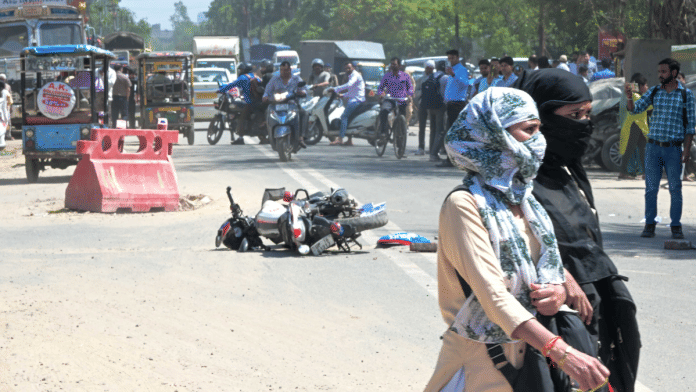
Over 45,000 workers and labourers gathered in multiple locations of Noida to stage their demands of hike in salaries and better working conditions, including eight-hour shifts. Later, stone-pelting, vandalism, and arson were reported from pockets such as Sector 63.
Noida city turned into a fortress Tuesday, with every corner being barricaded and under police watch. Security remained on high alert across industrial and residential locations, while the police continued route marches. Workers gathered at a few locations but quickly dispersed.
“The situation is normal in Noida. All senior officers are present here. We are in constant communication with our officers in Noida. We receive different inputs through social media, media and through UP 112,” UP Police chief Rajiv Krishna told the media Tuesday.
The CM, he said, formed a high-powered committee on Monday itself to look into the violence.
“The government and CM are very sensitive towards the workers. A few individuals and groups have come to light which caused provocations in this matter. We have electronic and CCTV evidence,” the police chief said, promising appropriate response from the administration.
Also Read: The anatomy of an unorganised protest—How it spread from Manesar to Noida
‘Rumours & narratives’
Additional Commissioner of Police (Law and Order) Rajeev Narain said that 350 people have been arrested in connection with the protests in Noida. “Some people were found misusing social media platforms, spreading rumours, and providing false information, through recently created WhatsApp and X bot accounts. Cases have been registered against them,” he said Tuesday.
Later, Uttar Pradesh Director General of Police (DGP) Rajiv Krishna, too, suggested that there was a larger conspiracy at play.
“Prima facie, this points towards an organised conspiracy. A detailed investigation into the digital trails of all the aforementioned handles will be conducted by the Uttar Pradesh STF (Special Task Force). Strict legal action will be ensured against all such handles that attempt to disrupt law and order through the dissemination of rumors and malicious propaganda,” DGP Krishna said.
As the Uttar Pradesh government increased minimum wages for workers with the revised rates implemented retrospectively from 1 April, Nirmal Gorana, the convener of National Campaign Committee for Eradication of Bonded Labour, said that the protests stemmed from the basic demands that workers had.
“Our demands were for the state. It was not a fight of workers versus police. We were only raising our demands…,” he said, adding that the workers have the right to protest. “This is how we fight for our rights.”
Asserting that the committee doesn’t support any violence, Gorana said that WhatsApp is used as it is the only medium to communicate for organising any protest.
“The protest did not begin on Monday. Workers have been raising their voices (for some time). In today’s day and age, everybody communicates on WhatsApp. This is how people organise (protests). How is this a criminal activity?”
Greater Noida-based industrialist Jitendra Singh Rana refused to be drawn into the debate into the details of the protests and called it “a faceless protest”.
“We could see the involvement of people from outside. It was conducted in an unorganised manner; it wasn’t even convened by any union. There was no union leader, no face,” the Indian Industries Association (IIA) former chairperson said.
(Edited by Tony Rai)
Also Read: How do workers and employers view India’s new Labour Codes? New study has answers