







Mumbai: The National High Speed Rail Corporation Limited (NHSRCL), which is implementing India’s first bullet train project between Mumbai and Ahmedabad, has put out a fresh large-scale hiring advertisement for multiple posts across operations, maintenance, safety and infotech, signalling a shift from purely civil construction towards preparing the corridor for its first phase of operations.
According to NHSRCL’s latest vacancy notices, the corporation is hiring for over 200 posts, including engineers, controllers, train managers, station managers, depot controllers, operations controllers and personnel for signalling, telecom, rolling stock, electrical systems and automatic fare collection.
The entire project is estimated to cost Rs 1,08,000 crore without taxes and is being executed with a loan from the Japan International Cooperation Agency (JICA).
The Mumbai-Ahmedabad High Speed Rail (MAHSR) project, which is also the first high-speed rail service on the corridor, is expected to be fully operational by 2029. The full corridor, once operational, is expected to cut travel time between Mumbai and Ahmedabad to about two hours and seven minutes, compared with much longer travel times by conventional rail or road.
Phase 1 of the project connecting Surat and Bilimora, is scheduled for 15 August 2027. This will be followed by Phase 2 (Vapi to Surat), Phase 3 (Vapi to Ahmedabad), Phase 4 (Thane to Ahmedabad), and finally Phase 5 which will connect Mumbai to Ahmedabad.
The large-scale recruitments announced by the MHSRCL on 15 June are for 209 non-executive operations and maintenance-related posts, while 15 for executive positions like IT (Information Technology) and safety.
Applications for these posts will close on 14 July at 11.59 pm, according to the official vacancy page and advertisements by NHSRCL on social media. The place of posting has been listed as “any location/office of NHSRCL project”, indicating that selected candidates may be deployed across the Mumbai-Ahmedabad High Speed Rail corridor.
NHSRCL was incorporated on 12 February 2016 to finance, construct, maintain and manage the High-Speed Rail (HSR) Corridor in India. It’s a Special Purpose Vehicle based on the collaboration between the Central government through the Ministry of Railways and two state governments–Maharashtra and Gujarat.
According to NHSRCL’s official website, “the company would require a manpower strength of about 3,000–4,000 officials (estimated) for executing the operations of high-speed corridor.” It further stated that, “the company has started construction of an exclusive training institute at Vadodara to cater to this aspect”.
The Junior Engineer-level vacancies uploaded include 31 posts in civil/track, 47 in electrical, 20 in signalling and telecom, 14 in rolling stock-electrical, three in rolling stock-mechanical, 55 for train manager/station manager/depot controller/operations controller and five in automatic fare collection systems.
The Deputy Engineer-level vacancies include 18 posts in civil/track, four in electrical, five in signalling and telecom, three in rolling stock and four in operations.
The posts in safety and IT, advertised by the NHSRCL, include AGM/JGM safety roles, assistant manager safety roles, DGM IT, DGM AFC systems, senior manager IT, senior manager data analytics, senior manager cloud infrastructure and assistant manager IT. These applications opened on 10 June and will close on 9 July.
An NHSRCL spokesperson did not immediately comment when asked to elaborate on the manpower hiring plans.
Project details
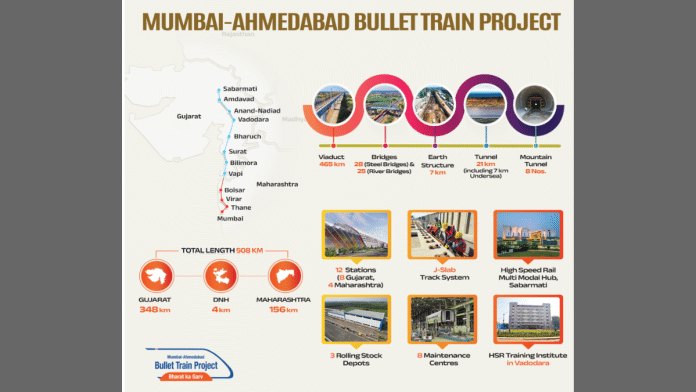
The Mumbai-Ahmedabad High Speed Rail corridor spans 508 km and will connect Maharashtra, Gujarat and Dadra & Nagar Haveli.
The corridor will have 12 stations—BKC (Bandra-Kurla Complex), Thane, Virar, Boisar, Vapi, Bilimora, Surat, Bharuch, Vadodara, Anand-Nadiad, Ahmedabad and Sabarmati. Trains on the corridor are planned to run at an operational speed of 320 kmph with a design speed of 350 kmph.
The project is being developed using the Japanese Shinkasen Technology and operational standards. According to the NHSRCL, “The entire process of track installation is mechanised with cutting-edge machinery, designed and manufactured as per Japanese specifications.”
“To understand the methodology of Shinkansen track construction works, extensive training and certification courses are being organised for the Indian engineers, work leaders and technicians on various subjects in the relevant fields by Japanese experts,” the company’s website states.
About 90 percent of the alignment is elevated. The corridor will also include 25 river bridges, 28 steel bridges and eight mountain tunnels.
The Maharashtra section remains among the most challenging parts of the project, as it includes a 21-km tunnel section, of which about 7 km will be the country’s first undersea rail tunnel under the Thane Creek. The tunnel will use a combination of the New Austrian Tunnelling Method and Tunnel Boring Machine technology. Out of the eight total tunnels in the corridor, seven are located in the Maharashtra’s Palghar district while one is situated in the Valsad district in Gujarat.
In recent months, the NHSRCL announced the breakthrough of another mountain tunnel in the Palghar district on 2 June, marking the third such tunnel breakthrough in Maharashtra in five months. The corporation has also reported progress on tunnel boring machine assembly, track installation, river bridges, steel bridges and station works.
(Edited by Nardeep Singh Dahiya)
Also Read: These Maharashtra villages didn’t want to give up land for bullet train. But they’re on board now