







Chennai: It’s a familiar pattern in Tamil Nadu politics: successive governments build or propose new administrative complexes, only for the next one to reverse the decision, citing cost, heritage or ideology.
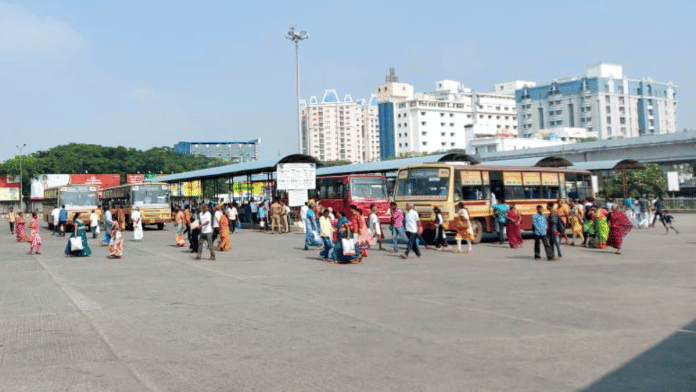
The Vijay-led Tamilaga Vettri Kazhagam (TVK) government seems to be continuing the tradition and actively considering shifting the Secretariat to the site of the city’s 36-acre Koyambedu mofussil bus terminus, once Asia’s largest bus station, which opened in November 2002. It later moved to a new bus terminus on the outskirts of Chennai, primarily to decongest the city.
State officials confirmed that consultations are underway to assess the possibility of a new site for the Secretariat building. The proposed project is estimated at Rs 350 crore.
“Internal discussions are underway on this. There is no confirmation or notification so far,” a senior government official told ThePrint. “There are issues of space constraints at the existing Secretariat, and the government wants to propose a modern building with digital facilities to facilitate the movement of government officials and even public visits, and has better connectivity with access to public transportation.”
The government has framed the move as a cost-effective solution aimed at easing chronic space constraints at the Secretariat in the Fort St. George complex and easing traffic without the massive expenditure of a separate project.
TVK sources say that repurposing the existing bus terminus infrastructure will help save on costs and put underutilised public land in a strategic western Chennai location to use.
But the question many are asking is: Is the Secretariat shift a necessity or just political symbolism?
The opposition Dravida Munnetra Kazhagam (DMK) dismisses the move as non-essential, saying it is just political symbolism.
Analysts also believe the move is an exercise aimed at making a political statement.
“We have seen this kind of an attempt to present party symbolism earlier when the Omandurar Multi Speciality Hospital was turned into a Secretariat by Kalaignar Karunanidhi,” political analyst Arun Kumar told ThePrint.
“There was a political vendetta further when the All India Anna Dravida Munnetra Kazhagam (AIADMK) came to power and moved the Secretariat to Fort St. George again. It is exactly what the DMK would do if they came to power after the TVK builds a new building in Koyambedu. It is just symbolism for every party.”
The politics of moving the seat of power
The Tamil Nadu Secretariat operates primarily from the Fort St. George complex, a site steeped in colonial history. Originally constructed by the British East India Company starting in 1639-1640, the fort served as the administrative headquarters of the Madras Presidency.
The complex, which has over 30 departments, has undergone renovations over the years. Still, officials have long complained of space shortages, outdated facilities, fragmented operations across buildings, and limitations in accommodating growing staff and digital infrastructure needs.
Fort St. George remained the undisputed hub during the British era and the early years after Independence. But for more than 20 years, successive governments have either tried to move to or build new administrative complexes.
Under AIADMK leader J. Jayalalithaa in the early 2000s, plans were made to shift to new sites, including Queen Mary’s College or Sholinganallur, citing the need for modern facilities. But these plans faced protests and delays and failed to take off.
The DMK government under M. Karunanidhi from 2006 to 2011 built a new Assembly-Secretariat complex at the Omandurar Government Estate on Anna Salai. Inaugurated in 2010 by the then Prime Minister Manmohan Singh, it was seen as a state-of-the-art green building costing around Rs 450 crore. It featured modern amenities and was meant to symbolise progress and efficiency.
But when the AIADMK returned to power in 2011 under Jayalalithaa, the new complex was swiftly abandoned. The government moved back to Fort St. George, converting the Omandurar building into the Tamil Nadu Government Multi Super Speciality Hospital, inaugurated around 2014.
The decision was justified on grounds of fiscal prudence and respect for heritage, though critics saw it as a political reversal of a rival’s legacy project.
The hospital continues to serve the public today, and proposals to revert it to administrative use have been firmly rejected by subsequent DMK governments. Other proposals similarly rose and fell with changes in government.
The TVK government appears to be proposing repurposing the Koyambedu site rather than a lavish new construction. Government officials believe Koyambedu, located in the centre of the city, is a good alternative.
But analysts said the bus terminal was not a viable alternative because it was far away from other government offices and courts. Moreover, traffic congestion is another issue at Koyambedu.
“It is practically not a feasible option to make the Koyambedu terminus a Secretariat building because everyday movement of government officials would further congest the place,” said Arun Kumar.
(Edited by Sugita Katyal)