





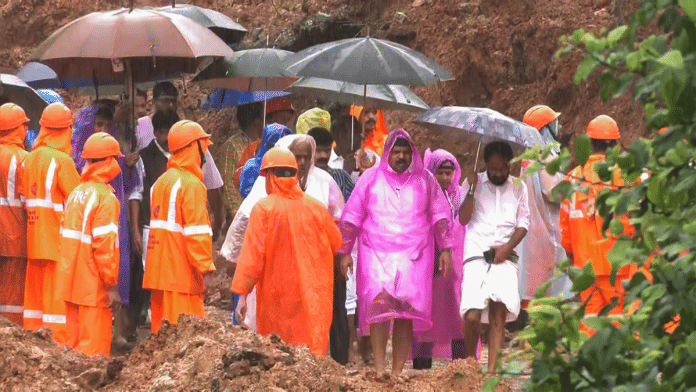

Thiruvananthapuram: Less than two years after the devastating Mundakkai-Chooralmala landslides, another landslip at the under-construction Kozhikode-Wayanad tunnel project nearby has raised questions about whether it’s a natural or man-made disaster.
Three people were killed Tuesday after a landslide at the tunnel construction site at Kalladi in Meppadi panchayat. While authorities continue to search for the five people still missing, Tuesday’s incident marks the third major landslide-related tragedy to hit the panchayat in the past decade, with the deadliest incident in 2024 claiming nearly 300 lives.
Unlike the 2024 disaster, which followed days of heavy rainfall well above average, Kerala and Wayanad have so far recorded a rainfall deficit this monsoon.
According to the India Meteorological Department (IMD), Kerala recorded a 28 percent southwest monsoon deficit between 1 June and 6 July, while Wayanad recorded a 57 percent deficit during the same period.
There are also questions over the state’s ambitious Kozhikode-Wayanad tunnel project—expected to bring crucial connectivity for the hill district—over whether sufficient geological and environmental safeguards were in place.
C. K. Vishnudas, director of the Wayanad-based Hume Centre for ecology and Wildlife biology, told ThePrint that the incident appeared to have been caused by alterations made to the natural hill during construction without sufficient precautionary measures.
According to him, the tunnel entrance was located adjacent to the Kalladi River, along a natural drainage path that channelled runoff from the surrounding hills. After excavation altered the slope, rainwater accumulated over the concrete structure instead of draining naturally, causing the weakened slope to give way.
“Rain is not a factor there. Even now rainfall is deficit here. So there is no reason for a natural landslide. For that we need 2,000 mm rainfall. This case is clearly about damage caused by the intervention,” Vishnudas said. In fact, he said, the rainfall deficit may have reduced the scale of the incident.
Soon after the incident, Congress minister and Wayanad district in-charge T. Siddique termed it a “man-made disaster”, alleging that excavated debris stored at the tunnel site had contributed to the landslip.
The contractor, however, maintained that the landslide was not caused by the excavated soil—a claim supported by the locals.
On Wednesday, Kerala Chief Minister V. D. Satheesan announced that the government would probe the incident as well as the construction. “The central government gave environmental clearance (for the tunnel project) with many strict conditions. We will see whether those conditions were complied with. The construction will continue after checking all these aspects,” he said, adding that the construction works will be temporarily stopped.
ThePrint reached out to Dr Sekhar Lukose Kuriakose, the member secretary of the Kerala State Disaster Management Authority (KSDMA) over a call, but did not receive a response. This report will be updated when and if there is a response.
Why the tunnel is crucial
The Rs 2,043.74 crore Anakkampoyil-Kalladi-Meppadi Twin-Tube Road Tunnel Project aims to construct an 8.11-km twin road tunnel connecting Anakkampoyil in Kozhikode district with Meppadi in Wayanad, providing an alternative to the existing Thamarassery Ghat Road, where travel often takes more than an hour depending on traffic and weather conditions.
Funded by the Kerala government through the Kerala Infrastructure Investment Fund Board (KIIFB), the project is being implemented by Konkan Railway, while the tunnel construction contract was awarded to Bhopal-based Dilip Buildcon Limited (DBL).
Planned in 2021 by the previous left government, the State Level Expert Appraisal Committee (SEAC) had granted environmental clearance for the project in March 2025, while the Union Ministry of Environment, Forest and Climate Change (MoEFCC) gave its nod in February 2026.
The heavy excavation phase of the project was inaugurated in March this year by then chief minister Pinarayi Vijayan with a controlled rock blast at the Marippuzha side in Kozhikode, while a month later, the Supreme Court dismissed a plea filed by activists seeking to halt the project.
However, the project approvals also acknowledged the risks.
According to the minutes of the SEAC meeting held on March 1, the tunnel alignment passes through villages notified as Ecologically Sensitive Areas (ESA) and traverses highly fragile terrain prone to landslides, including areas affected by the devastating disasters of 2019 and 2024. The committee said these conditions necessitated additional precautions during construction.
The environmental clearance also imposed a series of safeguards. These included preparing detailed landslide hazard maps, installing automated weather stations to suspend construction during heavy rainfall, setting up four monitoring stations to measure ground vibrations, adopting controlled blasting or advanced tunnelling methods to minimise geological disturbance, prohibiting the dumping of excavated soil and construction waste near public roads and habitations, and continuously monitoring nearby streams to prevent pollution and disruption of their natural flow.
“The tunnel road is really needed. But there should have been a proper study on it,” Nasar B., a former Meppadi panchayat councillor, told ThePrint, adding that local residents had long expressed concerns about the project
Nasar said that preliminary work on the tunnel had been underway in Wayanad for nearly a year. He said the impact of Tuesday’s landslip was limited because relatively few workers were present at the site and there were only a handful of nearby houses. The incident partially damaged one house and completely destroyed a mosque, according to him, while 46 families over 100 individuals have been relocated to a camp.
Vishnudas said the primary argument for the tunnel has always been connectivity, particularly the frequent travel Wayanad residents have to make to Kozhikode for specialised healthcare. However, he argued that the state failed to seriously explore safer alternatives before opting for the tunnel.
“In terms of connectivity, there have been talks about widening the ghat road. But it never happened. Similarly, alternative roads and widening of the Wayanad-Kuttiady road also never happened. So there should have been more thought, including exploring areas that are less prone to disasters in Wayanad. More than connectivity for people, the administration wanted the tunnel,” he said.
Meanwhile, CPIM state secretary M. V. Govindan said the issue has been made political to attack the previous LDF government. “This issue shouldn’t be seen as political. The government should focus on coordinating the searches and completing the rescue operation,” he said Wednesday.
Located on the southern end of Wayanad in Vythiri Taluk, Tuesday’s landslide also triggered another debate among locals, the slow disappearance of the Panchayat due to repeated disasters. Located in Vythiri taluk, Meppadi grama panchayat comprises 23 wards, five of which have now been affected by repeated landslides over the past decade.
The 2019 Puthumala landslide claimed 17 lives. Five years later, the Mundakkai-Chooralmala disaster killed nearly 300 people, emptied Attamala village and devastated Mundakkai and Chooralmala.
A study by the Hume Centre has identified northern, western and southern Wayanad, covering around 21 percent of the district’s land area as highly susceptible to landslides. The vulnerable region spans 12 of Wayanad’s 23 panchayats, including Thirunelly, Thavinhal, Thondernad, Vellamunda, Padinjarathara, Thariode, Pozhuthana, Vythiri, Meppadi, Muppainad, Noolpuzha and parts of Sulthan Bathery.
(Edited by Viny Mishra)