





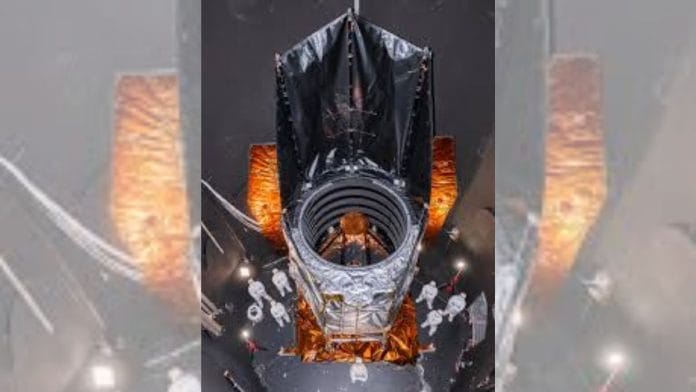

New Delhi: NASA’s next major space observatory, the Nancy Grace Roman Space Telescope, is scheduled to launch on Sunday from Kennedy Space Center in Florida. The mission aims to survey vast regions of the universe, study the nature of dark energy, and search for planets beyond the solar system.
Named after Nancy Grace Roman, NASA’s first chief astronomer and often called the “mother of Hubble,” the telescope is one of the agency’s flagship astrophysics missions. Although the primary mirror is the same size as Hubble’s, Roman’s field of view is about 100 times larger, enabling it to map enormous stretches of sky in great detail far more quickly than previous observatories.
Rutgers University astrophysicist Kristen McQuinn, mission head of the Roman Science Operations Center at the Space Telescope Science Institute, described the telescope’s complementary role to Newswise.
While Hubble provides sharp multi-wavelength views and the James Webb Space Telescope examines individual objects in exquisite infrared detail, Roman will excel at wide-area surveys. It will discover rare objects and events and show how galaxies, stars, and planets fit into their larger cosmic environment, potentially identifying targets for follow-up by Hubble, Webb, and other telescopes.
Also read: IIT Delhi denied Rishikesh Kumar hostel, isolated him in lab projects, says brother
Measuring the universe
Two of Roman’s primary goals involve the “universe’s biggest mysteries.” Dark matter exerts gravitational influence on galaxies without emitting or reflecting light, while dark energy is the unknown force accelerating the expansion of the universe.
“The goal is not necessarily for Roman to take a picture of dark matter or dark energy, but to measure their effects with far greater precision,” she said. “That could help us understand what the universe is made of, how it developed and what may happen to it in the distant future.”
By observing huge numbers of galaxies and exploding stars across cosmic distances, Roman will measure the universe’s expansion history and the distribution of matter with unprecedented precision.
The telescope will also hunt for exoplanets using gravitational microlensing—detecting brief brightenings when a star and any orbiting planet pass in front of a more distant star—and by monitoring slight dips in starlight as planets transit their hosts.
NASA expects the surveys to uncover more than 1,000 new planets via microlensing alone, plus hundreds of thousands more through transit detections, dramatically expanding the known population of worlds beyond our solar system. A technology-demonstration coronagraph will further attempt to directly image faint planets and disks by blocking a star’s glare.
McQuinn’s team will handle observation planning, image processing and calibration from the Wide Field Instrument, and operation of the data archive that scientists worldwide will use.
“Launch day will be both the culmination of years of preparation and the beginning of the mission’s most important work,” she said. “What excites me most is knowing that astronomers around the world will soon begin using its data, not only to answer questions we already have, but also to make discoveries none of us has yet imagined.”
(Edited by Ratan Priya)