



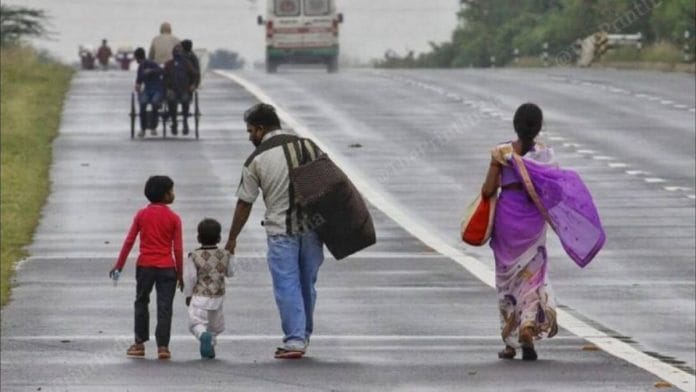

New Delhi: The migrant exodus during the Covid-19 pandemic in India was due to the lack of “immobility infrastructure” in the country, said Biao Xiang, former professor at Oxford University and currently Director of Germany-based Max Planck Institution for Social Anthropology.
Xiang described “immobility infrastructure” as that set up by many governments to help countries function during a time when mobility was limited amid lockdowns. He said, “Between March and May 2020, crores and crores of migrant workers had to go home on foot in India and in my view, (it) was because the immobility infrastructure was lacking.”
He was speaking at the panel discussion ‘Social Dimensions and Disruptions Caused by
Covid-19 in China and India’, organised as part of the virtual All India Conference of China Studies hosted by the Institute of China Studies (ICS) Friday.
ThePrint was a digital partner for the event.
According to Biao, mobility infrastructure is a system of interlinked technologies, institutions, and factors that facilitate and condition mobility. With the pandemic and lockdowns, however, governments had to think of this in the inverse — immobility infrastructures.
Other panelists examined other impacts of the pandemic on economies in China and India — including delivery services and conditions in rural areas — and the role of the government in providing infrastructural support and relief.
Also read: Fight against Covid at final stage, should not let our guard down, says Mandaviya
Indian and Chinese delivery workers as frontline workers
Independent journalist Sowmiya Ashok compared regulatory frameworks in the digital economy in India and China during the pandemic, with special focus on food delivery services.
“The one major factor that the pandemic has changed… is it has taken what are ‘invisible workers’ — delivery workers — and propelled them into frontline workers,” she said.
Ashok noted how Chinese digital service platform Meituan and its rival Ele.me, as well as Swiggy and Zomato in India, greatly profited during the pandemic, but at the cost of delivery workers who felt underpaid.
In China, an estimated 80 million people were left unemployed by the end of March 2020. “Digital service platforms were egged on to mop up this excess unemployment that was spilling over,” she said.
While the Chinese government has introduced some regulatory policies, there is none in India, claimed Ashok.
Also read: ‘Cut Covishield gap, skies won’t fall’, says Covid task force member as vaccines pile up
Govt aid to rural China during pandemic was ‘not substantial’
Another of the panelists, Cody Abbey, Project Manager at Stanford Center on China’s Economy and Institutions, spoke of the impact of the pandemic on rural China.
From February to April 2020, incomes of Chinese villagers decreased significantly and the difficulties faced by them were exacerbated by higher prices of common goods, said Abbey.
On whether rural China received government relief during this time, he said: “By this time [April 2020], about 20 per cent of villagers received any kind of aid…but 20 per cent is not a lot. Even if they receive financial aid, they would receive $127 which is about a quarter of the average migrant worker salary of $550, so it wasn’t substantial”.
As a result, rural Chinese families cut back spending on food like meat, iron-rich foods, vegetables, and fruits, which could have potential impacts on nutrition, especially for rural children, he added.
(Edited by Poulomi Banerjee)
Also read: India’s R value for Covid dips to 0.94 from 0.98, several major cities still over 1