





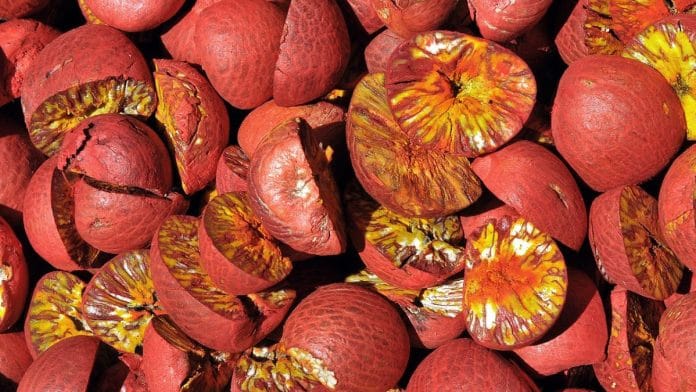



Bengaluru: Suresh Balnadu, a 66-year-old farmer in Karnataka, is preparing for tough times with his arecanut yield expected to fall by up to 40 percent.
Apart from growing diseases in plants, fluctuating prices and the classification of betel nut as carcinogenic, the livelihood of small farmers also faces other challenges such as extreme climate vagaries and unpredictable markets.
“We don’t know whom to share our concerns with,” Balnadu told ThePrint. He added that the extreme volatility has forced him to rely more on pepper as a primary crop for an income.
Karnataka and Kerala together account for 72 percent of India’s arecanut production, with 2,64,000 hectares that produce an estimated 4.15 lakh tonnes per year, according to the industry associations. More importantly, nearly 60 million people depend on arecanut for a livelihood, according to the Arecanut Research & Development Foundation.
Industry associations say that more than 85 percent of the area under cultivation consists of small and marginal holdings, adding to the strain on planters who rely exclusively on arecanut as their primary source of income.
Arecanut growers in Karnataka have written to the Prime Minister Narendra Modi-led Union government, asking it to convince the World Health Organization (WHO) to re-categorise betel nut from its current classification as ‘carcinogenic’.
In its letter, dated 24 January to Union Health Minister J.P. Nadda, CAMPCO said the classification of arecanut as carcinogenic “has caused serious distress among farmers and has far reaching socio-economic implication”.
The letter added that the classification is largely based on studies examining chewing preparations such as betel quid (or paan), gutka, and paan masala, which include tobacco and other additives, rather than arecanut in its natural or traditional form.
“According to the latest classification, WHO has termed it carcinogenic. It is the same in some (states of India) as well. It could hamper the market for arecanut in the future,” S.A. Satishchandra, the president of the Central Arecanut and Cocoa Marketing and Co-operative Society (CAMPCO), told ThePrint.
The letter comes days ahead of a scheduled 30 January WHO South-East Asia Regional Office (SEARO) webinar titled ‘Areca Nut Challenge: Turning Policy into Impact in South-East Asia’.
“We also wish to highlight an apparent inconsistency in the current IARC classification, wherein arecanut is placed under Group I (‘Carcinogenic to Humans’), while arecoline, one of its principal constituents, is classified under Group 28 (‘Possibly Carcinogenic to Humans’),” CAMPCO said in the letter.
“Such contradictions underscore the need for further rigorous, India-specific scientific scrutiny before arriving at any policy-level conclusions,” it added.
Chewing arecanut is part of several cultures in South and Southeast Asia, including places like India, Bangladesh, Sri Lanka and Thailand. In India, it is consumed as gutka, paan masala and paan, and is also served to guests at weddings.
It is colloquially known in Hindi as ‘supari’, ‘puwak’ in Sri Lanka, ‘gua’ in Sylheti (Bangladesh), ‘mak’ in Thailand, ‘pinang’ in Malaysia, ‘pugua’ in Guam and ‘kun-ywet’ in Myanmar.
Also Read: Great Indian Paan caught in health vs livelihood battle. Ban hurting magahi betel, areca nut
‘Insurance premium higher than compensation’
In August 2023, over Rs 8 crore in cash was seized from a BJP MLA’s home in Channagiri in Davangere district. At the time, Madal Virupakshappa, the BJP MLA, justified the possession of funds as proceeds from the sale of arecanut, suggesting that such wealth was common among planters.
However, the situation on the ground differs significantly from what was projected by the BJP MLA.
Arecanut farmers say lower yields and fluctuating prices have added to their financial strains. Balnadu says that the crop insurance premium, like the Pradhan Mantri Fasal Bima Yojana (PMFBY), is sometimes higher than the compensation he receives.
“Including our pepper plantation, I paid around Rs 47,000-48,000 as insurance premium. There is some commission also. I got back Rs 2,800 for pepper out of the Rs 5,800 premium and the remaining (arecanut) I got nothing,” Balnadu said.
Across Karnataka, leaf spot disease in arecanut plants has added to the challenges.
The state’s horticulture ministry said in a written response to the Karnataka Legislative Council that nearly 90,000 hectares in the Maland region, coastal districts and Shivamogga had been affected by the disease.
Chaluvarayaswamy, Karnataka’s minister for agriculture, answering on behalf of his colleague S.S. Mallikarjun, informed the Council that the state had sent a proposal to the Centre seeking Rs 577.76 crore to help with the adoption of phytosanitary measures for the removal and destruction of disease-affected plant parts, plant protection and integrated nutrient management to control leaf spot disease, yellow leaf disease and rot disease affecting the arecanut crop.
According to the written response, the government has earmarked Rs 860.65 lakh in 2025 for the control of leaf spot disease in arecanut under the “special interventions” component of the National Horticulture Mission.
As part of this, the government will provide a subsidy of Rs 1,500 per acre for up to two acres to farmers for the management of plant diseases and pests.
It added that the government had provided a subsidy amount of Rs 452.61 lakh to 14,115 farmers.
Moreover, the crop has been notified under the restructured weather-based Crop Insurance Scheme for the monsoon and post-monsoon seasons, and compensation is being provided under the scheme in case of crop loss due to weather conditions.
(Edited by Sugita Katyal)
Also Read: Areca Nut isn’t a harmless sweet ‘supari’. Govt must regulate it like tobacco