


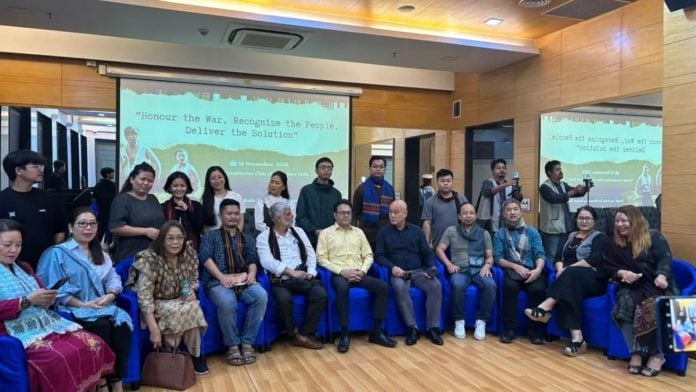
New Delhi: Even as Manipur remains racked by violence—between Meitei and Kuki-Zo groups at first, and between Naga and Kuki-Zo groups now—the Kuki-Zo Women’s Forum has again renewed the demand for a separate Union Territory with a legislature. They argue that constitutional separation is the “sole condition for survival” for the displaced community that has a history dating back to the Anglo-Kuki War and the Indian National Army (INA), or the ‘Azad Hind Fauj’.
The Kuki-Zo body seeks official recognition of the Anglo-Kuki War as a significant chapter of India’s freedom struggle and the acknowledgement of Kuki-Zo contributions to the INA and nation-building.
On Monday, the Kuki-Zo Women’s Forum, Delhi and NCR (KZWFD), held a press conference in New Delhi to address the “systematic erasure of Kuki-Zo anti-colonial history”, the continuing cycle of “ethnic cleansing and fatal ambushes targeting innocent Kuki-Zo civilians” in Manipur, and the “urgent constitutional necessity of a separate administration (Union Territory with legislature)”.
In a press statement, the forum said that Kuki-Zo people have stood as sentinels of India’s eastern frontier, waging the historic Anglo-Kuki War (1917-1919) against British imperialism, and that they fought alongside Netaji Subhas Chandra Bose’s Indian National Army (INA).
“Yet in post-Independence India, our people have endured decades of unaddressed bloodshed: from the 1990s ethnic cleansing by the National Socialist Council of Nagaland (Isak-Muivah)or NSCN-IM, to the state-sponsored violence unleashed on 3 May 2023, and continuing to this very week with fatal attacks on innocent villagers,” the statement said.
The forum said ongoing ambushes and targeted killings by Manipur armed outfits (NSCN-IM factions and ZUF-K) have “claimed 40 innocent Kuki-Zo lives, including 11 women and two unborn children”.
“While thousands of homes and essential records have been lost to the flames, our shared history and heritage are now being subjected to systematic attempts at marginalisation,” the forum’s statement said, as it discussions focused on “honour the war, recognise the people, deliver the solution”.
Also Read: 4 Nagas killed in suspected militant attack on two vehicles in Manipur’s Ukhrul
Recalling the past: Anglo Kuki war & INA
Speaking of the decades-old history of the Kuki-Zo ethnic tribe, Dr Robert Lunkhopao Haokip, Research Fellow at the Lakshmi Mittal and Family South Asia Institute, Harvard University, said, “A people without recognition of its history struggles to secure its future.”
He talked about a time, dating back to over a hundred years ago, when the British Raj demanded forced labour for World War I, and Kuki chiefs refused, declaring “war against the King-Emperor”. For over a year (December 1917 to May 1919), across 6,000 square miles of rugged hills, 2,400 Assam Rifles and 3,000 Burma Military Police waged the largest counter-insurgency operation on India’s eastern frontier, Robert Haokip said.
He went on to speak about how during the Second World War on the Assam-Burma borderlands, the Kuki-Zo people fought for the rising tide of anti-colonial liberation. “Defying the British Raj, at least 6,000 Kukis actively aided, guided, and fought alongside the Japanese Imperial Army and Netaji Subhas Chandra Bose’s Indian National Army (INA). Despite severe crop failures and starvation, Kuki villagers sheltered weary INA soldiers, sustaining 24 combat deaths, deportations to Calcutta jails, and 586 imprisonments, proving our historic devotion to freedom,” he said.
In the present context, marked by prolonged displacement, loss of homes and records, and growing misrepresentations of our past, “preserving our historical legacy is vital to safeguarding our cultural identity and constitutional place in the nation”, Haokip said.
The way forward
Even as violence continues to rage across Manipur, Prasenjit, a professor at the North-Eastern Hill University (NEHU), has identified the core focus areas that need to be addressed. It includes implementing an Article 239A model that requires central legislation by Parliament under Articles 2 and 3, or constitutional amendment procedures.
He said an Article 239A framework provides the constitutional mechanism to resolve inter-tribal land disputes demographic overlaps (such as between Nagas and Kuki-Zos) even without mutual local consensus, securing legitimate rights for the Kuki-Zo people within a clearly defined jurisdiction. “Our aspiration is not conflict. Our aspiration is peace with a political foundation: Separate administration, justice, and dignity,” he said.
‘A separate administration’
Amid the ongoing violence, the political demand of a separate administration for the Kuki-Zo people has turned into a political necessity. “The issue is no longer whether there is a problem, but how to resolve it politically,” said Dr Seilen Haokip, Chairman of Kuki National Army (KNA) and Spokesperson of Kuki National Organization (KNO). “When a community is systematically uprooted from the state capital through state- backed violence, separate administration ceases to be a mere political demand; it becomes the sole condition for survival,” he added.
Seilen Haokip delineated the “few reasons” for the Kuki-Zo stand, including a separate administration that is constitutionally defined as a Union Territory with legislature under the Constitution. A UT with legislature is essential because the “Kuki-Zo people were driven out of the capital of Manipur through state government-sponsored ethnic cleansing, using Manipur Police commandos and other state forces, marking the culmination of years of socio-political and economic exploitation”.
He also believes that “no Indian citizen could ever want to return to the same administrative fold after experiencing the brutal, inhuman treatment meted out to the Kuki-Zo community by the majoritarian Meitei community from 3 May 2023 onward”.
He also said that Kuki-Zo people “won’t forget the horrible, inhuman experience inflicted upon them or ever think again of living under the same administration as the valley-dominated community”.
Key demands raised
Among the key demands raised by the Kuki-Zo Women’s Forum is the recognition of the Anglo-Kuki War (1917-1919). they sought an official recognition of the Anglo-Kuki War as a significant chapter of India’s freedom struggle and acknowledge Kuki-Zo contributions to the INA and nation-building.
The forum has also demanded that Kuki-Zo history be featured in national curricular, museums, and archives, and that an Anglo-Kuki War Research and Heritage Centre be established under the Ministry of Culture. Other demands include the safeguard of Kuki-Zo identity, customary laws, traditional land rights, village institutions, and historical records.
“Stop armed attacks and targeted killings, ensure impartial investigations, and deliver justice for the 40 reported civilian deaths, including two unborn children, by the Manipur NSCN-IM and its faction ZUF-K, and for all the Kuki-Zo Victims in the conflict since 3 May to date,” said the Kuki-Zo Women’s Forum, as part of their demands.
The forum also said there is a need to assess the failure of constitutional governance and consider President’s Rule, where constitutionally justified, to restore impartial administration and civilian security.
“Expedite the creation of a Union Territory with a legislature, through the appropriate constitutional and legislative process,” the forum said. “Ensure safe and permanent rehabilitation, adequate housing, education, and livelihood restoration for displaced Kuki-Zo families, in accordance with applicable relief and rehabilitation laws.”
The last demand was to strengthen healthcare in remote Kuki-Zo areas through dedicated trauma specialists, emergency medical teams, functional ambulances, and timely, impartial helicopter evacuation for critically ill and injured civilians.
(Edited by Nardeep Singh Dahiya)
Also Read: Army Para officer’s new mission: A ‘Drop of Hope’ for his Manipur village