





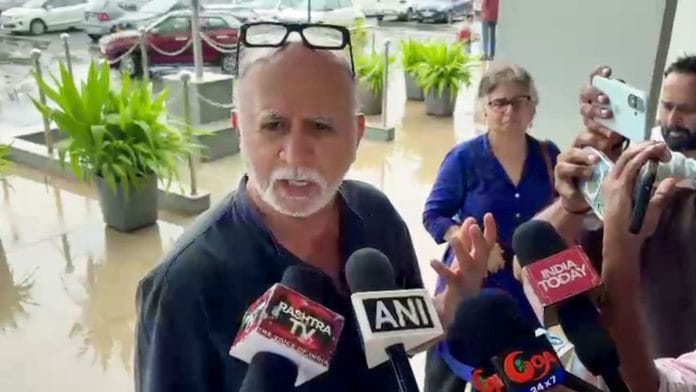


New Delhi: It was on 21 November, all of 13 years ago, when news channels began flashing headlines about Tehelka magazine founder and editor-in-chief Tarun Tejpal being accused of rape by a young colleague.
Given Tejpal’s track record as a journalist and author, the media industry was shaken to its core, the shock made worse by Tehelka’s crusading stance on systemic violence against women and its investigative stories holding power to account.
Nine days later, Tejpal was formally arrested by the Goa Police Crime Branch at their headquarters in Dona Paula, Goa, after he submitted himself to their custody following the rejection of his anticipatory bail plea by a sessions court.
He was charged with outraging a woman’s modesty, sexual harassment, use of criminal force with the intent to disrobe a woman, aggravated rape, wrongful restraint, and wrongful confinement of a young woman journalist who worked at Tehelka’s Mumbai office.
That case meandered on, Tejpal spending almost seven months in jail, till the sessions court acquitted him in May 2021. Calling the verdict “deeply flawed” and “highly prejudiced”, the Goa government appealed.
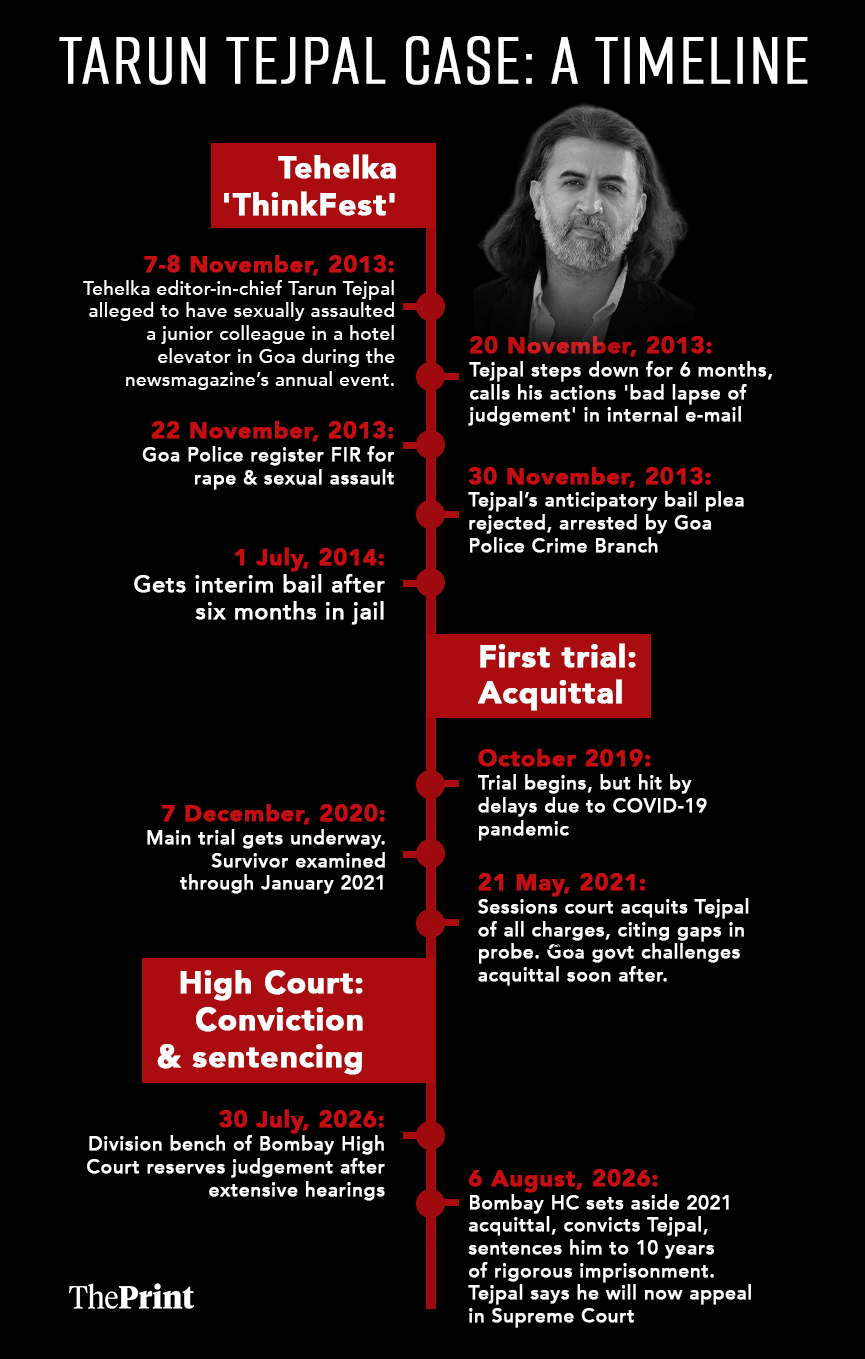
On Thursday, the Goa Bench of the Bombay High Court sentenced Tejpal to 10 years of rigorous imprisonment along with a fine of Rs 10,11,000.
Also Read: ‘Perfect victim’ myth, apology emails & abuse of dominance—HC order convicting Tarun Tejpal
Back to the beginning
The incidents dates back to November 2013, when Tehelka magazine organised THiNK Fest in Goa, highlighting American actor Robert De Niro as the main attraction of the event. Tejpal had assigned the survivor as the point of contact for De Niro and his daughter.
On the night of 7 November, around 11 pm, after the survivor and Tejpal dropped off the actor and his daughter at their suite in Goa’s Grand Hyatt Hotel, they both stepped inside a guest lift. According to the complainant, Tejpal then “used force against her wish, wrongfully restrained her, molested, sexually harassed and raped her” inside the lift.
Following the first incident, the survivor confided in her friends who worked with her at Tehelka and her partner. Going by submissions made in court, which ThePrint has accessed, the survivor, who had lost her father only four months before the first incident and had been brought up by a single mother, stayed put at the venue to continue executing her duties as the chief point of contact for De Niro and his daughter.
Following the first instance of sexual assault, Tejpal contacted the survivor again, first to check on work-related updates and then sent another text “the finger tips” followed by “where are you” and “??”.
On 8 November, when the survivor reached the lobby to take a lift to the actor’s floor, Tejpal coerced her into taking the lift together. The survivor told the court that Tejpal forced himself on her again for the second time even as she kept trying to push him away and asking him not to.
Fight for accountability
Afraid of losing her job, but determined to hold Tarun Tejpal accountable, the young journalist wrote a detailed email about her ordeal to Shoma Chaudhury, then managing editor of Tehelka. She demanded the setting up of a sexual harassment unit within the organisation to look into the case, an apology and acceptance of the sexual harassment by Tejpal and an acknowledgement of the same from Tejpal to the entire organisation.
Following this, Tejpal wrote two emails to the survivor: an informal email at 3.20 pm on 19 November, followed by a formal one at 3.23 pm.
“I am sorry at the immense distress that’s been caused to you by my lapse of judgment, but I want you to know it’s been totally devastating for me too, in every possible way,” read the informal email.
“It wrenches me beyond describing, therefore, to accept that I have violated that long-standing relationship of trust and respect between us and I apologise unconditionally for the shameful lapse of judgement that led me to attempt a sexual liaison with you on two occasions on 7 November and 8 November 2013, despite your clear reluctance that you did not want such attention from me. I understand the extreme distress you have been feeling and if regret could turn back time, the force of mine would surely place us all back in a space and time before this terrible lapse,” read the second, formal email.
Goa Police acts
Following the exchange of emails between the survivor and Chaudhury and between her and Tejpal, the Goa Police took suo motu cognisance after the newspapers and TV channels were flooded with allegations against Tejpal. The Goa Police submitted before the court that the police “initiated a preliminary enquiry” after “seeing the news”.
“It was reported that the female victim had sent a detailed mail to Shoma Chaudhury, Managing Editor of Tehelka, which we requested her to forward,” the police submitted.
After their probe, the police summoned Tejpal, but he filed for anticipatory bail in Delhi instead. He was subsequently arrested.
During the investigation, the Goa Police recorded the statements of 152 people associated with Tejpal and the survivor, filing a 2,846-page chargesheet before the court.
According to the Goa Sessions Court record, the police submitted surveillance footage of Tejpal and the survivor entering and exiting the lifts, text messages exchanged between the two, hard copies of emails written by Tejpal where he apologised, clothes worn by both on 7 and 8 November, statements of 71 people involved in the THiNKfest, friends and colleagues of both, and call recordings and mobile phones belonging to both.
“On the ground floor at CCTV camera time 22:33:59 hrs, the accused Tarun Tejpal by catching the hand of victim took the victim in the lift and the door of the lift closed. On the 2nd floor at CCTV camera time 22:36:08 hrs, the accused Tarun Tejpal and victim came out of the lift and then walked towards the staircase during which time accused is seen wiping his mouth with left hand and the victim adjusting and making her dress proper with her left hand,” read the chargesheet filed by the Goa Police.
Tejpal remained in jail from 30 November, 2013 until July 2014, when the Supreme Court granted him bail.
In September 2017, Tejpal contested framing of charges in the Bombay High Court, but a stay was not granted. In August 2019, the Supreme Court rejected his plea to quash the First Information Report (FIR) against him. Tejpal’s legal counsel had argued in the top court that he was framed by the sessions court.
The Supreme Court ordered the trial court to complete the trial in the next six months.
Also Read: Tejpal’s 10-yr jail sentences for rape, assault to run concurrently; to appeal conviction in SC
Trial court acquittal
The trial began in October 2019, but was stalled in 2020 due to the COVID-19 outbreak.
The Supreme Court subsequently issued a fresh order asking the trial court to complete the trial by 31 March, 2021.
In May 2021, and 18 cross-examinations later, the Goa Sessions Court acquitted Tarun Tejpal of all the charges, observing that the complainant “did not demonstrate any kind of normative behaviour” that a victim of sexual assault “might plausibly show”.
Public Prosecutor Tushar Mehta has argued that the trial court’s logic that it was “implausible for the victim to confide in three male colleagues rather than her female roommate” was “flawed”. The prosecution also observed that the survivor was “subjected to an excessive and invasive” cross-examination.
“The victim was subjected to a brutal cross-examination spanning nearly 700 pages across 18 separate hearing dates,” Mehta argued. The prosecution said that the “highly invasive questioning and aggressive attacks on her character made it seem as though the victim and not the respondent (Tejpal) was on trial”.
“The trial court not only failed to disallow these inappropriate and irrelevant questions but also subsequently used the resulting material to unfairly discredit the victim,” Mehta said.
Tejpal, who had consistently denied the allegations, had welcomed the Sessions Court judgement, describing it as a “long-fought-for vindication” in a statement read out by his daughter Cara Tejpal outside the court in Goa. The statement called it a “rigorous, impartial and fair trial”. It went on to add, “The past seven-and-a-half years have been traumatic for my family as we have dealt with the catastrophic fallout of these false allegations on every aspect of our personal and public lives.”
High court reversal
Following the acquittal from the Goa Sessions Court, the Goa government appealed against it in the High Court. Now Solicitor General, Mehta urged the Goa bench of the Bombay High Court to impose the maximum sentence on Tejpal. “This court must give a clear message to society that when a girl says no, it means no,” he submitted before the court Thursday.
The high court observed that the trial court had “erred in discrediting the victim’s testimony on the ground that she evaded answering whether she lifted her legs at any point; and unjustifiably granted the benefit of the doubt to the respondent where none reasonably existed”.
It added that the trial court also erred in observing that “there was no whisper of admission of sexual assault or any of its attributes in the apology e-mails”. The trial court, it said, also erred in stating her oral testimony “lacked CCTV support” and “most glaringly”, permitting an “invasive, humiliating cross-examination into the victim’s past sexual history, moral views, and personal WhatsApp messages, directly violating statutory embargoes under the Indian Evidence Act that prohibit questioning a victim’s character or past relationships”.
Taking cognisance of the evidence and arguments presented by both the survivor’s legal counsel and Tejpal’s legal counsel, the Bombay High Court set aside the trial court’s order. “We, accordingly, set aside the Judgment and Order of the Trial Court and convict the Respondent for offences punishable under Section 376(2)(f) and (k), 354, 354A, 354B 341 and 342 of the Indian Penal Code, 1860,” it said.
(Edited by Nardeep Singh Dahiya)