



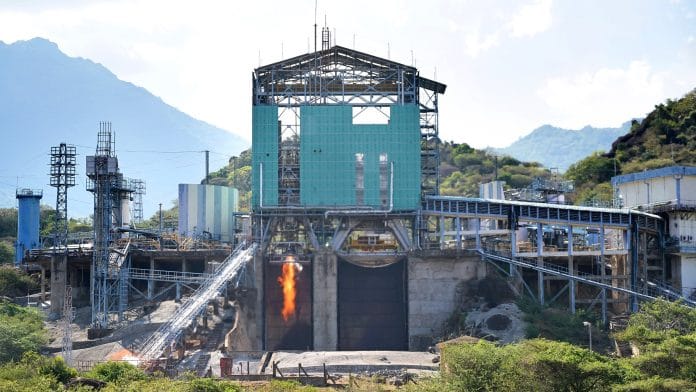

New Delhi: The Indian Space Research Organisation (ISRO) successfully conducted a flight acceptance hot test of its CE20 cryogenic engine at uprated thrust conditions of 220 kN, advancing efforts to enhance the payload capability of the LVM3 launch vehicle and supporting the Gaganyaan programme.
The test was conducted on September 9 at the ISRO Propulsion Complex (IPRC) in Mahendragiri, Tamil Nadu, ISRO said on Thursday.
In a post on X, the space agency said, “Flight acceptance hot test of CE20 cryogenic engine earmarked for the C32 upper stage of upcoming LVM3 mission at uprated thrust conditions of 220kN is successfully carried out at ISRO Propulsion Complex, Mahendragiri on September 09, 2026.”
ISRO also said the performance of the LOX Tank Pressurisation Module (LTPM), intended for the C32 stages of the Gaganyaan missions, was successfully demonstrated during the test.
The CE20 engine powers the upper cryogenic stage of the LVM3 launch vehicle. The space agency has been working to operate future LVM3 missions with an uprated C32 stage using the CE20 engine at 22-tonne thrust to enhance the vehicle’s payload capability.
The latest test follows a sea-level hot test of the CE20 engine conducted in March at the Mahendragiri facility at the 22-tonne thrust level. The test was carried out using a Nozzle Protection System and a multi-element igniter.
The March test was aimed at qualifying the engine for sea-level testing at the higher thrust level. ISRO had said the engine and test facility performed as expected during the 165-second test.
The CE20’s high-area-ratio nozzle makes sea-level testing particularly challenging because of its low exit pressure. ISRO has noted that flow separation inside the nozzle can cause severe vibrations and thermal stresses, potentially affecting the nozzle’s structural integrity.
The latest successful flight acceptance test marks another step towards operationalising the uprated C32 stage for upcoming LVM3 missions.
The development also comes shortly after ISRO successfully launched the Advanced Earth Observation Satellite-05 (EOS-05) aboard the GSLV-F17 from the Satish Dhawan Space Centre in Sriharikota on September 5.
ISRO Chairman V Narayanan had described the mission as a significant achievement, noting that the 2,367-kg satellite was successfully placed in its intended orbit. He said the satellite would become India’s first dedicated imaging satellite from geosynchronous orbit once operationalised. (ANI)
This report is auto-generated from ANI news service. ThePrint holds no responsibility for its content.