







Just when Indian Prime Minister Narendra Modi’s political star seemed to be rising again, a brutal police crackdown on student protesters has darkened the horizon.
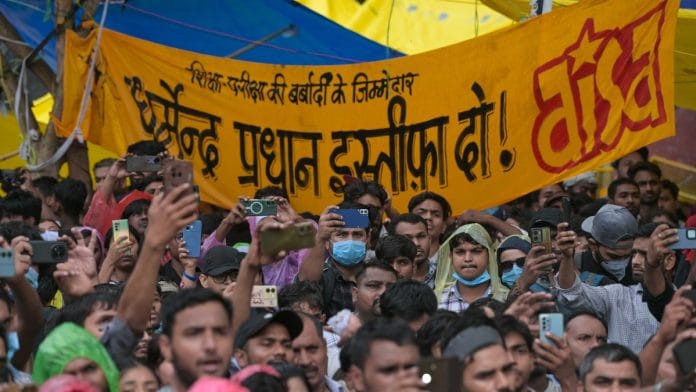
Outside parliament in New Delhi this week, the police used tear gas and batons to disperse thousands of young people. Their offense? Demanding accountability for systemic exam leaks, canceled test papers, and bungled scoring that have frozen the lives of millions.
The state’s response was a serious miscalculation. What began as a demand for administrative integrity has, through police violence, grown into a general anti-government movement. It has challenged the prime minister’s carefully curated strongman image and subjected him to a wave of open, irreverent mockery on the streets that would have been difficult to imagine just a few weeks ago.
In a belated attempt to quell the outrage, Modi promised fast-track courts to ensure “swift and stringent” punishment for those involved in paper leaks. Yet crowds at New Delhi’s historic Jantar Mantar site are swelling. Solidarity marches are spreading across Indian cities, and diaspora groups from London to Sydney have taken to the streets.
To understand why this crisis is politically perilous for the Indian leader, one must look past the immediate protests.
Modi has been on a mission to dislodge the opposition from power in important state capitals after his ruling Bharatiya Janata Party lost its absolute parliamentary majority two years ago. The unexpected success of the strategy filled the party with unbridled hubris.
Fresh off the BJP’s first-ever electoral victory in the state of West Bengal — achieved in part after millions of voters were stripped from electoral rolls — the government appeared poised to execute one of its favorite projects. Rumors swirled in New Delhi that the regime was preparing legislative moves to redistribute parliamentary seats, effectively disadvantaging the socially progressive, economically vibrant south in favor of the BJP’s stronghold in the poor, overpopulated north. (That constitutional amendment bill, which has been defeated once by opposition lawmakers, is yet to be reintroduced in the current monsoon session of parliament.)
At the same time, the government ignored the warning signs on the streets. It dismissed the Cockroach Janta Party, a movement born in May out of an AI-generated meme mocking elite disdain for unemployed youth.
That was the first mistake. Like Gen-Z movements in Kenya or Nepal, the CJP mobilized hyper-connected, disillusioned young people around a single concrete issue. Their demand was simple: the resignation of Education Minister Dharmendra Pradhan.
But by responding with batons instead of dialogue, authorities transformed a targeted administrative grievance into a direct challenge to the prime minister’s authority. That was a far bigger blunder.
State repression is not new in India. The history of the Congress Party, now the main opposition, is checkered with authoritarian overreach, most notoriously during Indira Gandhi’s 21-month emergency in the mid-1970s when press freedom was curtailed and tens of thousands of student activists were jailed. Many senior BJP leaders’ early careers were shaped by that period.
The Modi government has continued with that tradition, using a pliant local media to brand all dissent as anti-national. In 2020, the government crushed civil-society protests against a discriminatory citizenship law. That crackdown — which was also in New Delhi — succeeded because the ruling party successfully framed the issue through a sectarian lens, convincing the Hindu majority that their own privileges were not at risk.
Education corruption is different. It is an equal-opportunity dream killer.
Young people now feel cheated by the claim that education is a pathway to jobs that will put them on track to a middle-class life. Returns on an additional year of schooling in India are worse than in sub-Saharan Africa. It’s especially bad for young men. In real, or inflation-adjusted terms, graduate men earned a steadily increasing wage premium, compared with non-graduates. But that gap peaked in 2011.
Which is why even in a state like Karnataka, home to India’s outsourcing hub of Bengaluru, more than a fifth of the youth aren’t in education, training, or employment. They’re waiting for something good to come along. This search is increasingly long, and pointless. Eventually, most young people take whatever work they can find. The 40% unemployment among the 15- to 25-year-old graduates falls to 20% among the 25- to 29-year-olds, but very few have the shot at the kind of life they see more privileged Indians enjoying on Instagram.
With a Gen-Z population of nearly 400 million competing for quality education and decent jobs, state-administered exams are often the sole vehicle for upward mobility for lower- and middle-income families. When test papers are leaked to wealthy elites or exams are canceled overnight, it destroys hope. A Hindu youth from rural Uttar Pradesh in the north suffers the exact same betrayal as a Muslim youth from the more affluent southern states of Tamil Nadu and Kerala. The BJP’s playbook — polarizing the electorate along religious lines — is useless against a crowd united by economic despair.
Over 12 years in power, Modi’s political model has relied on turning citizens into passive beneficiaries of the state’s munificence. Welfare transfers, subsidized housing, and free cereals are framed not as entitlements, but as gifts from a benevolent leader. Modi’s face is everywhere from ration bags to railway tickets.
Accepting the students’ demands — sacrificing the education minister and guaranteeing leak-free exams — forces the government to make a painful concession: that clean governance and fair opportunities aren’t discretionary favors. Finally, a climbdown became unavoidable. On Saturday, Pradhan announced on X that he had sent his resignation to the prime minister. This may well give Modi some reprieve from the current spate of protests. However, having tasted success once, the youth may move on to another demand to bend the government’s will. Once citizens remember they have rights, the paternalistic illusion of a strongman state begins to unravel.
The CJP and its digital-native leaders lack the institutional structure to challenge Modi at the ballot box. That task will inevitably fall to established opposition leaders like Rahul Gandhi. By dragging Gandhi away from his sit-in protest outside the prime minister’s residence this week, the police gave his Congress Party some unexpected leverage. Since its surprising resurgence in the 2024 general elections, the Congress has suffered a string of setbacks. The anti-Modi coalition that Gandhi leads has vastly shrunk in size.
The next general election is in 2029, and three years in politics is too long a timeframe to predict anything. However, one thing is certain. Modi and his No. 2 Amit Shah, the home minister who controls the police in New Delhi, must know just how bad the shoe of inchoate public anger pinches. It was once on the other foot. A similar kind of unrest during the 2011 anti-corruption movement had paved the way for them to wrest power from the Congress 12 years ago.
By challenging the government’s aura of invincibility, India’s youth have forced the state to confront the one thing it fears most — an angry, united electorate demanding its rights.
This report is auto generated from the Bloomberg news service. ThePrint holds no responsibility for its content.