








New Delhi: The Energy Statistics India 2026 report by the Ministry of Statistics and Programme Implementation (MoSPI) highlights a contradiction in the country’s energy journey: renewable energy is growing fast, but coal continues to power the system.
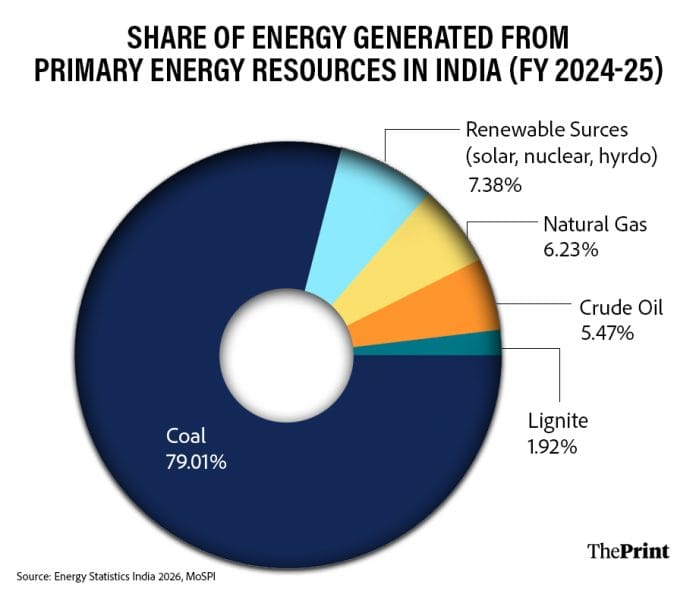
“Coal remained the backbone of India’s energy supply, accounting for nearly 79 percent of the total energy supplied domestically in FY 2024-25,” the report, released Monday, states.
Production trends reinforce this dominance. “Coal production grew by 4.98 percent, reaching 1,047.52 million tonnes, up from 997.83 million tonnes in the previous year. The Non-Coking Coal is having the dominating share of the total production of Coal, at around 93.65 percent during FY 2024-25.”
At the same time, renewable energy, which accounts for 7.4 percent of energy supply, is expanding at an unprecedented scale. Renewable electricity generation has more than doubled, rising from 189,314 gigawatt-hour (GWh) to 416,823 GWh, while solar and wind have expanded rapidly, registering a CAGR (cumulative annual growth rate) close to 16.5 percent.
Financial flows, the report shows, are also shifting in favour of clean energy. It highlights that in line with India’s Net Zero target for 2070, credit to the renewable sector has surged sharply.
“A credit flow of Rs 1,688 crores during 2021 into the Renewable Energy sector has increased to Rs 10,325 crores during 2025,” the report states. “The same is testament to India’s efforts to become self-reliant in the field of energy.”
Overall, India’s energy consumption continues to climb across sectors, driven by economic growth, urbanisation and rising incomes. As the report puts it, “the requirement of energy is indispensable and ubiquitous.” It adds that there is a “higher quench for energy to support the rapidly expanding urbanisation and industrialisation.”
Total Final Consumption (final energy delivered to end-users) has surged by around 30 percent since FY 2015-16, reaching 608,578 Ktoe (Kilo Tonnes of oil Equivalent) in FY 2024-25. The increase is broad-based, with the residential sector leading the growth.
“In the year 2024-25, reflecting India’s rapid urbanisation the residential sector witnessed the highest growth at 8.04 percent, followed by commercial/public service sectors (5.06 percent), transport (4.36 percent) and Industry sectors (2.67 percent) as compared to previous year, all of which are the driving forces of an economy and testament to the steadfast progress of Indian economy,” the report states.
Rising consumption is also visible at the individual level. Energy use per person has increased by over 19 percent in the last decade–from 15,296 Mega Joule/person in FY 2015-16 to 18,096 Mega Joule/person in FY 2024-25.
Electricity consumption has grown even faster, the report mentions. “The per-capita-electricity-consumption has gone up from 780 KWh/person during FY 2015-16 to 1,153 KWh/person during FY 2024-25.”
For context, per capita energy consumption includes transportation fuel, heating (gas/wood), and industrial fuel, whereas per capita electricity consumption measures only electrical energy used per person.
High import dependence
If coal represents domestic strength, oil and gas highlight India’s biggest vulnerability–import dependence. That energy dependence is playing out at present, as India is hit by disruptions in global oil & LPG flows due to Iran’s blockade of the Strait of Hormuz.
“To meet the domestic demand, India relies heavily on imports of coal, crude oil and natural gas,” the report says.
The scale of this reliance remains significant. In FY 2024-25, crude oil import dependency stood at around 89.44 percent, while natural gas imports accounted for 49.73 percent and coal imports for 23.50 percent.
Crude oil imports increased to 243.22 million tonnes in FY 2024-25, and natural gas imports surged by 12.34 percent. This growing dependence exposes the economy to global price volatility and geopolitical risks.
The report notes that India remains vulnerable to fluctuations in global energy prices. “These fluctuations affect the trade balance, as rising energy prices increase India’s import bill, leading to a higher trade deficit,” it adds.
“As India continues to expand its industrial base and infrastructure, the cost of energy becomes a critical factor in maintaining competitiveness and economic stability.”
Regional divides shape energy map
The geography of India’s energy resources reveals another layer of complexity: coal reserves are concentrated in a few eastern states.
As of 31 March 2025, Odisha accounts for 25.2 percent of total reserves, followed by Jharkhand at 23.3 percent and Chhattisgarh at 21.3 percent. Together, these states hold nearly 70 percent of India’s coal wealth.
Renewable energy, however, is distributed differently. The report notes that over 70 percent of renewable potential is concentrated in six states, led by Rajasthan (24 percent), followed by Maharashtra (14 percent), Andhra Pradesh (9.1 percent), Gujarat (9 percent), Karnataka (8.6 percent), and Madhya Pradesh (8.09 percent).
Oil and gas reserves remain limited and largely offshore. The Western offshore region accounts for 31 percent of crude oil reserves, while natural gas is similarly concentrated in offshore basins.
This uneven distribution creates a structural divide between energy producing and energy consuming regions, complicating infrastructure planning and the transition to cleaner sources.
India’s energy story, according to the MoSPI report, remains one of coexistence–where rapid renewable growth is unfolding alongside a deep dependence on coal and imports.
(Edited by Tony Rai)