



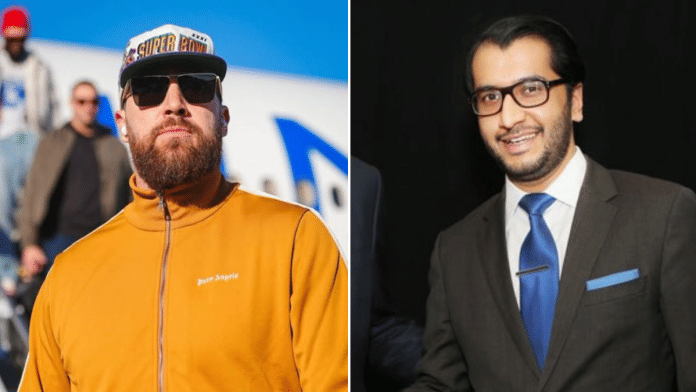
New Delhi: An Indian origin investment advisor has been sentenced to 11 years in prison in the US for running a multi-million-dollar Ponzi scheme that used investors’ money to repay earlier investors and fund an extravagant lifestyle of private jets and expensive apartments, the US Department of Justice (DoJ) said.
American professional footballer and singer-songwriter Taylor Swift’s husband Travis Kelce is among the victims, with the prosecutor reported to have brought up his name. Details of the investment, however, are not known.
According to an indictment filed in a Missouri court, Siddharth Jawahar took in more than $35 million from investors between July 2016 and December 2023, but invested only about $10 million.
District Judge Zachary M. Bluestone on Tuesday also ordered the 38-year-old to pay $31.35 million in restitution to victims, a statement by the U.S. Attorney’s Office, Eastern District of Missouri said.
Judge Bluestone cited the “enormous” losses and the length of the fraud and echoed a victim, who said Jawahar “weaponized” investors’ trust. He also said Jawahar’s failure to begin repaying victims was a major factor in the sentence, the statement added.
Jawahar, the indictment alleged, “being an investment adviser, by use of the mails and by use of means and instrumentalities of interstate commerce, directly and indirectly, did willfully employ devices, schemes, and artifices to defraud one or more investors and prospective investors; did willfully engage in transactions, practices, and courses of business which operated as a fraud and deceit upon investors and prospective investors; and did willfully engage in acts, practices, and courses of business which were fraudulent, deceptive, and manipulative”.
It also states that Jawahar used money from new investors to repay older investors and fuel an extravagant lifestyle that included travel on private jets, stays at luxury hotels, a luxury apartment in Austin and New York City, memberships at multiple private clubs across the country, spending sprees at clothing stores and expensive outings at fancy restaurants.
Jawahar was indicted by a grand jury in U.S. District Court in St. Louis on 21 December 2023 on three counts of wire fraud and one count of investment adviser fraud.
A company, investors & a Ponzi scheme
According to the indictment, Jawahar ran Texas-based investment company Swiftarc Capital LLC, created on or about 1 December 2010. On or about May 17, 2013, Swiftarc Capital was registered as an investment advisor with the Texas Securities Commissioner, the indictment reads.
It adds that after Jawahar created Swiftarc Capital, he initially solicited and received investors’ funds, which he invested in a diverse array of securities.
But in 2015, Jawahar began investing the majority of client funds in a single investment, Philip Morris Pakistan (PMP). Eventually, 99 percent of client funds were consolidated into the PMP investment, the indictment says.
However, Jawahar did not inform investors of a dramatic decline in PMP’s value. Instead, he falsely represented to investors that shares were trading at a much higher price, misleading investors about their profits, a DoJ statement on 8 January 2024 said.
Investors were falsely led to believe that he’d invested their money in a specific company or companies, but he never made the promised investments, said the DoJ statement.
Beginning in or about July 2016 and continuing through in or about December 2023, Jawahar spent only approximately $10 million on investments in companies. Rather than making the investments that he had promised his investors, he fraudulently used newly acquired investor money to pay back previous investors and to fund his lifestyle, the indictment states.
“In 2015, he began investing client funds in a single investment, Philip Morris Pakistan (PMP). Eventually, 99% of client funds were consolidated into PMP. When the value of PMP declined, Jawahar did not tell investors and falsely claimed that his investors were making profits,” the DoJ statement said.
“Beginning by at least in or about July 2016, and continuing through at least in or about December 2023, in the Eastern District of Missouri, and elsewhere, the defendant, Siddharth Jawahar, with the intent to defraud, devised and intended to devise a scheme and artifice to defraud investors and to obtain money and property from investors by means of material false and fraudulent pretenses, representations, and promises, as described further herein.”
“During his scheme to defraud, Jawahar took tens of millions of dollars from his investors. Instead of making the investments that he promised to make on his investors’ behalf, however, defendant spent his investors’ money on Ponzi scheme payments to previous investors and extravagant lifestyle expenses, including payments for flights on private planes, stays at luxury hotels, and expensive outings at lavish restaurants,” said the indictment.
When Swiftarc Capital investors asked to withdraw significant amounts of their investment money, Jawahar was unable to repay by selling PMP shares at the inflated price he had conveyed to investors.
Unable to repay Swiftarc Capital investors by selling off shares in PMP, Jawahar fraudulently solicited potential investors for new and additional payments to repay Swiftarc Capital investors and fund his lifestyle, the statement said.
While perpetrating his multi-million-dollar Ponzi scheme, Jawahar “used Swiftarc investor dollars to fund extravagant expenses-financing flights on private planes, stays at luxury hotels, and expensive outings at lavish restaurants”.
“Without informing potential Swiftarc investors that large portions of their investment dollars would fund defendant’s lifestyle and investor repayments, defendant fraudulently persuaded potential Swiftarc investors to provide him with funds that they falsely believed would be invested in companies,” said the statement.
Further, as to many of the limited investments that Jawahar did actually make as promised, he falsely inflated the profitability of those investments in his communications with investors.
On 21 January, Jawahar admitted “misleading investors by falsely entering into agreements in which he agreed to invest their money in a specific company or companies, including one Missouri investor who gave him $175,000, another Missouri investor who gave him $75,000, a New York investor who handed over $350,000 and an Ohio investor who gave him $250,000. Jawahar never made the promised investments”, said the DoJ statement.
Cease & desist
The indictment states, after creating Swiftarc Capital, he “controlled and managed several additional entities that he utilized during his scheme to defraud”.
They included Swiftarc Fund LP, Swiftarc LLC, Swiftarc Holdings, SJ Investment Holdings LLC, Order of Magnitude Ventures LLC, Extra Sensory Perception Inc., Swiftarc Growth Fund LP, Swiftarc Opportunities Fund LP, SJ Investment Holdings LLC, SV Labs SPV 1 LP, Swiftarc Venture Labs Fund GP LLC, SJDB Ventures LLC, Swiftarc Ventures LLC, Swiftarc Venture Labs Fund LP, Swiftarc Telehealth Labs Fund LP, NI Stubbs LLC, and Swiftarc Beauty Fund LP.
Jawahar’s entities are collectively referred to as “Swiftarc”, according to the indictment.
On 7 June 2022, the Texas State Securities Board revoked Swiftarc Capital’s authority to conduct investment activities and ordered Jawahar to “cease and desist from engaging in fraud”.
The indictment says Jawahar did not notify investors about the cease-and-desist order before taking their money and continued to fraudulently solicit and receive investor funds, including $1 million from an investor weeks after the state board’s order.
(Edited by Sugita Katyal)