



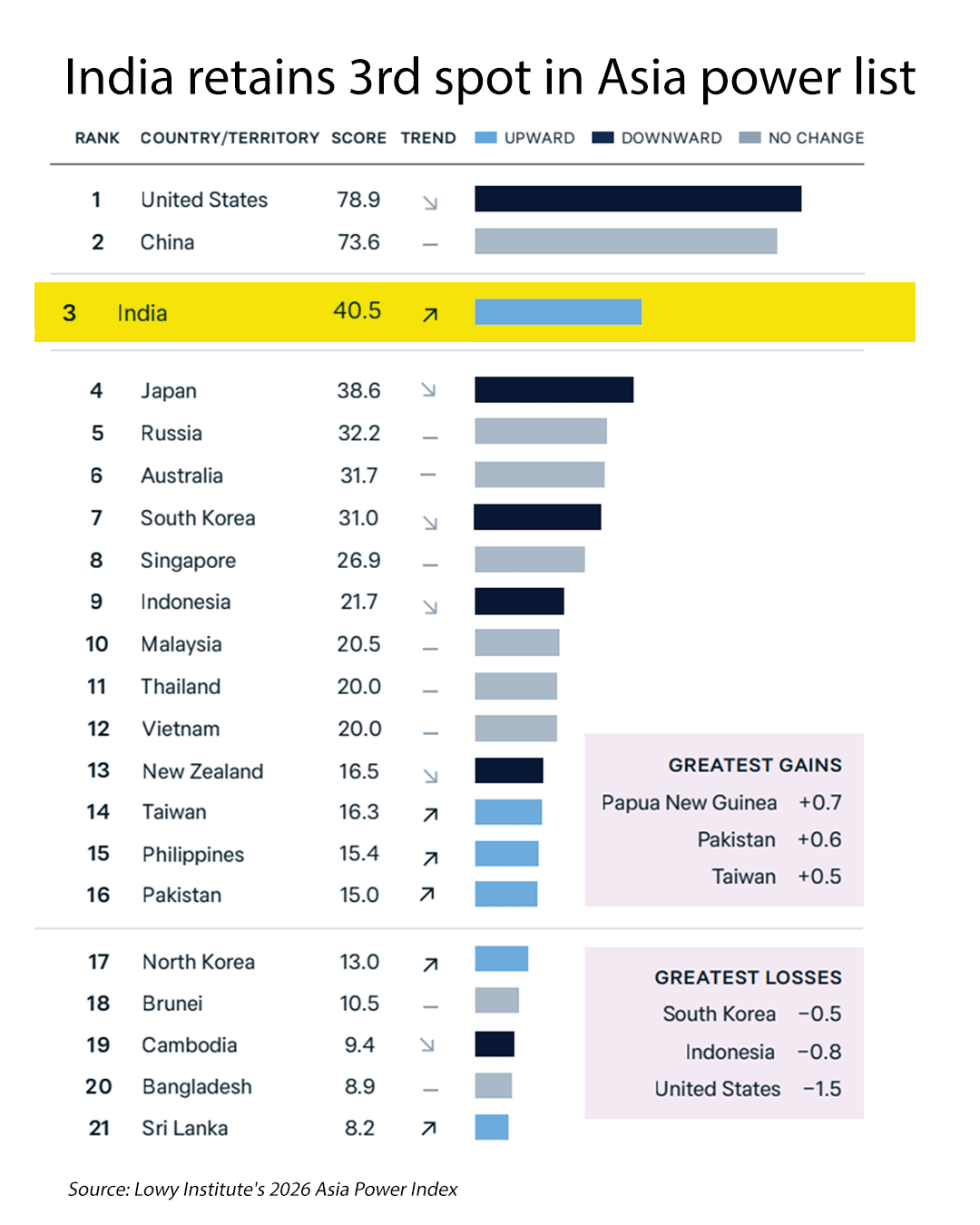
New Delhi: India has retained its position as Asia’s third most powerful country for the third consecutive year, scoring 40.5 points in the Lowy Institute’s 2026 Asia Power Index. While the country registered gains in diplomatic influence, future resources and cultural influence, its economic capability remained a weak spot.
The latest assessment places India behind the United States and China, which scored 78.9 and 73.6 points, respectively. Japan and Russia occupy the fourth and fifth positions. India’s score has risen from 40 points in 2025 and 39.1 in 2024, when it overtook Japan to enter the third position.
The gap between India and China has narrowed to its smallest level since the index was launched in 2018. However, China’s comprehensive power remains 80 percent higher than India’s, highlighting the considerable difference in their regional capabilities.
The Lowy Institute’s Asia Power Index
The Asia Power Index is an annual assessment by Australia’s Lowy Institute that measures the distribution of power across the Indo-Pacific. It evaluates 27 countries and territories based on their ability to shape their external environment and influence other countries.
The index uses eight measures: Economic capability, military capability, resilience, future resources, economic relationships, defence networks, diplomatic influence and cultural influence. Countries scoring 70 points or more are classified as superpowers; those scoring 40 points or more are major powers; countries with 15 points or more are middle powers; and those scoring below 15 points are minor powers. With 40.5 points, India remains in the major powers category.
India’s influence growing beyond its economic strength
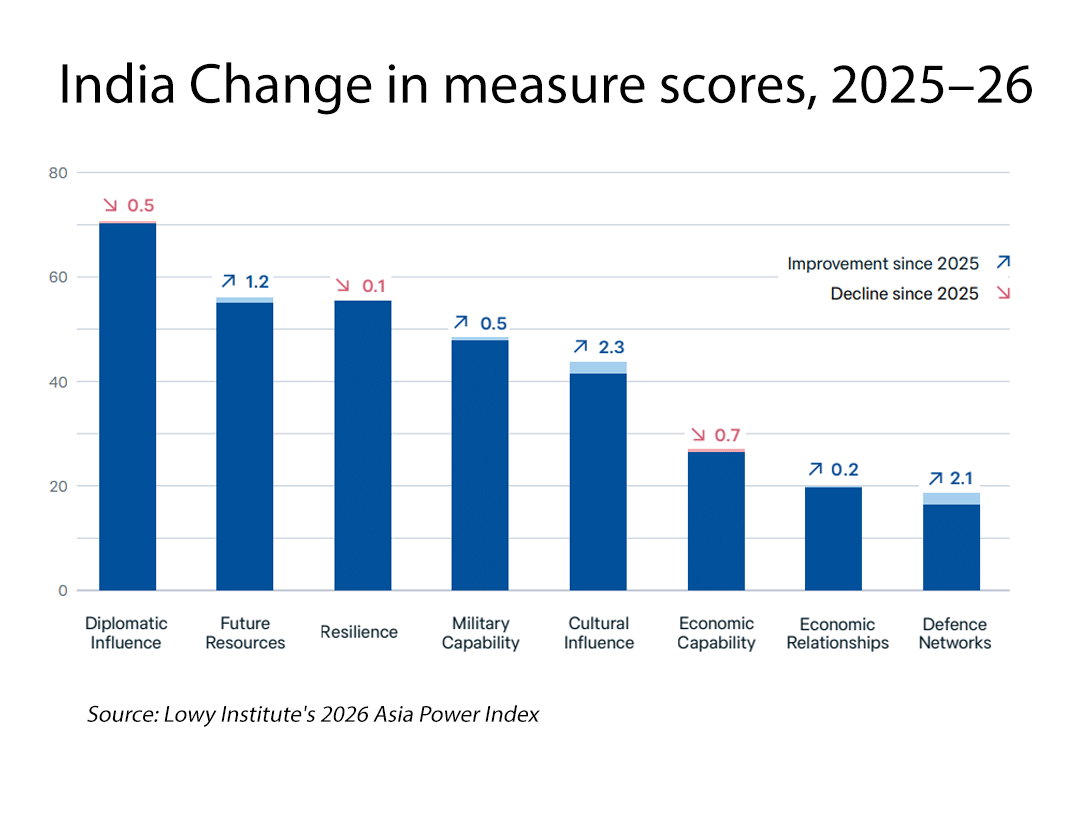
The Lowy Institute’s assessment of India, titled ‘India Gains Influence’, describes a year in which the country’s overall regional standing improved despite domestic challenges and a decline in its relative economic capability.
A significant part of this improvement came from India’s diplomatic performance. The country maintained its standing at a time when diplomatic influence declined across much of the region. Assessments of Prime Minister Narendra Modi’s regional leadership also improved, placing him behind only Chinese President Xi Jinping among the region’s most effective leaders.
However, the report draws a distinction between India’s regional leadership and its wider global standing. Perceptions of Modi’s global leadership and India’s strategic ambition weakened during the year, according to the report. The institute pointed to India’s relatively low diplomatic profile during the Gulf conflict, including its muted response after a US submarine sank an Iranian naval vessel returning from an exercise hosted by India.
This presents a more complex picture of India’s diplomacy: Its influence within Asia is strengthening, but its ability to shape developments beyond the region remains a challenge.
Economic potential rises, but capability faces pressure
One of the more interesting findings in the assessment is the contrast between India’s future economic prospects and its current economic capability. The country’s future resources improved, supported by a more favourable economic forecast. Its economic capability, however, weakened. The institute attributed this to the depreciation of the rupee, a change in the IMF’s methodology for measuring economies and a nearly $20 billion decline in outbound investment.
The distinction matters because economic capability is a key foundation of a country’s ability to sustain military strength, build partnerships and exercise influence abroad. India’s improving future-resource outlook suggests considerable potential, but the decline in present economic capability shows that this potential has yet to translate fully into regional power.
Defence partnerships & cultural reach
India’s growing engagement with Southeast Asia is another factor behind its improved standing.
The institute noted greater regional defence engagement and BrahMos missile sales to Southeast Asian countries as contributors to India’s improved defence networks. The development reflects India’s efforts to deepen security relationships and expand its role as a defence partner beyond its immediate neighbourhood.
Its cultural influence also strengthened, with improvements in cultural projection, information flows and people-to-people exchanges.
India’s economic relationships remained relatively stable as well. It was among a small group of countries that did not register a decline in this measure, with regional trade and investment ties supporting its performance.
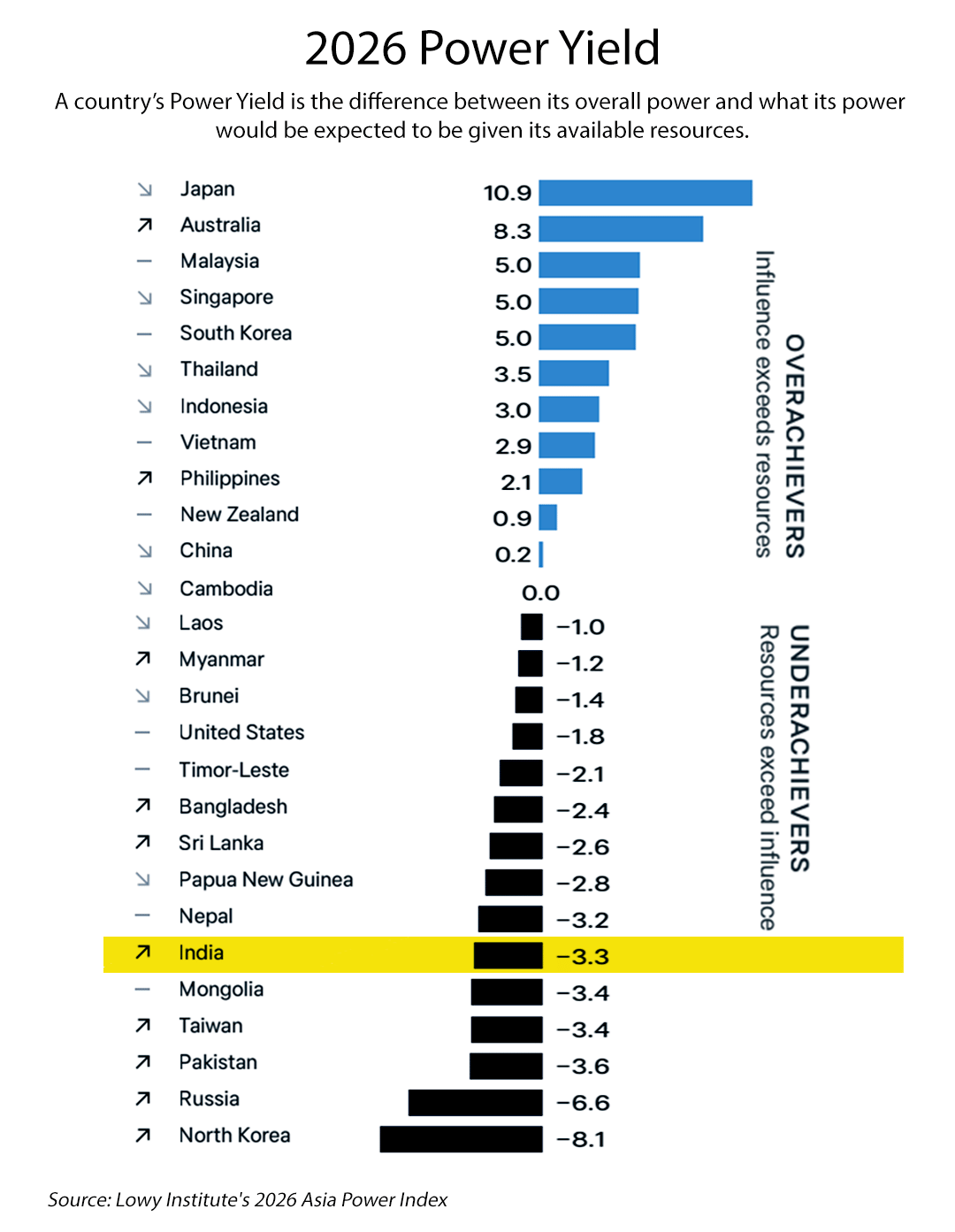
These developments helped India improve its overall Power Yield—a measure of how effectively a country converts its available resources into actual influence. The institute said India’s Power Yield gap narrowed for the first time since 2023.
China remains well ahead despite narrowing gap
India’s improving performance has coincided with a slight narrowing of the power gap with China. The difference between their overall scores fell to 33.1 points, the smallest since the index began in 2018.
The latest movement reflects a modest rise in India’s score and a marginal decline in China’s, rather than a major shift in the balance between the two countries.
US-China power gap in Asia shrinks
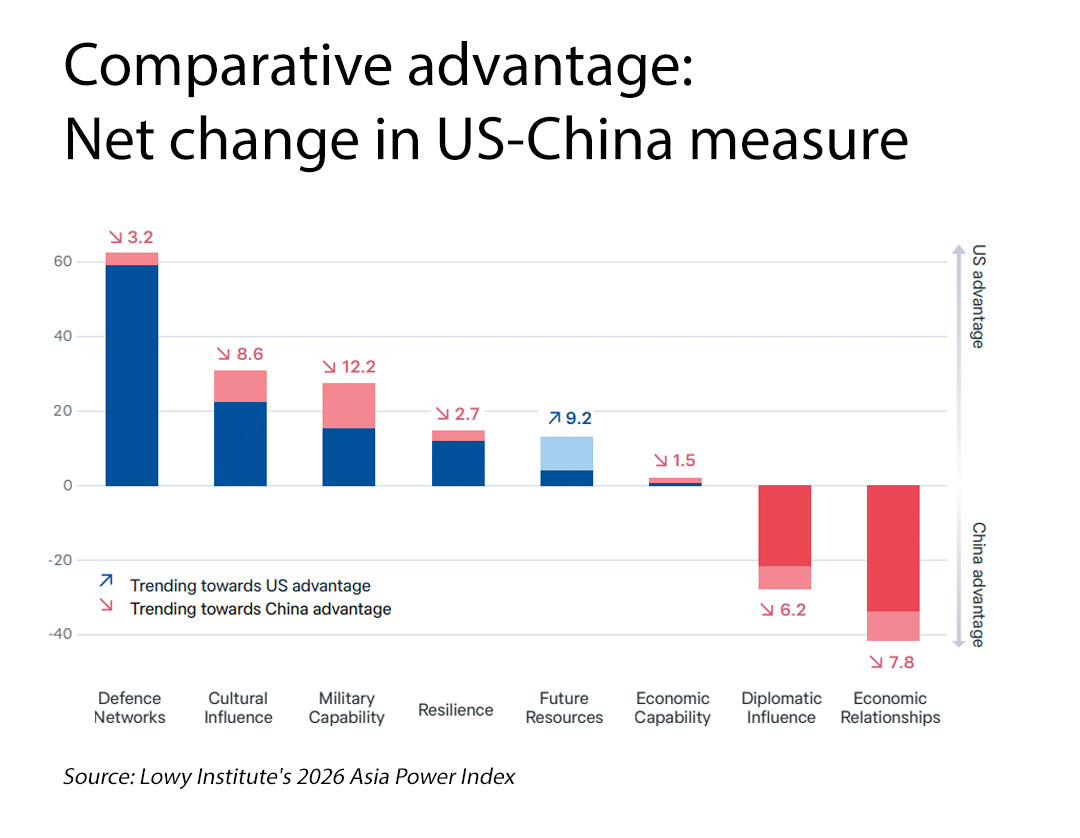
The gap between the United States and China has narrowed to its smallest level since the Lowy Institute launched the Asia Power Index in 2018, reflecting a decline in Washington’s overall standing in the region.
The US retained the top position with 78.9 points, while China followed with 73.6 points, leaving a difference of just 5.3 points. In 2024, the gap stood at nine points, when the US scored 81.7 against China’s 72.7.
The Lowy Institute attributed the narrowing gap largely to setbacks for Washington rather than a significant rise in Beijing’s overall power. The US lost ground across economic capability, military capability, defence networks and diplomatic influence, with its overall score falling by 1.5 points in 2026.
The conflict with Iran, which began in February 2026, was among the factors identified by the report. The conflict diverted American military resources from the Pacific towards West Asia and put pressure on its stocks of long-range missiles, raising questions about its capacity to sustain military commitments in the region.
Washington’s diplomatic standing also weakened. Its diplomatic influence score fell by six points to 76.7, marking the fourth consecutive annual decline and the largest single-year drop in this measure since the index began.
China, meanwhile, remained relatively stable across most parameters, registering improvements in military capability, cultural influence and resilience. Its economic relationships score declined, but the institute noted its continued military modernisation and expanding diplomatic and cultural presence across Asia.
The report also found that the military capability gap between US and China had narrowed to its lowest level since 2018. The US, however, continues to hold advantages in defence spending, air power, land warfare firepower and global force projection, while China has strengthened its military position in the Pacific.
The methodology
The 2026 Asia Power Index, authored by Lowy Institute researchers Hunter Marston and Jack Sato, uses a composite methodology comprising eight measures of power, 30 sub-measures and 131 indicators across 27 countries. Its framework draws on the OECD’s Handbook on Constructing Composite Indicators and uses a distance-to-frontier approach to standardise data and compare countries against the best- and worst-performing countries in each dataset.
More than half the indicators are based on original Lowy research; the remainder is sourced from publicly available data. For diplomatic influence, the index combines measurable indicators—such as diplomatic networks, multilateral participation and voting alignment with qualitative, expert-based assessments of political leadership, strategic ambition and the effectiveness of foreign-policy bureaucracies.
The weightings reflect Lowy experts’ collective judgment, informed by academic literature and consultations with regional policymakers. However, the methodology does not disclose the number or identities of the experts consulted.
(Edited by Viny Mishra)
Also read: India’s improved performance in Asia Power Index a reality check for Congress: BJP