





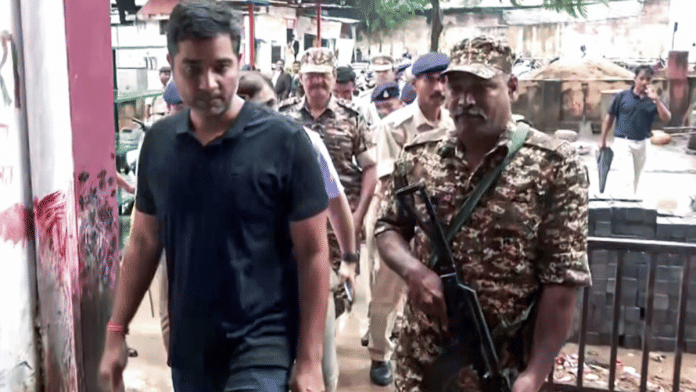



New Delhi: Granting bail last week to former chief minister Bhupesh Baghel’s son Chaitanya in the liquor scam cases, the Chhattisgarh High Court slammed the Enforcement Directorate and the state’s Economic Offences Wing, observing there is no documentary evidence to suggest he was “at the apex” of the syndicate, and that the agencies overwhelmingly relied on the statements of witnesses or co-accused.
Additionally, the high court pulled up the state police’s EOW also for violating the established procedure while dealing with an accused who faces an open-ended warrant. It warned the state’s director general of police against similar violations in future.
It granted Chaitanya bail in the two liquor scam cases probed by the state’s EoW and the Enforcement Directorate. It is alleged that the scam took place during his father Bhupesh Baghel’s tenure as chief minister. The agencies have claimed that the liquor syndicate, with Chaitanya at its centre, caused a loss of more than Rs 3,000 crore to the state exchequer.
Chaitanya was arrested by the ED in the money laundering case on 18 July last year, followed by his arrest on 24 September by the EOW. The liquor policy probe picked up pace after the Vishnu Deo Sai-led BJP government came to power in December 2023.
The ED, which had been probing the case based on recoveries made by the Income Tax Department during searches linked to former IAS officer and then excise department joint secretary Anil Tuteja’s premises, wrote to the EOW to register a case against civil servants and former excise minister Kawasi Lakhma, a Congress leader.
In the Chaitanya Baghel bail order, Justice Arvind Kumar Verma observed that the ED has not produced any documentary evidence on record establishing his direct involvement in the generation of proceeds of crime. “The material relied upon by the Enforcement Directorate does not disclose any document, official communication, financial instrument, bank account, or property standing in the name of the applicant which would, by itself, demonstrate direct involvement in the generation of proceeds of crime,” he observed.
The high court accepted one of the grounds raised by Chaitanya’s counsels, advocates N. Hariharan, Mayank Jain, and Arpit Goel, that the ED’s case primarily stems from “coerced, uncorroborated, and inconsistent” statements of a person, and that these were recorded “after issuance of open-ended warrants” against him.
The allegations, as they stand, are premised primarily on statements recorded under Section 50 of the Prevention of Money Laundering Act (PMLA) and broad assertions regarding influence and proximity, rather than concrete acts of commission, the judge observed.
Section 50 empowers the ED to summon individuals, compel document production, and record statements which are admissible in court of law, in contrast to statements made before the police or any other agency.
“While it is alleged that the applicant stood ‘at the apex’ of the syndicate, no contemporaneous documentary evidence has been placed on record to establish that the applicant exercised control over procurement decisions, fixation of commission rates, award of tenders, movement of liquor, or handling of cash collections,” Justice Verma said.
He noted the agency had not produced crucial evidence such as minutes of the meetings, written instructions, digital communications or financial trails originating from the applicant to corroborate their claims made in the prosecution complaints.
A list of ‘compelling’ reasons
Discussing several aspects of the case probed by the EOW, Justice Verma drew a long list of arguments in favour of granting bail to Chaitanya.
Among the list of “compelling” reasons cited by the judge was the “procedural lapse” committed by the EOW, in which the investigating officer chose to merely record the statement of Lakshmi Narayan Bansal, rather than arrest him, even though an open-ended warrant was issued against him in a separate corruption case.
The high court observed that both the EOW and the ED relied on Bansal’s statement.
Bansal roaming free despite a warrant against him, while his statement serving as the sole reason for Chaitanya’s custody amounted to a “naked discrimination” violating Article 14, the High Court observed. “Such selective application of the law glaringly reflects a ‘pick and choose’ approach, which is antithetical to the concept of fair and impartial investigation,” Justice Verma observed in the order.
Moreover, the court emphasised that Chaitanya was neither named in the FIR lodged by the EOW on the ED’s complaint, nor in as many as six chargesheets filed by the state agency in the case.
The court further highlighted that charges are yet to be framed against several accused persons, and that the case, in any event, has 51 accused persons, 1,110 witnesses, and approximately 990 documents spanning thousands of pages, with the investigation still not concluded.
The continued investigation and filing of chargesheets have also been without the approval of the competent court, which the High Court said, further weakens the sanctity of the EOW’s case.
The High Court also noted that all the 22 arrested people named in six charge sheets before Chaitanya’s arrest have obtained bail from different levels of courts.
These include Arun Pati Tripathi, Trilok Singh Dhillon, Anurag Dwivedi, Arvind Singh, Sanjay Kumar Mishra, Vijay Bhatia, and Sunil Dutt, who were alleged to be the principal kingpins, cash aggregators, excise officials, and direct beneficiaries of the liquor syndicates and had a “demonstrably graver” role than the “peripheral money routing” allegation against Chaitanya.
“Viewed cumulatively—absence of the applicant’s name in the FIR, consistent non-arraignment in first charge-sheet and thereafter five supplementary charge sheets, lack of recovery, completion of investigation, grant of bail to similarly placed co-accused, procedural lapses on the part of the investigating agency, and the inevitability of a protracted trial—this Court finds no compelling reason to curtail the applicant’s liberty any further,” Justice Verma observed.
(Edited by Ajeet Tiwari)