





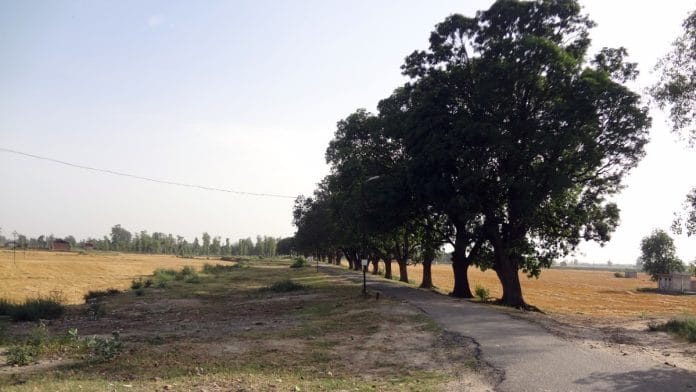

New Delhi: For decades, street lanes in rural India did not have a name that anyone beyond the village recognised. Directions hinged on landmarks like a banyan tree, a temple, or a neighbour’s house.
The central government now wants to change that. The Ministry of Panchayati Raj Thursday proposed a nationwide system to name, classify and digitally code every road inside India’s villages, creating what could become the country’s first comprehensive database of intra-village roads.
Ministry officials said the consultation paper is expected to be uploaded on the MyGov platform within the next three to four days, after which feedback will be sought from citizens, panchayats and other stakeholders over a 21-day window.
The proposal brings together two government initiatives already underway: the SVAMITVA (Survey of Villages and Mapping with Improvised Technology in Village Areas) scheme, which is using drones to map villages, and DIGIPIN, the Department of Posts’ geo-spatial addressing system.
The aim is to create a single digital database of roads for India’s nearly six lakh villages. If implemented, it would allow roads and lanes inside villages to be identified and located more easily, allowing a better track of infrastructure works carried out under different schemes.
“How will a fire engine know whether it can enter a particular lane? If there’s an emergency, responders often don’t know how to reach the spot,” V. Uday Kumar, adviser in the Ministry of Panchayati Raj, said while explaining the rationale behind the initiative.
He added that village roads are often identified through informal landmarks such as a resident’s house, making them difficult for outsiders, emergency services and delivery personnel to locate. A standardised road network linked to digital maps and geo-spatial addresses, he said, would improve navigation, support disaster response, and create a common database that can be used across government departments for planning, monitoring and maintenance of rural infrastructure.
Also Read: Karnataka empowered panchayats the most, UP & Tripura made biggest strides in decade—govt report
Why village roads have stayed off the map
While highways and rural roads built under government schemes are mapped and documented, the lanes within a village frequently exist outside any official record. Even widely used digital map services, officials said, do not capture this layer in any usable detail.
“Even if you look at Google Maps, it does not cover the village properly. It does cover the area, but not clearly,” Kumar said. He added that commercial mapping platforms largely stop tracking roads once they move past highways and arterial stretches into a village settlement, leaving the interior lanes effectively invisible.
The result, officials said, is that identification within villages still depends on personal references rather than addresses. This absence of documentation has consequences beyond inconvenience, officials argued.
Officials said that a large share of public expenditure in villages goes into road construction and maintenance. According to Kumar, panchayats spend roughly 80 percent of the funds routed to them on roads, drains and related works—yet without a common identification system, there is no reliable way to track which road has already been worked on, under which scheme, and by whom.
Kumar said this led to instances of the same stretch being taken up for work twice, under two different schemes, without either agency being aware of the other’s intervention. A standardised database, he said, would help eliminate such duplication and the wasteful expenditure that comes with it.
How proposed coding, mapping system will work
Under the proposed framework, village roads will be classified according to their width and connectivity and assigned unique alphanumeric codes linked to the state, district and village. The coding system is being designed to align with existing databases under the Pradhan Mantri Gram Sadak Yojana (PMGSY), helping create a uniform national record.
The initiative will be linked to DIGIPIN, the Department of Posts’ geo-spatial addressing system, allowing roads to be tied to precise geographic coordinates. The data will be hosted on Gram Manchitra, the ministry’s geospatial planning platform.
Officials said the proposal has been made possible by the SVAMITVA scheme, under which high-resolution drone surveys have been carried out in around 3.30 lakh villages. The imagery captures village settlements and internal roads in far greater detail than conventional mapping platforms, enabling accurate digital mapping of even narrow lanes.
The ministry officials said that a standardised road database could improve emergency response, navigation, delivery services, infrastructure maintenance and monitoring of development schemes.
The road data is also expected to be integrated with Bharatmap, the government’s mapping portal, although officials said no decision has yet been taken on sharing the information with private navigation companies.
Officials clarified that the authority to officially name roads will continue to rest with Gram Panchayats and state governments. The Centre’s role, they said, is limited to creating a common framework so that every village road can finally be identified, mapped and found.
(Edited by Amrtansh Arora)
Also Read: In Bihar villages, children are learning to fight fake news. Study shows classrooms help