



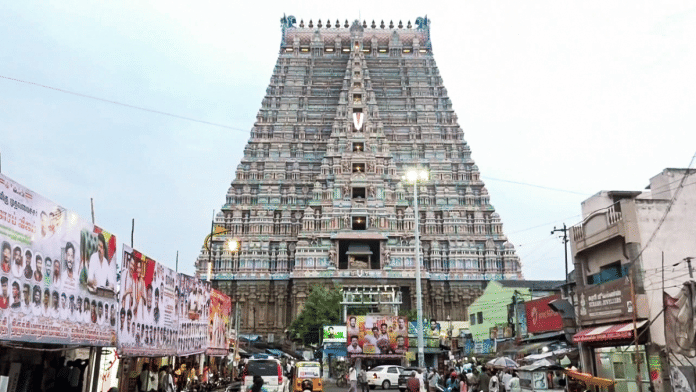
Chennai: The C. Joseph Vijay-led government in Tamil Nadu has made the sixth U-turn in five months—this time relaxing the mobile phone restrictions imposed in major temples just a month earlier.
The latest U-turn comes after criticism of the ban on smartphones in 52 temples across the state. Devotees can now carry their phones inside temple premises, provided the devices remain switched off. Photography, videography, selfies, and social-media content is strictly prohibited in the temples and fines will be imposed in case of violations.
The ban was implemented 1 September 2026, covering temples across the state managed by the Hindu Religious & Charitable Endowment Department (HR&CE). The move was aimed at protecting the sanctity and peaceful atmosphere of places of worship and prevent disturbance to devotees.
The HR&CE Minister S. Ramesh had earlier stated that the aim of banning phones in temples was to stop disruptive activities such as devotees photographing or recording videos of deities and idols inside temples.
The Vijay government wanted to curb unauthorised photography, videography, selfies, and social media content of deities, idols, or temple premises seen as flouting guidelines and commercialising the sacred space.
Vijay’s previous U-turns
On 21 September, a government order was issued classifying the Public (Law and Order) Department as an intelligence body exempt from the RTI Act. Just six days later, the order was withdrawn following strong opposition from allies, the Opposition, and activists.
The first U-turn by Vijay came within a few days of his becoming the chief minister when he withdrew an order appointing his personal astrologer as an Officer on Special Duty in the CMO.
The next U-turn was the cancellation of a circular restricting protests by Left student organisations amid nationwide backlash linked to NEET issues. It was withdrawn after national backlash.
Another decision the government went back on was on land acquisition proceedings for the Melma SIPCOT industrial expansion in Tiruvannamalai after farmer resistance and legal concerns.
Another U-turn by the TVK government involved a circular issued on 18 August 2026 by the Tahsildar of Guziliamparai taluk in Dindigul district directing Village Assistants and Revenue Inspectors to collect the names and addresses of all members and leaders of the Communist Party of India (CPI) and the Communist Party of India (Marxist) in every revenue village, with a warning for action on non-compliance. Since it was linked to a local land dispute involving CPI(M) workers, the order drew strong political criticism and was quickly withdrawn.
These successive reversals have drawn both praise for responsiveness and criticism for hasty decision-making.
After the implementation of the ban on smartphones in temples, devotees were required to deposit smartphones at designated counters near the entrances, paying a Rs 5 fee per device in most cases and receiving a token or receipt for retrieval after darshan. Ordinary mobile phones without cameras were allowed in the temples.
The measure followed existing Madras High Court directions, including a December 2022 Madurai Bench order that was against devotees photographing or recording deities and idols, and mobile phones were already restricted at temples such as those in Palani, Tiruchendur, Madurai, and Rameswaram.
To implement the ban, temple authorities set up lockers or deposit counters staffed by employees or volunteers. As part of the process, details such as the devotee’s photograph, phone model, and number were sometimes registered. An exemption was later granted for pregnant women, those carrying infants, elderly persons, and persons with disabilities. On festival days with heavy crowds, depositing phones was made non-mandatory in some cases. The department left the Rs 5 fee at the individual temple’s discretion.
However, the system quickly ran into practical problems and devotees complained about inadequate locker facilities, long queues for depositing and retrieving phones, especially during peak hours and for visitors from other states and the inability to contact family members or handle emergencies while inside. On the part of temple authorities, managing the counters caused delays and logistical strain for the staff. The opposition from devotees prompted the HR&CE Department to ease the rules.
Under the revised norms, announced 11 October, people may carry phones inside but must keep them switched off. No calls, messages, photography, or video recording is permitted inside temple premises. Temple authorities have put up banners at entrances and are making loudspeaker announcements to inform devotees of the relaxation in the regulations. Meanwhile, security personnel and temple staff will monitor compliance.
Deposit counters remain available for those who prefer to leave their phones outside and a Rs 5 fee applies at some temples such as Vekkali Amman in Woraiyur and Jambukeswarar in Thiruvanaikoil, while the service is free at others including Sri Ranganathaswamy in Srirangam, Samayapuram Mariamman, and Rockfort in Trichy.
(Edited by Viny Mishra)
Also read: Five rollbacks of govt orders in four months. Is bureaucracy driving Vijay’s TVK administration?