





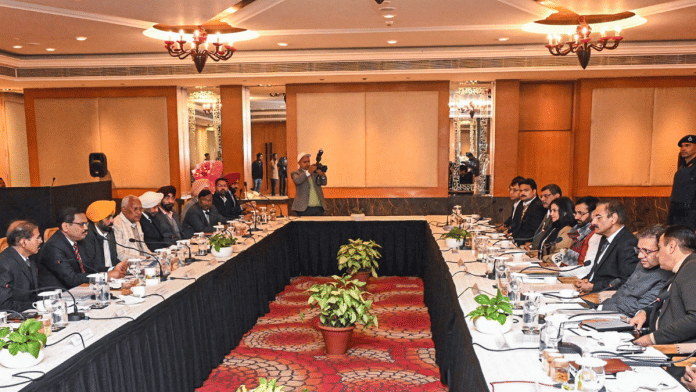



Gurugram: A meeting between Punjab Chief Minister Bhagwant Mann and his Haryana counterpart Nayab Singh Saini ended Tuesday without any breakthrough on the decades-old Sutlej-Yamuna Link (SYL) canal dispute.
The bilateral talks, held at Taj Chandigarh, failed to arrive at any conclusion despite a central government directive for both states to find a mutually acceptable solution.
Emerging from the meeting venue, Saini described the talks as “fruitful” and said he expected a positive outcome in the future.
Mann evoked the historical legacy of Bhai Kanhaiya, a disciple of the 9th Sikh Guru Tegh Bahadur, known for offering water even to enemies wounded in war, to strike a conciliatory tone.
He said Haryana was not an “enemy” of Punjab but its “brother”, while emphasising that water wasn’t just a big dispute at the national level, but was also going to become a major issue at the international level.
Both chief ministers said the meeting would be followed by talks between officials of the two states.
When a journalist asked Mann why Punjab was hesitant to arrive at a solution when the meeting was about the construction of the SYL canal and not about water sharing, Mann asked him mockingly, “What will flow in the canal? Juice?”
He then told the media with a smile, “Sorry, I don’t have any breaking news for you today.”
The sense of déjà vu was evident.
Exactly 40 years ago on this very day—27 January 1986—the then chief minister of Punjab and Haryana, Surjit Singh Barnala and Bhajan Lal, sat across the table, the then Union Home Minister S.B. Chavan present, attempting to resolve a related but equally intractable territorial dispute: the transfer of Hindi-speaking villages from Punjab to Haryana in exchange for Chandigarh.
That 75-minute meeting ended in a similar impasse. No villages were transferred. Chandigarh remains a Union Territory.
The territorial commission tasked with identifying contiguous Hindi-speaking areas had stumbled upon an unexpected obstacle—a single village called Khandu Khera, whose residents insisted they spoke Punjabi.
In a house-to-house mini census ordered by the Mathews Commission, enumerators, closely watched by observers from both states, found that 91.9 percent of residents had registered their language as Punjabi.
This one village sat on the border between the Hindi-speaking belt of Abohar-Fazilka and Haryana, breaking the territorial contiguity required by the Rajiv-Longowal Accord.
Also Read: ‘This wealth is Himachal’s, we deserve rightful share,’ says CM Sukhu amid Punjab-Haryana water row
The shadow of the Rajiv-Longowal accord
Both the issue discussed today and the one debated 40 years ago (i.e., SYL and transfer of territory and villages) trace their lineage to the same source—the Rajiv-Longowal Accord of 24 July 1985.
That memorandum of settlement, signed between Prime Minister Rajiv Gandhi and Akali Dal president Sant Harchand Singh Longowal, was meant to end militancy and resolve Punjab’s longstanding grievances.
The accord promised Chandigarh to Punjab by 26 January 1986, in exchange for Hindi-speaking villages being transferred to Haryana.
It also mandated the setting up of the Eradi Tribunal to adjudicate water-sharing claims between Punjab and Haryana regarding the Ravi and Beas rivers, the very waters at the heart of the SYL canal dispute today.
Less than a month after signing the accord, Sant Longowal was assassinated by Sikh militants on 20 August 1985.
Since then, no government has resumed construction of the canal. When the 26 January deadline passed without Chandigarh being transferred, the accord effectively became a dead letter.
Today, four decades later, it continues to influence the politics of northern India.
A dispute with no end in sight
The SYL canal was conceived under the 1981 Water Accord to provide Haryana’s allocated 3.50 million acre-feet of Ravi-Beas water.
Of the canal’s total length of 214 km, 122 km fall within Punjab territory and remain unconstructed. Punjab’s consistent position has been unequivocal: it has no surplus water to share.
In 2004, the Punjab Assembly passed the Punjab Termination of Agreements Act, unilaterally cancelling the 1981 accord. The Supreme Court struck down this legislation in 2016, reaffirming that Punjab was bound by the original agreement.
Yet, the canal remains incomplete, and no political party in Punjab has restarted construction.
Following the Supreme Court’s directions, the Central government facilitated five rounds of bilateral talks between the two states since last year. Union Water Resources Minister C.R. Patil presided over meetings on 9 July and 5 August last year, but neither yielded any progress.
In November, during a Northern Zonal Council meeting in Faridabad, Union Home Minister Amit Shah shelved all river water disputes.
In a letter to both chief ministers last year, Patil made the Centre’s position clear: Punjab and Haryana should resolve the SYL dispute through direct dialogue, with the Centre providing support only if required. This marked a significant shift from the Centre’s earlier approach.
The echoes of 1986
At the 27 January 1986 press conference, after the failed meeting with S.B. Chavan, then Chief Minister Barnala made a counter-claim. He announced that Punjab would claim 1,000 Punjabi-speaking villages in Haryana’s Sirsa, Hisar, Kurukshetra, and Ambala districts before the second territorial commission.
Barnala’s message was clear: if linguistic and territorial reorganisation was back on the table, Punjab had as much to claim as to concede. The Central government never set up that second commission. Barnala’s claim of 1,000 villages remains a footnote in history.
Three commissions—Mathew, Venkataramiah and Desai—tried and failed between 1985 and 1986 to find a formula for territorial exchange.
The Mathew Commission did not reach a conclusion because of Khandu Khera. The Venkataramiah Commission recommended transferring 70,000 acres, but Punjab and Haryana couldn’t agree on which land. The Desai Commission was boycotted by Punjab, and then its term ended.
The cost of stalemate
Haryana argues that the SYL canal is essential for its agricultural survival and that it is merely seeking what was promised under a legally binding agreement. Punjab counters that its groundwater levels have plummeted, its own agricultural needs have grown, and sharing water it doesn’t have would be an act of economic suicide.
The Tuesday meeting in Chandigarh demonstrated that 40 years of negotiations, commissions, the Supreme Court orders, and bilateral talks have not yielded any results.
The SYL canal remains unbuilt. Chandigarh remains a Union Territory. And two chief ministers left the table exactly as their predecessors did four decades ago, with both sides entrenched in their positions.
(Edited by Sugita Katyal)
Also Read: Should Goa share Mhadei waters? A living river can’t be divided like property