





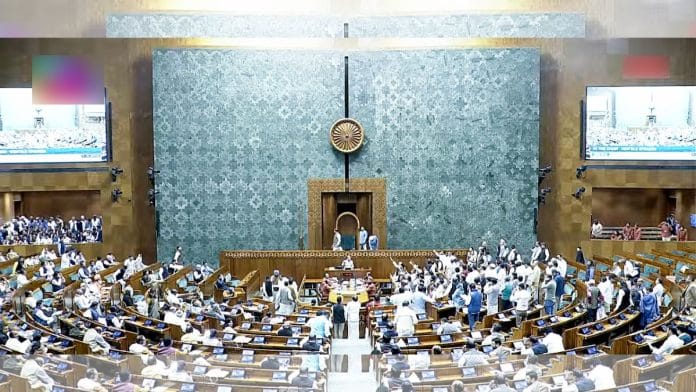


New Delhi: The Opposition has moved a resolution seeking the removal of Lok Sabha Speaker Om Birla, bringing renewed attention to the constitutional provisions governing the removal of presiding officers of Parliament.
While the Constitution allows the Lok Sabha Speaker to be removed through a resolution of the House, such motions have been rare in India’s parliamentary history, and none has ever succeeded.
The result of this motion, however, concerns the Speaker and isn’t a no-confidence motion against the ruling party.
As a result, while the Constitution provides mechanisms to ensure accountability of presiding officers, the outcome of such motions has typically been determined by the numerical strength of the ruling party or coalition in Parliament.
Elected typically by the majority party in the House, the Speaker is expected to be impartial and does not vote except in the event of a tie.
BJP member Birla, currently in his third elected term as MP from Rajasthan’s Kota, was first elected as Speaker of Lok Sabha in June 2019. This was followed by his re-election for a second term in June 2024.
A total of 118 MPs signed the resolution against Birla, accusing him of “openly espousing the version of the ruling party on all controversial matters”.
Congress MPs accused the Speaker of partisan conduct and levelling “unwarranted allegations” against women MPs from the Opposition parties, triggering a political spat on X.
In its notice, the Congress-led Opposition sought to indict Om Birla on four counts: Disallowing the LoP from finishing his speech on the motion of thanks to the President’s address, suspending eight Congress MPs, allowing a BJP MP’s objectionable attacks on Jawaharlal Nehru and Indira Gandhi, and accusing Congress MPs of planning an attack on Prime Minister Narendra Modi.
The process for the removal of the Lok Sabha Speaker is governed by Article 94(c) of the Constitution, which says that the Speaker may be removed by a resolution of the Lok Sabha passed by a majority of all the then members of the House.
It starts with a written notice of the resolution that must be given at least 14 days in advance. The notice is submitted to the Secretary-General of the Lok Sabha.
Then, for the motion to be admitted for discussion, at least 50 Members of Parliament must support it. If the number isn’t met, the motion is not taken up for consideration.
Once admitted, a debate is scheduled on the resolution. During this debate, the Speaker cannot preside over the proceedings. Instead, the Deputy Speaker or another member designated by the House presides over the sitting.
The Speaker has the right to participate in the debate, but cannot exercise a casting vote.
If the motion succeeds, the Speaker is removed from the constitutional office and only remains a member of Parliament.
Also Read: Congress, TMC find common ground—motions to remove LS Speaker Om Birla, CEC Gyanesh Kumar
Past attempts to remove the Speaker
Resolutions seeking the removal of a Lok Sabha Speaker have been moved twice in the past.
The first was in 1954 against G.V. Mavalankar, India’s first Lok Sabha Speaker. The motion was debated but ultimately defeated in the House.
In 1987, a motion seeking the removal of Balram Jakhar was moved, debated and eventually defeated.
An attempt in 1966 to bring one against Sardar Hukam Singh did not fructify as the Opposition failed to rustle up the minimum support required on the floor.
With none of these motions succeeding, no Lok Sabha Speaker has ever been removed through the procedure.
While the Constitution doesn’t provide specific grounds for initiating proceedings against the Speaker, historically, it’s been done on allegations of partisan conduct and a lack of confidence.
Rajya Sabha: A different constitutional framework
Compared to removing a Lok Sabha Speaker, the threshold for the removal of the Rajya Sabha Chairman is much higher as it requires approval from both Houses of Parliament.
Article 67(b) governs the process for removing the presiding officer of the Rajya Sabha, who is also the Vice-President of India.
Here, the Chairman can be removed by a majority resolution of the Rajya Sabha. The resolution must then be agreed to by the majority in the Lok Sabha. At least 14 days’ notice must be given before moving the motion.
In India’s parliamentary history, such attempts have been even rarer.
It was only in 2024 that Opposition parties first submitted such a notice and sought the removal of Chairman Jagdeep Dhankhar, accusing him of partisan conduct in the House.
The motion did not proceed to a vote and was rejected on procedural grounds only.
(Edited by Sugita Katyal)
Also Read: In a first since 1987, Oppn seeks to remove Speaker, accuses Om Birla of being ‘blatantly partisan’