



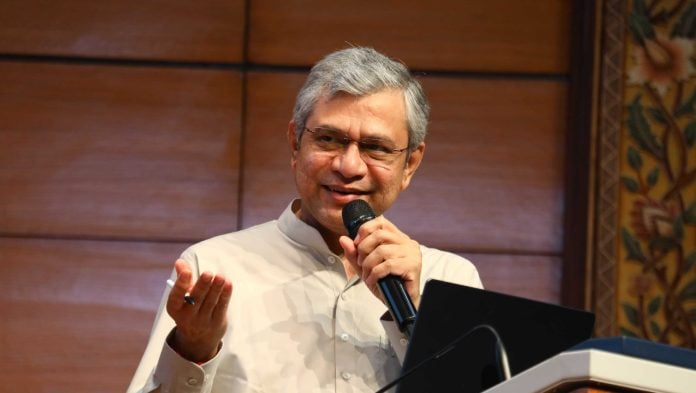
New Delhi: Union Minister for Electronics & IT and Information & Broadcasting Ashwini Vaishnaw Wednesday said he would meet editors on the Digital Personal Data Protection (DPDP) Act, 2023, a day after the Supreme Court sought the Centre’s response to a petition by the Digital News Publishers’ Association (DNPA) challenging the law.
“Please tell your editors that I would like to meet all of them in a proper scheduled meeting,” Vaishnaw told reporters at the Cabinet briefing.
“When the Constitution has a press freedom guarantee, no law can override it,” he said. “Journalistic freedom has been guaranteed by the Constitution. There is no intention to affect journalistic practices… The privacy law maintains the journalistic freedom that the Constitution guarantees.”
Citing the Supreme Court’s 2017 judgment in the Justice K. S. Puttaswamy (Retd) vs Union of India, which held privacy to be a fundamental right, Vaishnaw said the law “is in tandem with the Supreme Court judgment… The Supreme Court judgment, in a sense, has been converted into law by Parliament.”
Vaishnaw said press freedom had been raised at the start of the legislative process. “One of the first questions asked in the JPC was what will be the freedom of the press,” he said, referring to the Joint Parliamentary Committee that examined the Personal Data Protection Bill, 2019, the predecessor of the current law.
On the consultation for the DPDP Act, Vaishnaw said, “When consultation took place, all media was a part of the consultation. The provisions were very clearly explained. Nowhere do they infringe upon the freedom of the press, journalism and media.”
He said the government had addressed the concerns of the Editors’ Guild of India. “When the Editors’ Guild raised this question, we explained to them that nothing will get in the way, but they are still raising problems,” he said. “Our intent is clear. There is no khot (flaw) in it,” Vaishnaw said.
Referring to what he called the “extreme Left”, Vaishnaw said, “They didn’t think we would agree to the right to privacy, and that the BJP would make up some excuse. They would say we are lying about the law. Then they started opposing the rules, and now, when it is time to enforce DPDP, they are going out and about and want a stay on the right to privacy.”
Vaishnaw said the government was “open to suggestions” and would “act accordingly”.
The petition
On Tuesday, the Supreme Court sought the Centre’s response to the DNPA petition, which argues that the absence of an exemption for journalism in the DPDP Act and its rules could hamper investigative reporting. The court declined to stay the DPDP Act without hearing the government and listed the matter for 17 November.
The DNPA comprises the digital wings of 21 news organisations, including The Indian Express, The Hindu, India Today, Times Group, Zee, NDTV and Network 18.
Senior advocate Madhavi Divan, appearing for the DNPA, argued that certain provisions would enable a “complete regime of pre-censorship” if journalists had to obtain prior consent from their sources or the subjects of their stories before publication. The association told the court that newsrooms would shut down if journalists were made to seek permission before publishing information.
The petition says the DPDP Act and rules could restrict reporting by requiring journalists to comply with provisions on notice, consent, withdrawal of consent and erasure of personal data. It argues that the DPDP Act carries no written exemption for journalism, unlike data protection laws in the European Union, Singapore and the United Kingdom, and notes that earlier versions of the legislation had such exemptions.
The petition challenges Section 36 of the DPDP Act, read with Rule 23, and questions the constitution and powers of the Data Protection Board of India. The DNPA has separately challenged Section 44(3), which amends Section 8(1)(j) of the Right to Information Act, 2005, to allow public information officers to withhold information which relates to personal information.
According to the petition, the DNPA submitted a representation to the ministries of Information and Broadcasting and Electronics and IT on 10 August 2026.
Earlier objections
In August 2023, the Editors’ Guild of India said the Bill lacked exemptions for journalism, and that under Section 36, the government could ask any data fiduciary to furnish personal information of citizens, including journalists and their sources.
In June 2025, the Press Club of India and 21 media bodies submitted a memorandum to Vaishnaw, signed by more than 1,000 journalists and photojournalists, seeking that the professional work of journalists be excluded from the DPDP Act.
The government notified the DPDP Rules on 14 November 2025, after a consultation that received 6,915 inputs. The substantive provisions of the Act and Rules come into force on 14 May 2027.
(Edited by Viny Mishra)
Also read Explainer: Why news publishers challenged data protection law in SC