





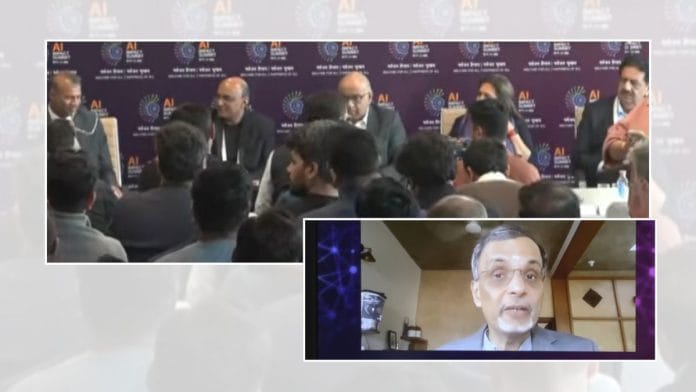

New Delhi: Artificial Intelligence must be deployed such that it strengthens employment rather than sidelines workers, according to speakers at the ‘Future of employability in the age of AI’ session at the ‘AI Impact Summit 2026’.
During discussions Monday at the Ministry of Electronics and Information Technology (MeitY)-hosted summit scheduled in New Delhi’s Bharat Mandapam from 16 to 20 February, the speakers placed the spotlight firmly on skills, education, and policy coordination.
Chief Economic Adviser to the Government of India V. Anantha Nageswaran said that the direction AI takes in India will depend on deliberate national choices. Technology adoption, he argued, can not be left to evolve on its own if the country wants to safeguard growth and social stability.
“This will not happen by drift. It will require political will, state capacity and a clear national commitment to aligning technological adoption with mass employability,” he said.
His remarks echo a broader political consensus that has been building in recent years.
Prime Minister Narendra Modi has repeatedly said that while technology changes the nature of work, investment in skilling and re-skilling will determine whether it becomes a threat or an opportunity. Also, in the Union Budget this year, Finance Minister Nirmala Sitharaman proposed the setup of a committee to assess the impact of AI and emerging technologies on employment, as well as recommend ways to optimise job creation.
Nageswaran pointed to India’s young and expanding workforce as both an opportunity and a warning.
Millions enter the labour market each year, but only a small share have received formal skills training, he noted. Without closing that gap, which he suggested, the demographic dividend could turn into a structural vulnerability, he said. He called for coordination among the government, industry, and academia to strengthen foundational education, scale high-quality training, and remove regulatory bottlenecks.
Industry leaders at the session said that the early evidence does not support the sweeping fears of mass lay-offs, even though the nature of work is changing.
Sanjeev Bikhchandani, the founder of Info Edge, whose offerings range from the flagship employment website naukri.com to real estate classifieds platform 99Acres.com, among others, said new technologies have historically raised anxieties about job losses, but productivity gains usually follow.
Bikhchandani said AI is currently being used within companies to improve efficiency and reach underserved markets rather than replace employees.
“If you don’t do AI, AI will be done to you,” he warned, urging young professionals to focus on learning practical tools.
Automation could significantly alter existing roles, particularly in IT services, where repetitive tasks were very common, Vineet Nayar, the CEO of HCL Technologies from 2007 to 2013, said. While some roles might shrink, he argued that new ones would emerge, especially through start-ups and new business models.
Now leading the Sampark Foundation, an NGO that partners with states to deploy affordable learning technologies in rural schools, Nayar said the education system must shift to problem-solving and creativity to prepare students for the transition.
The emphasis on skilling aligns with projections made by NITI Aayog, which has argued that AI could generate millions of new roles by the end of the decade, if backed by large-scale investment in training and digital literacy. The government’s policy think tank has recommended a national push to build AI talent and embed basic AI literacy across sectors, warning that routine and low-skill roles are most at risk if re-skilling efforts are lagging.
The question—speakers suggested—is no longer whether AI will reshape jobs, but whether India can move fast enough to ensure that the reshaping works in favour of its vast workforce.
(Edited by Madhurita Goswami)
Also Read: iPhone wasn’t the first touchscreen phone. Steve Jobs was good at stealing great ideas