





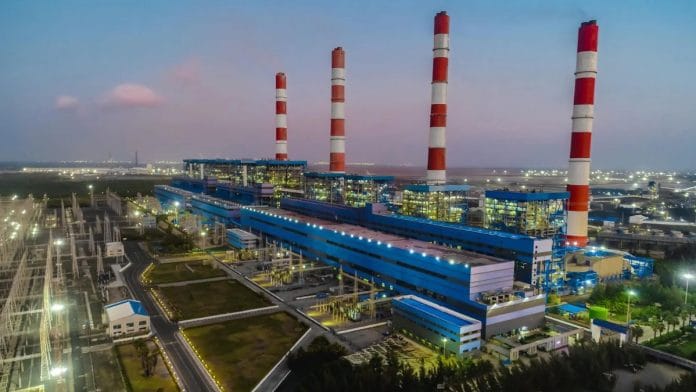



Gurugram: The Haryana government has constituted a high-powered committee to resolve its years-long dispute with Adani Power Ltd over electricity supply from the Mundra thermal plant.
The move comes after repeated supply breakdowns, years of litigation and mounting concerns over tariffs, despite Haryana’s long-term power purchase agreement (PPA) with the company.
The three-member panel, headed by former Supreme Court judge Justice Krishna Murari, has been given six months to study the origins of the agreement, the circumstances that led to the dispute and possible pathways for a negotiated settlement.
A senior Haryana government official confirmed the development when contacted by The Print on Tuesday.
The original deal
Interestingly, the original PPA for 25 years was signed between Adani Power and the Haryana government when the Congress government led by Bhupinder Singh Hooda was in power.
However, repeated breakdowns in power supply and alleged breaches of contracts have been reported on the heels of the BJP coming to power in 2014.
A former Haryana Power Department official, who requested anonymity, told ThePrint that in 2008, Haryana’s two distribution companies, the Uttar Haryana Bijli Vitran Nigam and the Dakshin Haryana Bijli Vitran Nigam, signed power purchase agreements with Adani Power for 1,424 MW of electricity from its Mundra plant in Gujarat.
The PPAs were awarded for 25 years through competitive bidding under Section 63 of the Electricity Act.
The contracted rate for the power was Rs 2.94 per unit. Adani Power’s bid was premised on sourcing 70 percent of its coal domestically and 30 percent through imports from Indonesia.
Units 7, 8, and 9 of the Mundra plant, with a combined capacity of 1,980 MW, were earmarked for this supply.
Also Read: If there’s one Gujarat model we must replicate, it’s the power sector reforms one
When Indonesia changed the game
However, the initial period of cooperation didn’t last long.
Adani Power approached the Central Electricity Regulatory Commission (CERC) in 2012, when the company argued that a change in Indonesian regulations had hiked the cost of coal imports, and that constituted a “change in law” event under the PPA, which allowed it to hike tariffs.
Adani Power sought either relief from the agreement on grounds of “force majeure”, or unforeseen circumstances that prevent someone from fulfilling a contract, or a compensatory tariff to cover the increased costs.
The CERC initially directed both parties to form committees towards a settlement. When that failed, the matter went to the Supreme Court.
In its 2017 judgment, the apex court ruled that changes in Indonesian coal regulations did not qualify as “force majeure” or change in law events that would allow Adani Power to exit the PPAs or revise tariffs unilaterally.
The Supreme Court ruled that the company had entered into a competitive bid knowing the risks of fuel imports, and it couldn’t now seek relief on that basis.
However, by this time, changes had been made in the domestic coal policy, with the New Coal Distribution Policy of 2013 restricting the allocation of domestic coal to coastal power plants, such as Mundra. The policy forced power plants to rely more on costlier, imported coal to bridge supply gaps.
The supply stops, the crisis deepens
Things came to a head in late 2020. Adani Power began defaulting on the contracted supply to Haryana, citing the financial unviability of the PPA at Rs 2.94 per unit.
By April 2022, the company had stopped supplying power to the state for over six months when demand was at its peak in the summer. Haryana then had to purchase power from alternative sources at a much higher price.
Under a supplementary agreement signed in 2023, Haryana was to receive only 1,096 MW, down from the original 1,424 MW.
The two sides agreed that the discoms would now be supplied only 70 percent of the contracted power, but with a revised tariff of Rs 3.20 per unit. However, even this didn’t resolve matters.
The All India Power Engineers Federation (AIPEF) alleged in its complaints to the Central and state governments in 2022 and 2023 that Adani Power continued to underperform on supply commitments.
The federation also alleged that units at the Mundra plant were operating below capacity, and some were being intermittently shut down.
There were also allegations by the AIPEF, denied by the company, that power contracted for Haryana was being diverted to Gujarat during peak demand periods, including during elections.
The federation claimed that transmission lines meant to carry electricity from Mundra to Haryana were operating in reverse.
The Haryana Power Purchase Centre put forward a claim of Rs 2,436 crore against Adani Power for non-supply and the additional costs incurred in procuring electricity from alternative sources at higher rates during high-level discussions. Adani Power, in turn, demanded the withdrawal of all pending cases and claims related to the original PPA.
On 30 January, the Haryana government issued a notification constituting the three-member committee to break the deadlock.
The terms of the committee’s constitution empowered it to examine all documents related to PPAs with the Mundra plant, particularly units 7, 8, and 9. The committee will analyse and ascertain the actual hardship faced by Adani Power and the costs incurred for delivering power to Haryana.
Under the notification, the committee would evaluate the rights and obligations of both parties regarding the PPA payment security mechanism, as well as assess the PPA’s viability with the existing tariff structure, and suggest measures to ensure long-term viability.
The notification mandated that the committee find an amicable solution to all pending claims and counterclaims while examining whether there are other measures to reduce the cost of generation.
The committee is chaired by Justice Krishna Murari, who retired from the Supreme Court in 2024. The other members are S.S. Dubey, former chairman of the Central Electricity Authority, and T.C. Gupta, retired chairman of the Haryana Electricity Regulatory Commission. The chief engineer of the Haryana Power Purchase Centre has been designated as the nodal officer to facilitate the committee’s work.
(Edited by Sugita Katyal)
Also Read: India produces enough power to meet its demand. Now, it needs a net-zero revolution