





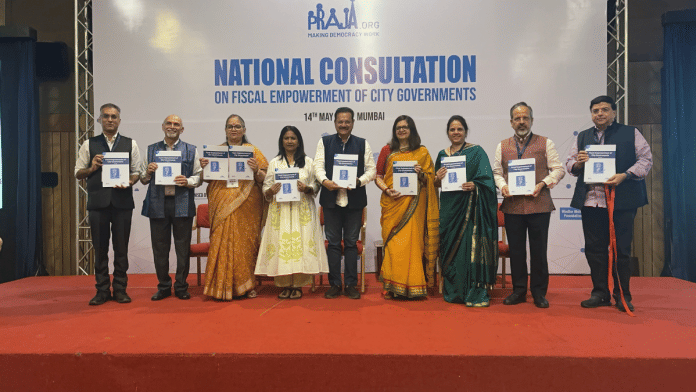


Mumbai: India’s urban local bodies are heavily dependent on state and central grants, while their own revenue has dwindled over the years, accounting for only a limited share of total municipal income, says a report released Thursday by the Praja Foundation.
The Mumbai-based non-profit organisation’s report, ‘National Consultation on Fiscal Empowerment of City Governments’, analysed municipal finances across 43 cities in 28 states and two Union Territories between 2017-18 and 2025-26.
It was prepared in collaboration with the National Institute of Urban Affairs (NIUA) and under the guidance of the Ministry of Housing and Urban Affairs (MoHUA). “City governments remain heavily dependent on intergovernmental transfers. The average share of state government grants to total income across 37 cities is 42.30 percent, while central government grants account for 17.02 percent,” Praja Foundation CEO Milind Mhaske said in the report.
Patna was the most dependent on state grants, with 74.05 percent of its income coming from state transfers, followed by Nagpur at 69.71 percent.
Between 2016 and 2023, excluding Mumbai, Municipal Own-Source Revenue (MOSR) accounted for only 36 percent of total receipts. Across the 42 cities studied, except Mumbai, total grants and transfers contributed 61 percent of total municipal receipts. State transfers accounted for 45 percent and central transfers for 16 percent.
Mumbai recorded an average OSR share of 67.71 percent of total income. Among big cities with populations above 30 lakh, Delhi recorded the highest OSR share at 61.35 percent, followed by Hyderabad at 58.61 percent.
Among mid-sized cities with populations between 10 and 30 lakh, Vishakhapatnam topped with an OSR share of 54.94 percent and was the only city in this category to cross 50 percent. Agartala, among smaller cities with populations below 10 lakh, recorded the lowest OSR share at 14.73 percent.
“An analysis of the finances of 43 city governments shows that while MOSR has broadly kept pace with the country’s nominal GDP growth, cities continue to remain heavily dependent on government grants, which account for nearly 60 percent of their revenues,” urban finance and management specialist Ravikant Joshi said at the report launch.
“While property tax collections are comparable to national averages, the share of other taxes and non-tax revenues remains significantly low.”
Property tax collection challenge
The report found that property tax remained the single largest component of municipal revenue, but its overall contribution was modest. In 37 out of the 43 cities studied, property tax revenue accounted for an average 14.4 percent of total municipal income.
Among larger cities, Chennai recorded the highest Nominal and Real Property Tax CAGR at 14.67 percent and 9.76 percent, respectively, after revising property tax rates in 2022. Kolkata recorded the lowest at –1.27 percent and –5.50 percent, indicating a decline in collections.
CAGR, or Compound Annual Growth Rate, refers to the average yearly growth rate. Nominal property tax CAGR measures growth in actual tax collections, while real property tax CAGR measures growth after adjusting for inflation.
Among smaller cities, Dehradun recorded the highest Nominal and Real Property Tax CAGR at 22.70 percent and 17.44 percent, respectively, aided by GIS-based property mapping that expanded its taxable base. Dharamshala recorded the lowest growth at –2.46 percent and –6.64 percent, respectively.
“Property tax remains the single largest contributor to municipal revenue, but collection and recovery continue to pose persistent difficulties. While the middle class pays its dues, it is difficult to collect these taxes from both the rich and the poor,” Lucknow mayor Sushma Kharakwal said at launch of the report.
“Despite cities being expected to function as self-governing institutions, municipal corporations still remain financially dependent on state and central government support for carrying out basic infrastructure and civic projects. Own-source revenue generation is one of the biggest challenges for local governments today,” she added.
Alternative solutions
Chandradeep Kumar, Assistant Municipal Commissioner of Ranchi, shared a model the city adopted for housing property tax collection.
“According to the 2011 Census, Ranchi has a population of 10 lakh people. It’s an agrarian population. To rid ourselves of the constant issue of collection, we established a revenue-sharing model in 2016, as part of a public-private partnership,” he said.
This model is a fully digitised system that entails self-assessment by property owners of the area, as well as other calculations pertinent to each land they own, via a portal on the corporation website.
“Around 7 percent of the revenue was shared with the agency in the partnership. They were assigned the task of assessment of data, revenue collection, reviewing the self-assessment forms and digitising it,” Kumar added.
At the discussion about the challenges faced by cities, Sofia Dahiya, Principal Chief Controller of Accounts, MoHUA, stressed the need for cities to explore innovative and alternative revenue sources beyond traditional grants and taxes.
“Municipal bonds should not be issued blindly for any random project. They have to be need-based and tied to the right kind of infrastructure projects that can generate long-term value for the city,” Dahiya said. “Cities must build financial discipline and project credibility before turning to debt-based financing mechanisms.”
Dahiya also highlighted the growing importance of green financing mechanisms, particularly green bonds, for climate-resilient urban infrastructure projects. “Green bonds can help cities access new pools of investment while simultaneously addressing environmental and sustainability goals,” she said.
Echoing the potential of such financing models, Shiny Mathew, former Town Planning Standing Committee Chairperson of the Kochi Municipal Corporation, said her city is already exploring a canal rejuvenation project through green bonds.
“We are looking at canal rejuvenation through green bonds as a sustainable financing model,” she said, pointing to increasing interest among urban local bodies in environmentally linked infrastructure financing.
(Edited by Sugita Katyal)
Also Read: What ails governance in India’s cities? Heart of problem lies in mayor’s office, says NITI Aayog