





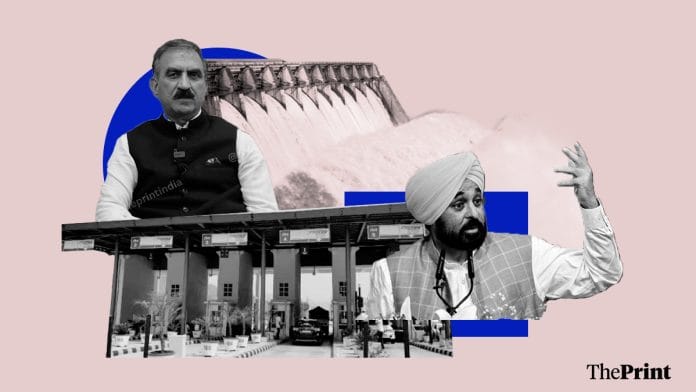



Shimla: Punjab and Himachal Pradesh—neighbours that often call themselves brother states—are now squabbling over money at the border. The latest flashpoint is Himachal’s decision to more than double entry fees for vehicles from other states starting 1 April, prompting Punjab to consider retaliating with a similar levy on vehicles registered in Himachal Pradesh.
In the Punjab Assembly Wednesday, Finance Minister Harpal Singh Cheema told the House the AAP government was looking into the option. He was answering a question from Rupnagar MLA Dinesh Chadha, who asked if Punjab planned to copy Himachal’s model.
Cheema said they would study it carefully, perhaps through local bodies near the border. But he didn’t hide his irritation. “Under the ‘One Nation, One Tax’ theory, no state can impose any tax on another state,” he said. “But it is sad to say that the Congress government in Himachal Pradesh raised an entry tax on vehicles from other states from Rs 70 to Rs 170 per vehicle,” adding that most Punjabis travel to the neighbouring state often.
The minister described it as a desperate step by a state in bad financial shape, with employees’ dearness allowance frozen and no new recruitments.
The response from Himachal Pradesh came the very next day. At a public meeting in Kutlehar assembly segment—on the border with Una district—Deputy Chief Minister Mukesh Agnihotri, speaking in front of Chief Minister Sukhvinder Singh Sukhu, didn’t mince words.
“We are Pahadi but we are not afraid of anyone. No one should try to scare us,” he said.
He then rattled off the bigger issues: “Himachal deserves Rs 5,000 crore in arrears from Bhakra Beas Management Board (BBMB). You have no right on Shanan Hydropower Project since it was never Punjab’s share, despite that you have occupied it. We have 7.19 percent share in Chandigarh, but you don’t want to talk about it. We consider Punjab as an elder brother but it does not mean you go on saying anything in your state assembly.” He asked Sukhu to take note.
Himachal’s revised toll policy for 2026-27 was notified in mid-February under the Himachal Pradesh Tolls Act, 1975.
From 1 April, private cars, jeeps and light motor vehicles registered outside the state will pay Rs 170 instead of Rs 70. Mini-buses and light commercial vehicles will pay up to Rs 320, three-axle trucks up to Rs 600. Himachal-registered vehicles remain exempt.
The state says the measure is aimed at managing tourist traffic and bringing in much-needed revenue—especially after the central government stopped the revenue deficit grant, leaving a hole of around Rs 10,000 crore, as Agnihotri mentioned in February.
This isn’t just about tolls, though. The two states have been at odds for years over bigger issues.
The Shanan Hydropower Project (110 MW) in Jogindernagar, Mandi, tops the list. It started with a 99-year lease in 1925 between the Raja of Mandi and British Punjab. The lease ended 2 March 2024. Himachal wants control back, saying the land and water are theirs. Punjab points to the 1967 central notification under the Punjab Reorganisation Act that gave it the project.
The Centre ordered status quo on 1 March 2024, under Sections 67 and 96. Punjab went to the Supreme Court in September 2024 for a permanent injunction; Himachal contested it. The case is still pending, status quo continues. In 2023, Punjab’s then Power Minister Harbhajan Singh visited the site and said on record, “Punjab is committed to the upkeep and maintenance of the project.”
Then there are the BBMB arrears. Himachal claims about Rs 5,000 crore as its 7.19 percent share in BBMB projects like Bhakra, Pong and Beas-Sutlej Link. Sukhu has said repeatedly that dam projects like Kishau and Renuka won’t move forward without written assurances on payment, even after Supreme Court nods in Himachal’s favour years ago.
On top of that, Himachal notified a 2 percent annual land revenue cess in December 2025 on BBMB hydel land under the HP Land Revenue Act, 1954. It adds up to roughly Rs 500 crore a year for BBMB—Rs 227 crore on Bhakra, Rs 59 crore on Pong, Rs 147 crore on Beas-Sutlej Link.
Punjab called it baseless and illegal. Water Resources Minister Barinder Kumar Goyal said in January it was a “brazen assault on federal principles” and would burden Punjab by another Rs 200 crore annually. BBMB objected formally, calling it ultra vires.
Social and cultural tensions have flared up too, especially last year.
In March 2025 a dispute broke out in Manali and Manikaran in Kullu district when locals in Himachal asked some Punjab tourists on motorcycles and vehicles to remove flags showing Jarnail Singh Bhindranwale’s photo. Some Himachalis said the flags were political and linked to separatism, while the tourists and Sikh groups insisted they were purely religious symbols.
The arguments escalated, and one Punjab tourist allegedly attacked a local youth with a sword in Manikaran after being told to take the flag down, and a local hotelier named Aman Sood was even summoned to court for allegedly disturbing peace and religious harmony.
Activists from Dal Khalsa and Sikh Youth of Punjab in Hoshiarpur and other places pasted Bhindranwale posters on Himachal Road Transport Corporation buses and some private ones heading towards the hills.
Several HRTC buses were vandalised in Punjab—windows smashed at the Amritsar stand, stones pelted on a Jalandhar-Manali bus at Sirhind and pro-Khalistan slogans scribbled on others.
HRTC suspended services on 10 routes to Punjab indefinitely and stopped overnight parking of its buses in Punjab until safety was guaranteed. Deputy Chief Minister Mukesh Agnihotri told the Himachal Assembly at the time, “We are in touch with Punjab authorities. Punjab is our big brother and we will resolve the issue amicably.”
He added that locals had “no issue with the Nishan Sahib and other religious flags, which are respected by all,” but stressed, “safety of passengers and staff is our priority”.
Chief Minister Sukhvinder Singh Sukhu said he had spoken directly to Punjab Chief Minister Bhagwant Mann and that “Bhagwant Mann has vowed to act”; he assured the House the matter “would be resolved amicably between the two states and the law and order situation would not be allowed to deteriorate”.
A senior Himachal Pradesh government official told ThePrint, “Punjab is our neighbouring state and so any disputes with a neighbour is never a good thing for anyone. Both states need to sit at a table instead of battling it out in public rallies or the state assembly.”
Himachal Pradesh and Punjab emerged from the reorganisation of British Punjab after Independence. Himachal was formed on 15 April 1948 by merging princely hill states and areas into a Chief Commissioner’s Province, becoming a Union Territory in 1956. Punjab was reshaped by the Punjab Reorganisation Act, 1966 (effective 1 November 1966), creating a Punjabi-speaking Punjab, separating Haryana, and transferring hilly districts (Shimla, Kangra, Kullu, Lahaul-Spiti, parts of Una) to Himachal, which gained full statehood on 25 January 1971.
They share a 400–500 km border and major rivers like Beas (from Rohtang Pass), Sutlej (Kinnaur-Bilaspur), and Ravi (Chamba) that flow from Himachal’s Himalayas into Punjab’s plains, supporting irrigation and hydropower. Sikh heritage ties them through sites like Gurudwara Paonta Sahib, Manikaran Sahib, and Rewalsar, linked to Guru Nanak and Guru Gobind Singh.
(Edited by Viny Mishra)
Also read: Key grant cut, cash-strapped Himachal slaps a hydropower land cess. Why Punjab is seeing red