






New Delhi: From Bangalore Urban district in Karnataka to Lucknow in Uttar Pradesh, urban centres in many states are witnessing a higher percentage of deletions under the Special Intensive Revision (SIR) exercise. According to experts, this primarily owing to higher migration to these areas, and mapping issues.
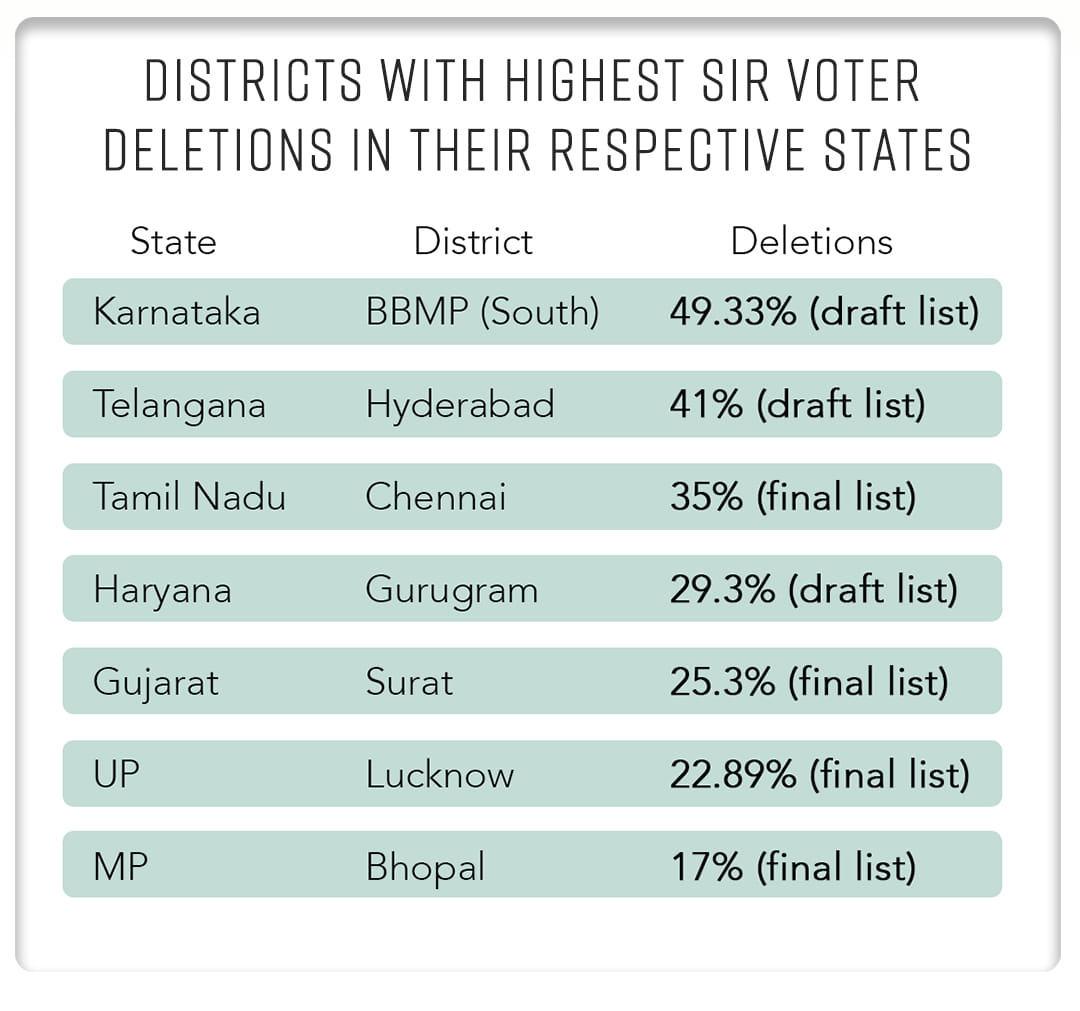
The latest example was visible in the draft electoral roll for Karnataka, published on Monday. Bruhat Bengaluru Mahanagara Palike, or BBMP, (South) saw 49.33 per cent deletion under the ‘ASDDO’ category (10.58 lakh), followed by 45.54 per cent deletion in BBMP (Central) (8.60 lakh), 45.12 per cent deletions in BBMP (North) (10.52 lakh), and 42.71 per cent deletions in Bangalore Urban (17.17 lakh). ‘ASDDO’ refers to voters which have been marked as absent, permanently shifted, dead, duplicate or others.
Similarly, Lucknow saw the highest deletions—9.14 lakh, amounting to 22.89 per cent—in Uttar Pradesh in the final electoral roll published in April. In Gujarat’s final voter roll published in February, Surat saw the highest percentage deletion of 25.3 per cent (12.65 lakh), followed by Ahmedabad at 21.5 per cent deletions (13.5 lakh). In Tamil Nadu, Chennai had the highest percentage of deletions at around 35 per cent, while Bhopal saw detention of around 17 per cent in the Madhya Pradesh SIR.
Meanwhile, 29.3 per cent voters in Haryana’s Gurugram were deleted from the draft electoral roll published last month, while Hyderabad saw a 41 per cent drop in voters in the draft voter list released earlier this month in Telangana.
“Traditionally, urban metros have this problem because they have a lot of migration. It is not a surprise if the number of deletions in these urban areas is more (as compared to rural areas),” former Chief Election Commissioner S.Y. Quraishi told ThePrint. “When people go to urban areas for their jobs, these jobs are also not always permanent. So they keep migrating from one city to another. This domestic migration accounts for a lot of changes in metros and big cities.”
Former Election Commissioner Ashok Lavasa emphasised analysing whether the voter deletions from urban areas is more or less this time. “The fact is that in urban areas, people do shift on account of employment, So the trend of in-migration, out-migration in urban areas is quite visible. Therefore, in any centre which is high on employment of people who don’t belong to that city, you will witness a lot of shifting population,” he said.
Similar data isn’t available for all states and districts, but that from Karnataka supports this analysis. The data shows that amongst the 17.7 lakh deletions in Bangalore Urban, a significant chunk—12.88 lakh deletions—were removed due to the electors permanently shifting from their place of residence. Similarly, in Bangalore (South) 6.19 lakh voters were marked as ‘shifted’, while 7.86 lakh voters were marked as ‘shifted’ in Bangalore (North) and 5.79 lakh voters were marked as shifted in Bangalore (Central).
Lavasa however said it is important to analyse people who have been deleted because of their inability to map themselves with the previous voter list of 2002 or 2003.
The ‘mapping’ exercise requires electors to map their relationship with the electoral roll published in 2002 or 2003, when the last intensive revision took place. They can either do ‘self-mapping’, which requires them to establish their names in the reference electoral roll, or ‘progeny mapping’, through which they can show their blood relatives on the reference list. Those who are ‘unmapped’ are called for a hearing with documents to prove their legitimacy as a voter.
“Deletion of people on account of shifting or their absence would happen even if there is no SIR. In any revision, especially when a state is expecting to go to polls, the effort is to delete all those people who have shifted or who are dead. That is part of the routine exercise,” Lavasa told ThePrint.
He explained that it isn’t clear whether the data for such deletions due to people shifting or being absent is higher or not, but added, “If people are being deleted on account of their inability to map themselves with the reference electoral roll, that is unfair because non-existence in the electoral roll of the reference year cannot disqualify an elector who has been subsequently enrolled following due process prescribed under the rules.”
In Karnataka, the districts with the highest deletions also have the most anomalies and mapping issues. The largest percentage of notices for electors with anomalies and for electors not being able to map themselves are also distributed among Bangalore Urban, BBMP (North), BBMP (Central) and BBMP (South). While the range for all the other districts under the ‘no mapping’ category lies between 0.03 per cent to 3.3 per cent, it is 34.9 per cent for BBMP (North), 32.9 per cent for Bangalore Urban, 28.1 per cent for BBMP (South) and 26.6 per cent for BBMP (Central).
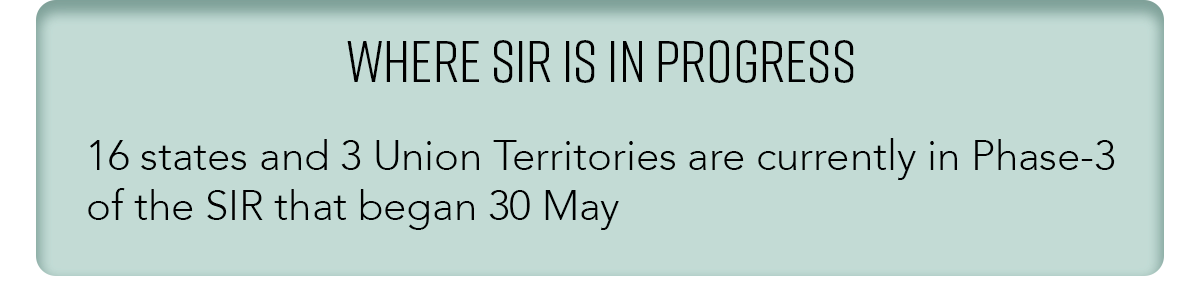
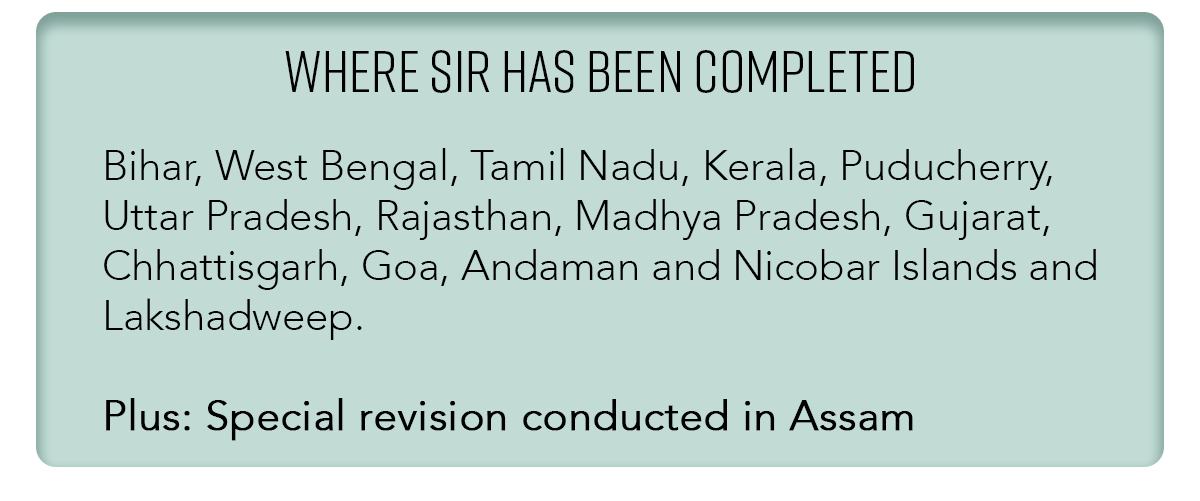
The SIR exercise has been completed in Bihar, West Bengal, Tamil Nadu, Kerala, Puducherry, Uttar Pradesh, Rajasthan, Madhya Pradesh, Gujarat, Chhattisgarh, Goa, Andaman and Nicobar Islands and Lakshadweep. Additionally, a special revision was conducted in Assam. Phase 3 of the SIR exercise is currently ongoing in 16 states and three Union Territories in a phased manner from 30 May.
Also Read: PIOs or Muslims—who is Modi govt aiming at when it says passport isn’t citizenship proof?
Urban deletions
The final electoral roll for Uttar Pradesh also saw the highest deletions in Lucknow, percentage-wise (22.89 per cent) as well as in absolute numbers—9.14 lakh. This was followed by Prayagraj with 8.26 lakh deletions, Kanpur Nagar with 68 lakh deletions and Ghaziabad with 57 lakh deletions. Percentage-wise, Lucknow was followed by Ghaziabad with 20.24 per cent deletions, Kanpur Nagar with 19.42 per cent deletions, Gautam Buddh Nagar with 19.33 per cent deletions and Meerut with 18.75 per cent deletions.
In Gujarat, urban centres reportedly saw more deletions in comparison to rural areas. Percentage wise, Surat saw the highest deletions at 25.3 per cent, followed by 21.5 per cent deletions in Ahmedabad, and 17.4 per cent deletions in Vadodara.
In Tamil Nadu as well, urban centres saw the highest number of deletions in the draft SIR published in December last year. Chennai topped the list with the highest drop at 35.6 per cent, followed by Chengalpattu (25.2 per cent) and Tiruppur (23.1 per cent). In Chennai, the number of electorate fell from 40.04 lakh before the SIR to 25.79 lakh in the draft roll, translating to 14.25 lakh deletions. In Coimbatore district, 6.50 lakh names were deleted from the voter list, while Tiruppur saw deletions of 5.64 lakh voters. The final electoral roll for Tamil Nadu was published in February.
Similarly, in Madhya Pradesh as well, urban centres saw higher deletions as compared to rural areas. Bhopal saw deletion of around 4.3 lakh names (20.6 per cent) in the draft electoral roll published in December last year. But the final roll published in February led to 3.46 per cent net additions in Bhopal. In Haryana, 4.6 lakh (29.3 per cent) voters in Gurugram were deleted from the draft electoral roll published last month. In Telangana, Hyderabad saw a 41 per cent drop in voters, from 47.36 lakh to 27.95 lakh, followed by a 36 per cent drop in voters in Medchal Malkajgiri district, and 35 per cent drop in Rangareddy district, in the draft voter list released earlier this month.
The trend isn’t the same in all districts, though. For instance, in Bihar, Gopalganj, Kishanganj and Purnia saw the highest percentage deletions, at 12 per cent, 9.6 per cent and 8.4 per cent respectively.
(Edited by Nardeep Singh Dahiya)
Also Read: Who is a citizen in India? The answer will determine who has rights
The corrupt socialist state lacks even the competence and credibility to do special intensive revision.