



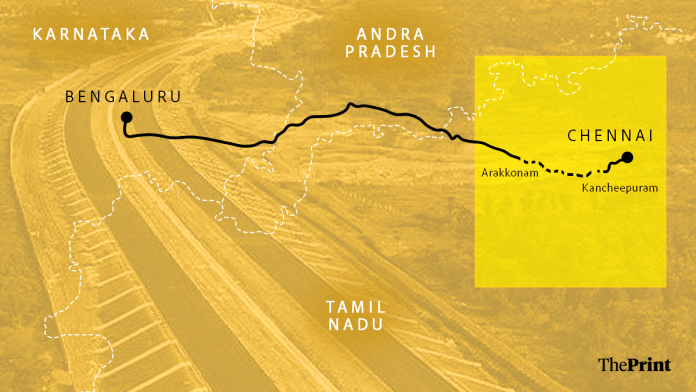
Chennai: The long-awaited Bengaluru–Chennai Expressway, a 262-km greenfield project aimed at transforming connectivity between two major southern economic hubs, has run into a legal roadblock, with a 25-km key stretch in Tamil Nadu emerging as a key bottleneck.
The legal dispute that is stalling the project’s completion involves the 25.5-km Arakkonam-Kancheepuram package in Tamil Nadu, given to a contractor called DP Jain & Co. Infrastructure Pvt. Ltd.
This makes the full end-to-end opening of the expressway by mid-2026, the current extended deadline, impossible to meet.
Officials now expect the complete 262.9-km stretch—spanning Karnataka (71.7 km), Andhra Pradesh (85.2 km), and Tamil Nadu (106 km)—to become operational sometime in 2027.
More than 230 km of the corridor has been completed so far, including 71.7 km of Karnataka, 78.5 km of the planned 85.2 km in Andhra Pradesh, and above 80 km in Tamil Nadu.
The expressway has been divided into 10 construction packages across three phases, with three packages each in Karnataka and Andhra Pradesh, and four in Tamil Nadu.
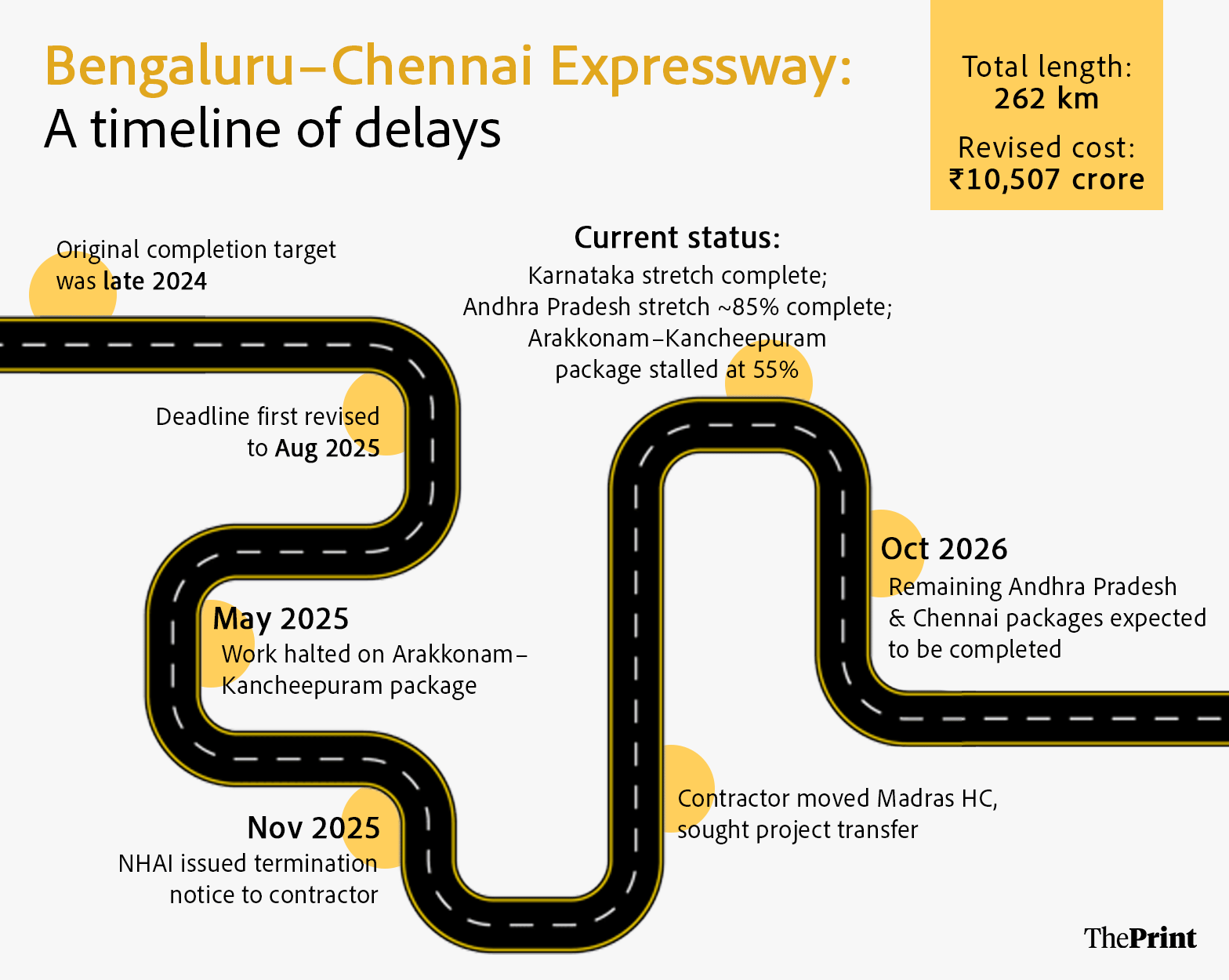
“With the matter in court on one (Arakkonam-Kancheepuram) package, we are uncertain when it can be completed for end-to-end operations,” Project Director Savitri Devi told ThePrint. “However, the other two packages (one each in Andhra and Chennai, on which work is still ongoing) would be completed by October 2026.”
NHAI Regional Officer Virender Sambyal told ThePrint that there are multiple contractors working on the project including Monte Carlo, KCC, RCCL, and DP Jain. A pending Andhra Pradesh package is being executed by Monte Carlo, while the Chennai package was given to DP Jain.
As for the Arakkonam-Kancheepuram package, work was completely halted in May 2025. The National Highways Authority of India (NHAI) issued a termination notice in November 2025, prompting contractor DP Jain to move the Madras High Court.
The contractor sought the court’s intervention to allow a transfer of the project to another entity, rather than terminating it.
NHAI sources said that DP Jain has asked for a transfer of the project to another entity or lender-supported party to avoid full termination, which could trigger immediate repayment issues, blacklisting risks, and loss of already spent amount on the package.
The contractor attributed the delay to rising costs due to increased prices of fly ash. But the NHAI argued that the concession agreement does not include clauses covering the procurement or pricing of fly ash, stating it is the contractor’s responsibility to source fly ash from the market.
The High Court ruled in favour of the NHAI, which the contractor challenged by filing a writ before a Division Bench of the High Court. The matter remains pending, and the work remains stalled.
“About 55 percent of the work has been completed on that package. Since the matter is pending in the court, we cannot determine when the project will be completed,” NHAI regional officer Virender Sambyal told ThePrint.
“We are ready for anything that the court orders. We are open to floating a new tender, cancelling the old tender or to transfer it,” he said.
Once work restarts on this stretch, completing the remaining section is estimated to take at least 12 months. The NHAI is awaiting court directions and is prepared to substitute the concessionaire, if required.
State government authorities waited for the NHAI to take action against the contractor, but have been in wait and watch mode since the matter remains subjudice.
ThePrint has reached out to DP Jain for comment via email. This report will be updated once a response is received.
The expressway is a critical infrastructure project connecting the two economic and technological hubs. It is expected to slash the travel time between the two cities to 2.5-3 hours from the current 5-6 hours through NH-48.
The project is expected to benefit a wide range of stakeholders, from regular commuters and business travellers, to logistics and freight operators who rely heavily on this corridor for the movement of goods across southern India. The expressway will also be a major boost for industries, manufacturers, and exporters in both states.
Also Read: At NITI Aayog, Vijay lays out TN development agenda—raises NEET, funds, youth skills & infra demands
A slow start
Land acquisition hurdles, forest clearances issues, and public resistance slowed the project down right since the beginning. Then came the technical and infrastructural challenges, such as securing railway approvals for road-over-bridges (ROBs) and shifting high-tension power lines and transmission towers, which added months to the schedule.
In the Kancheepuram-Sriperumbudur stretch, around 4.7 km of work remained pending for months primarily due to the power infrastructure relocation issues. However, NHAI officials said the issues have been resolved now.
Virender Sambyal said that the alternative site for erecting the transmission towers has been identified, the power disconnection approvals have come through and the work is in progress.
The work on that stretch would be completed soon, according to officials.
The project, meanwhile, has seen substantial progress in several other sections. Karnataka’s 71.7-km stretch from Hoskote to Bethamangala is completed.
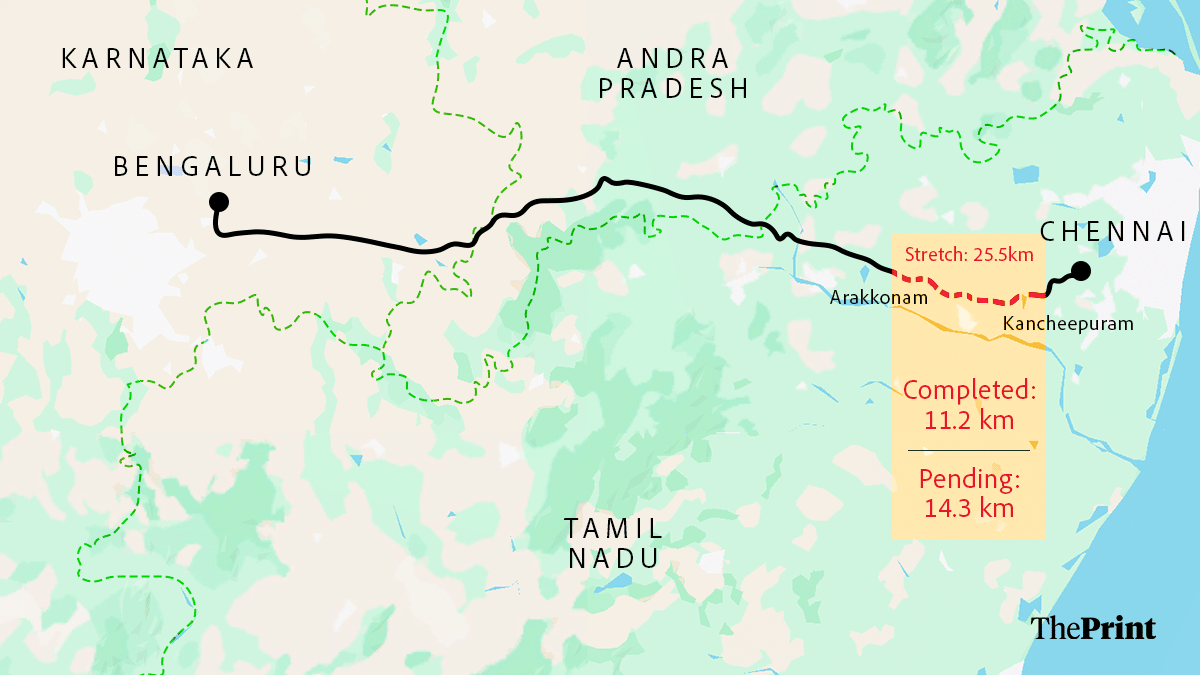
In Andhra Pradesh, the work is nearing completion with about 85 percent of it being done. In Tamil Nadu, covering approximately 106 km, the stretch was about 80 percent as of last year. The 25-km Arakkonam-Kancheepuram stretch has been stalled.
The expressway has faced a series of interconnected challenges that have repeatedly forced authorities to revise deadlines. Originally targeted for completion by late 2024, it was moved to August 2025. The project was then pushed to mid-2026, due to a combination of land acquisition delays, utility shifting issues, and contractor performance problems across multiple stretches.
As per the data presented in the Parliament on the project in March this year, the total cost of the identified project stretches has increased from Rs 7,811 crore when the project was started in 2022 to Rs 10,507 crore as of March 2026.
The Arakkonam- Kancheepuram package alone saw a rise from Rs 1,155 crore to Rs 1,525 crore.
NHAI regional officer Virender Sambyal told ThePrint that Tamil Nadu has the largest stretch of the expressway and there were multiple contractors working on the project including Monte Carlo, KCC, RCCL, and DP Jain.
NHAI to consider partial commissioning
Commuters and industry stakeholders in Chennai and Bengaluru, who have long awaited faster and safer travel, continue to wait as there is further delay. While travellers currently rely on the existing NH-48 corridor, which remains congested and time-consuming, the NHAI has indicated that it will explore phased commissioning where feasible to deliver partial benefits sooner.
“We will decide on opening the partial stretch of the expressway for the utilisation by the public. We will explore the possibilities of the same for the convenience of the travellers,” added Virender Sambyal.
(Edited by Ajeet Tiwari)
Also Read: Highways sector seeing downturn, but ‘cautious govt sees it as course correction’ after Bharatmala
Pl stop these articles as the project is getting delayed. Travelled several times but really tough after chittoor towards Chennai. Just publish the article when the project is 100% completed
Why do all infra projects get delayed? Why not start work after getting all permissions and land acquisition? Bad project management. Other than natural causes or very high price escalation or extreme shortage of RMs due to unexpected reasons, the project should not take more that 20% extra time.