



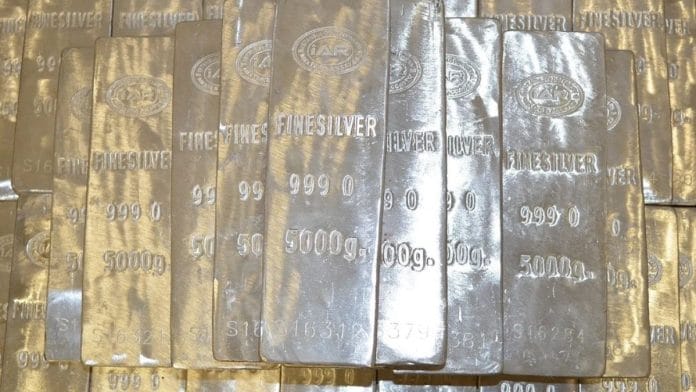

New Delhi: As the government gears up to make hallmarking of silver mandatory, a new report by a Delhi-based public policy consultancy has highlighted several economic and operational bottlenecks, recommending a transition period of three to five years for the industry to adapt.
In January this year, the Bureau of Indian Standards (BIS) director general told reporters on the organisation’s 79th foundation day that BIS was preparing to make silver hallmarking mandatory, though it had not firmed up the timeframe yet.
Hallmarking of precious metals serves as a guarantee of their purity or fineness, which protects consumers against fraud. While BIS has made hallmarking of gold mandatory since 2021, silver hallmarking has been voluntary since it was introduced in 2005.
In September 2025, the BIS had made it mandatory for voluntarily hallmarked silver articles to carry a hallmark unique identification (HUID), a six-digit alphanumeric code that allows any jewellery item to be uniquely identified and traced.
Titled ‘Economic and Operational Implications of Mandatory Silver Hallmarking in India’, the Koan Advisory report accessed by ThePrint said that while industry stakeholders support the objective of improving transparency and consumer protection, extending mandatory hallmarking requirements to silver jewellery and artefacts could create significant operational and economic challenges.
The report also highlighted significant gaps in the existing hallmarking infrastructure to support the potential transition to mandatory silver hallmarking vis-à-vis gold.
For instance, India has just around 230 BIS-recognised Assaying and Hallmarking Centres (AHCs) for silver, compared to 1,622 AHCs servicing gold jewellery.
Gold hallmarking became mandatory in India from 2021. It has been a big success with issues of false caratage reducing drastically over time. Caratage indicates the purity of gold, with 24 carats being 99.9 percent pure.
“This infrastructure gap is significant when considered alongside the structural characteristics of the silver market,” the report states.
According to the Koan report, available data suggests that AHCs are located in only about 90 of India’s roughly 800 districts, or approximately 10 percent of the total number of districts. This will leave a large proportion of manufacturing and retail clusters no choice but to rely on centres located in distant districts.
“Given the operational success of mandatory gold hallmarking, now covering almost 50 percent of all Indian districts, it is logical for the government to consider its extension to silver, considering silver represents a widely popular jewellery and artefact segment, even as it operates at significantly lower unit costs as compared to gold or platinum,” says the Koan report.
Also Read: Centre clears gold, silver import confusion ahead of Akshaya Tritiya festival
Economic feasibility
The economics of silver jewellery production differ a lot from those of the gold market, the report says.
According to government data, silver consumption in India is estimated at up to 7,000 tonnes annually, compared to 600-700 tonnes of projected demand for gold in 2026.
Some 20-30 percent of silver is used for industrial purposes, and another 20–25 percent is held as bullion for investment. The remaining 3,500-4,000 tonnes is used for producing silver ornaments, artefacts, coins and similar products.
Domestic production accounts for roughly 700 tonnes, with the balance is met through imports from countries such as Mexico, China, Argentina and Chile.
By comparison, India consumes approximately 800 tonnes of gold annually, the report adds.
“Indian gold jewellery manufacturing has gradually shifted towards larger, organised manufacturers. However, silver production continues to rely on decentralised artisan networks and small workshops. Traditional silver jewellery production often involves artisans within local craft clusters,” says the report.
This geographic dispersion has important implications for compliance, the report suggests. “Mandatory hallmarking would require manufacturers and artisans to register within the BIS system, maintain records, and physically access AHCs. In regions where AHC availability is limited, this could translate into increased logistical effort, time and cost.”
The report states that silver is also less dense than gold, implying that the physical volume of silver consumed is roughly 10 times that of gold.
“When combined with the market’s tendency toward lower purity grades and lighter-weight items, the number of individual silver articles produced is substantially higher,” the report suggests.
It recommends that, given the high volume of lightweight silver products in the market, mandatory hallmarking should initially exempt articles below a specified weight threshold.
“Evidence from our industry survey responses suggests that a substantial share of silver jewellery products fall within the sub-5 to 10-gram range, where the per-piece hallmarking cost represents a significant proportion of product value,” it says.
The report adds that most silver articles retail between Rs 300 and Rs 2,000, with many weighing under five grams. “For a lightweight item costing Rs 500, the Rs 50 per piece hallmarking fee, plus transportation, packaging and logistics, represents a disproportionately high percentage of the product’s value,” the report states.
Mandatory hallmarking compliance would also create logistical challenges for retailers operating with highly distributed inventory networks.
“Many silver retailers maintain stock across large numbers of retail outlets, regional warehouses, and third-party logistics facilities across multiple cities, with inventory frequently moved between locations in response to demand,” the report adds.
This would require large volumes of products to be consolidated, transported to assaying and hallmarking centres, processed, and redistributed across the network, the report says.
“This would generate significant logistical costs and coordination challenges, while also creating opportunity costs as inventory awaiting certification remains temporarily unavailable for sale,” it says.
Vedika Pandey, co-author of the Koan report, told The Print that the number of existing AHCs for silver could hinder a quick transition. She suggested that the government set up an Industry Study Group and allow a transition period of three to five years to help with a smooth transition without any adverse impact on silver manufacturers.
“Given the structural diversity of the silver jewellery sector, the BIS should consider constituting a formal working group comprising BIS officials, industry associations, hallmarking centres, jewellers’ representatives, and independent technical experts,” Pandey said.
Ajay Mathur is a TPSJ alum, currently interning with ThePrint.
(Edited by Sugita Katyal)
Also Read: SEBI allows equity funds to park more money in gold, silver—up to 35% of assets