





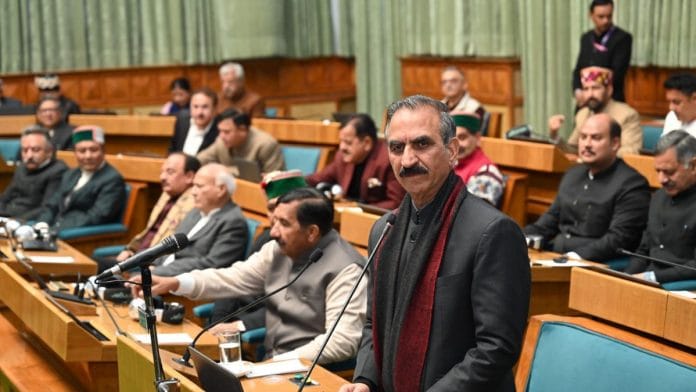



Shimla: Himachal Pradesh Chief Minister Sukhvinder Singh Sukhu Saturday presented a budget that contracted by Rs 3,586 crore compared to the last fiscal year and announced a deferral of salaries within the government—in measures that underscore the state’s worsening revenue crisis.
While presenting the Rs 54,928 crore budget for 2026-27 in the Vidhan Sabha, Sukhu said the Centre’s withdrawal of Revenue Deficit Grant (RDG) would lead to a loss of Rs 8,000 crore to the state every year.
It was the CM’s central explanation for a budget that shrunk from Rs 58,514 crore in 2025-26 and carries a revenue deficit of Rs 6,577 crore.
Himachal’s revenue receipts are estimated at Rs 40,361 crore against expenditure of Rs 46,938 crore. The fiscal deficit is projected at Rs 9,698 crore, or 3.49 percent of the the state’s GDP.
Austerity from the top
The most politically charged element to the budget was its salary deferral architecture. Starting with the CM, Sukhu himself will defer 50 percent of his pay for six months, he announced.
Ministers face a 30 percent deferral and MLAs, 20 percent. Senior IAS, IPS and IFS officers at the level of chief secretary, additional chief secretary and principal secretary will have 30 percent held back; other departmental heads, 20 percent.
In the police force, DGP and ADGP ranks face a 30 percent deferral; IG, DIG, SSP and SP levels, 20 percent. The same structure applies to senior forest officials. Group A and B employees, at higher posts, will have 3 percent of their salary deferred.
Group C and D employees are fully exempt from the exercise, as are all pension payments. “The deferred amounts will be released once the financial situation improves,” Sukhu said, framing the measure as shared sacrifice led from the front.
Fiscal squeeze
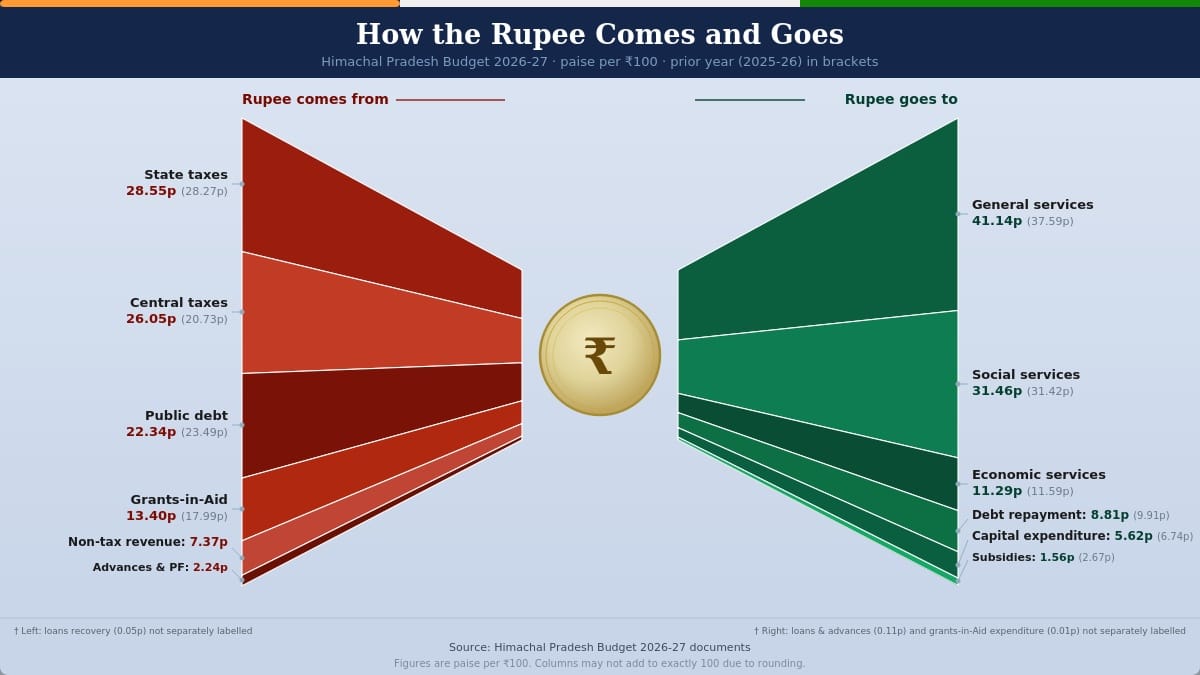
Of every rupee in the budget, 27 paise go to salaries, 21 to pensions, 13 to interest payments and nine to debt repayment—leaving capital expenditure, vital for roads and bridges in a mountainous state, at just 20 percent of total outlay. The MLA Local Area Development Fund has been halved too, from Rs 2.20 crore to Rs 1.10 crore per legislator.
But the government stuck to its election commitments to the poorest households. Around one lakh families classified as ‘extreme poor’ will receive 300 units of free electricity monthly, along with a Rs 1,500 monthly cash transfers to women in those households. These measures, the ruling Congress government said, was targeted relief in constrained times.
To boost rural incomes, minimum support prices (MSP) for crops cultivated through natural farming were raised in the budget. Wheat goes from Rs 60 to Rs 80 per kg; maize from Rs 40 to Rs 50; Pangi “zau” (barley) from Rs 60 to Rs 80; and turmeric from Rs 90 to Rs 150 per kg. Cow milk procurement price was also raised from Rs 51 to Rs 61 per litre.
Opposition attacks
Leader of Opposition and former chief minister Jai Ram Thakur was scathing in his attack of the budget. “This is an utterly dull budget—that’s why they stretched it out for so long. There’s nothing in it,” he told reporters.
“This is the first budget that has gone backwards instead of moving forward. Every year, the budget size increases, but this is the first time it has actually been reduced,” he said.
Thakur also targeted the atmosphere in the House during the presentation. “There was no interest among Congress MLAs and ministers during the presentation,” he said.
Pointing to the revenue deficit and the fall in capital expenditure, he added: “By deferring salaries, the Chief Minister has virtually admitted there is a financial emergency—but deferring problems is not the same as solving them.”
Sukhu pushed back, arguing that mountain states operate under fundamentally different conditions from revenue-rich plains. “Development costs here are far higher and avenues for earning revenue are very limited,” he said, adding that, “Himachal can never become a revenue-surplus state. Comparing us to others is simply unfair.”
Political analyst Nitin Sharma said the salary deferral’s significance lay more in optics than arithmetic. “People have repeatedly questioned the perks and salaries of ministers and MLAs. By beginning austerity at the top, the Chief Minister is trying to show the public that the government is ready to tighten its own belt first,” he said.
(Edited by Prerna Madan)
Also Read: Brotherly love to border toll: Why Punjab & Himachal keep squabbling over roads, rivers and revenue