


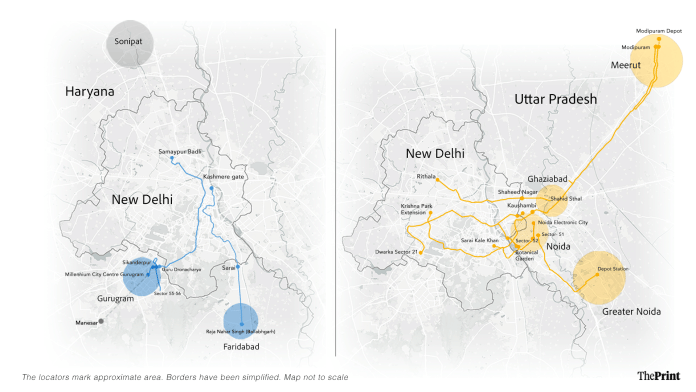
New Delhi: Seventeen years ago, Uttar Pradesh (UP) became the first state outside Delhi to connect to the capital’s Metro network when the Delhi Metro Rail Corporation’s (DMRC) Blue Line reached Noida City Centre in November 2009. Haryana followed a few months later in June 2010, when DMRC’s Yellow Line was extended to Gurugram.
Since then, several satellite towns in both states—Gurugram and Faridabad in Haryana and Noida, Ghaziabad and Greater Noida in UP—have gained Metro connectivity. But the expansion has been uneven, with Haryana falling significantly behind UP in extending rail connectivity.
Noida, for instance, gained a second direct connection to Delhi in December 2017, when DMRC’s Magenta Line was opened. In contrast, plans for another Metro corridor connecting Gurugram and Delhi via Dwarka have remained on paper. First conceptualised in 2011, the proposal has undergone several revisions. Earlier this month, it was confirmed that a corridor connecting Yashobhoomi in Dwarka to Rajiv Chowk in Gurugram was included in DMRC’s proposed Phase V(B) expansion. Construction, however, has yet to begin.
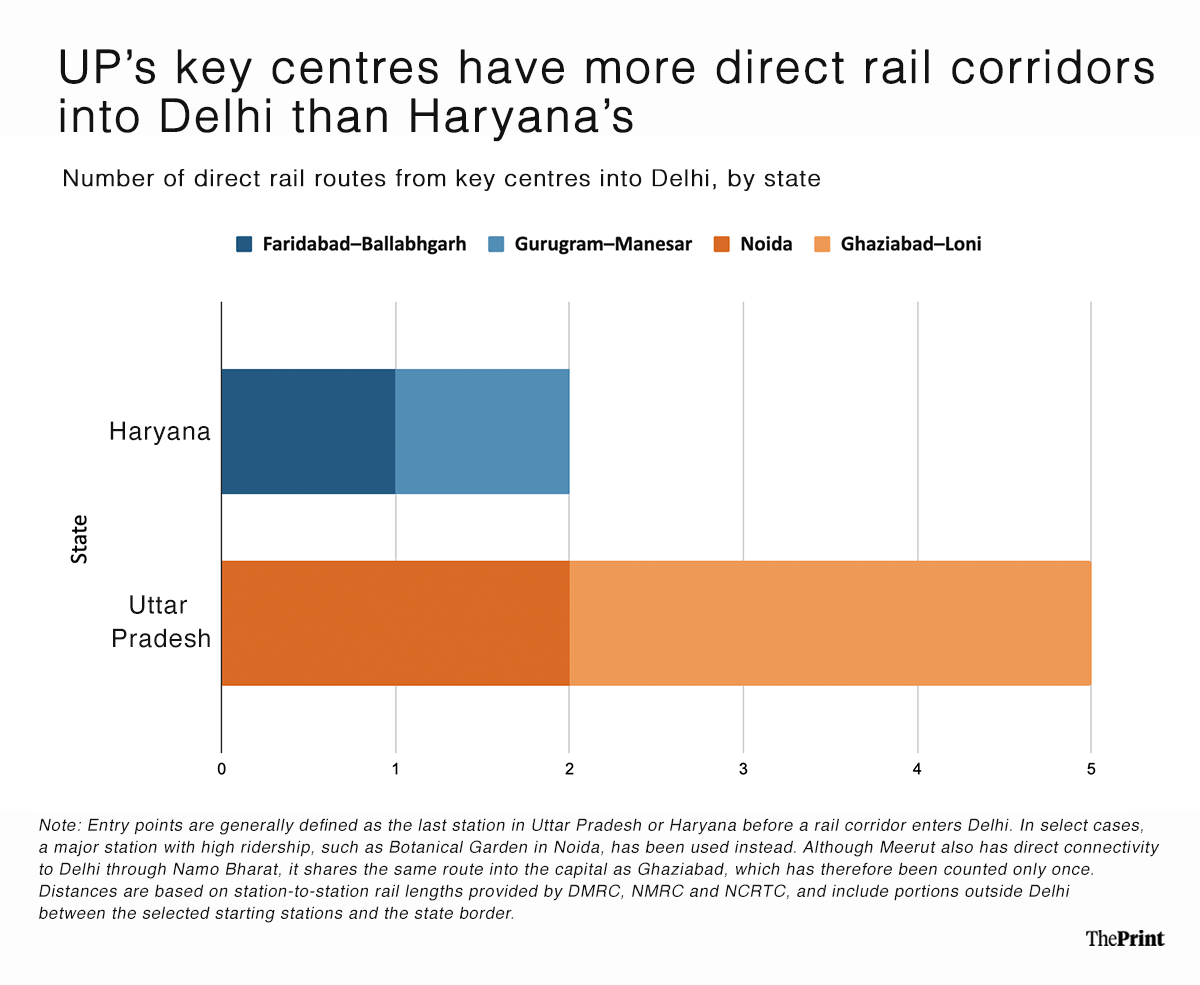
Today, passengers from UP can access five distinct rail routes into Delhi, including the regional rapid rail network, without changing trains. Haryana has just two. UP’s corridors also extend nearly twice as far into the capital, while its rail network within the state’s key centres is more than three times as long as Haryana’s, shows an analysis by ThePrint.
The analysis covers operational Metro and regional rapid rail networks, including locally developed Metro systems and the Namo Bharat corridor. It draws on data provided by DMRC, Noida Metro Rail Corporation (NMRC) and National Capital Region Transport Corporation (NCRTC), which operates Namo Bharat.
Also Read: DMRC employee sets Guinness record for fastest travel across all Delhi Metro stations
3 of UP’s 4 key centres have direct links to Delhi against 2 of Haryana’s 3
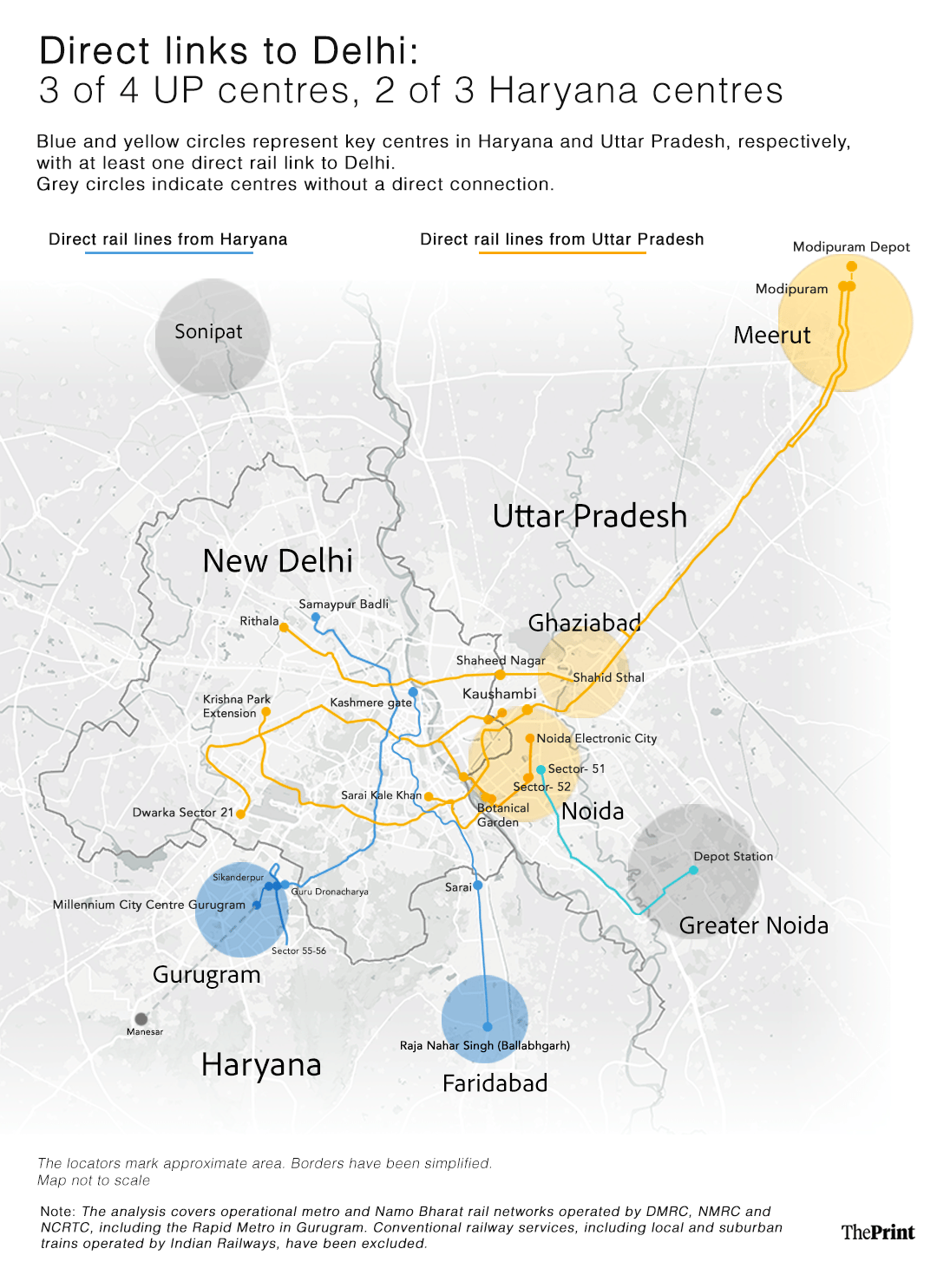
Under its Regional Plan-2021, the National Capital Region Planning Board (NCRPB) in 2005 identified seven ‘metro centres’ across UP and Haryana. With projected populations of at least 10 lakh each by 2021, these centres were envisaged as urban growth hubs that could attract economic activity and ease development pressures on Delhi.
The seven centres are Noida, Greater Noida, Ghaziabad–Loni and Meerut in UP, and Faridabad–Ballabhgarh, Gurugram–Manesar and Sonipat–Kundli in Haryana. These form the geographical basis of ThePrint’s analysis and are referred to hereafter as ‘key centres’.
Of UP’s four key centres, three—Noida, Ghaziabad–Loni and Meerut—have at least one operational rail corridor offering direct connectivity to Delhi.
Noida was the first to get a Metro connection, with the Blue Line reaching the city in 2009. In 2011, the line was extended to Vaishali, giving Ghaziabad its first direct Metro connection to Delhi. Meerut is the latest addition, with the Delhi–Meerut Namo Bharat corridor providing a direct regional rail connection to the capital via Anand Vihar. Unlike the Metro, which primarily caters to shorter urban journeys, Namo Bharat is designed for longer-distance intercity travel, with fewer stops and a maximum operational speed of 160 kmph—twice that of conventional Metro trains.
Greater Noida remains the only one of UP’s four key centres without a direct rail corridor to Delhi. Although NMRC’s 29.7-km Aqua Line connected Greater Noida to Noida in 2019, passengers travelling to Delhi still have to change trains at the Noida Sector 51–52 interchange to access the Blue Line.
Sewa Ram, professor of transport planning at the School of Planning and Architecture, New Delhi, said this could be rooted in the cities’ original planning. Noida was developed partly to decongest Delhi, while Greater Noida was conceived as an extension of Noida’s urban development rather than as a counter-magnet to the capital.
In Haryana, two of the three key centres—Faridabad–Ballabhgarh and Gurugram–Manesar—have direct Metro connectivity to Delhi.
The Yellow Line reached Gurugram in 2010, followed by the extension of DMRC’s Violet Line to Faridabad in 2015 and Ballabhgarh in 2018.
Sonipat–Kundli, Haryana’s third key centre, remains without an operational Metro or regional rapid rail connection. The 26.463-km Rithala–Narela–Nathupur (Kundli) Metro corridor, approved in December 2024, is at the tendering stage, with completion targeted for March 2029. Separately, the Haryana government approved the 136-km Delhi–Panipat–Karnal Namo Bharat corridor in March this year, which will include a station at Kundli.
5 routes into Delhi from UP, just 2 from Haryana
Some of UP’s key centres have gained multiple rail corridors into Delhi over the years.
Noida’s first connection through the Blue Line in 2009 was followed by the Magenta Line in 2017, giving the city two direct routes into the capital.
Ghaziabad, which first gained Metro connectivity through the Blue Line extension to Vaishali in 2011, subsequently acquired a second connection when DMRC extended the Red Line to Shaheed Sthal in 2019. The Namo Bharat corridor added a third regional rail connection in 2025.
In total, UP has five distinct rail entry points into Delhi—two from Noida and three from Ghaziabad. Meerut also has direct connectivity through the Namo Bharat corridor, but shares the same route into the capital as Ghaziabad and is therefore counted only once.
In contrast, Gurugram and Faridabad continue to rely on their original corridors into Delhi—the Yellow Line and Violet Line, respectively.
Sanjay Gupta, head of the Department of Transport Planning at the School of Planning and Architecture, New Delhi, said geographical concentration of commuter demand is an important consideration when assessing the need for additional rail corridors between Gurugram and Delhi.
Much of the demand, he said, is concentrated around employment hubs such as Cyber City and Udyog Vihar, which are served by the Yellow Line and its connection to the Gurgaon Rapid Metro. Demand for rail travel between Delhi and other parts of Gurugram was relatively limited, with commuters relying on other modes of transport, he added.
The Delhi–Meerut Namo Bharat corridor, by contrast, had a more defined demand for faster connectivity, Gupta said. This included service-sector employees and traders travelling from Meerut to the capital, particularly those accessing Delhi’s wholesale markets.
Ram also pointed to Gurugram’s reliance on informal public transport. “The lifeline of Gurgaon is the shared auto. People coming from Delhi, especially in the service sector, first take Kapashera buses and then transfer to shared autos and disperse,” he said.
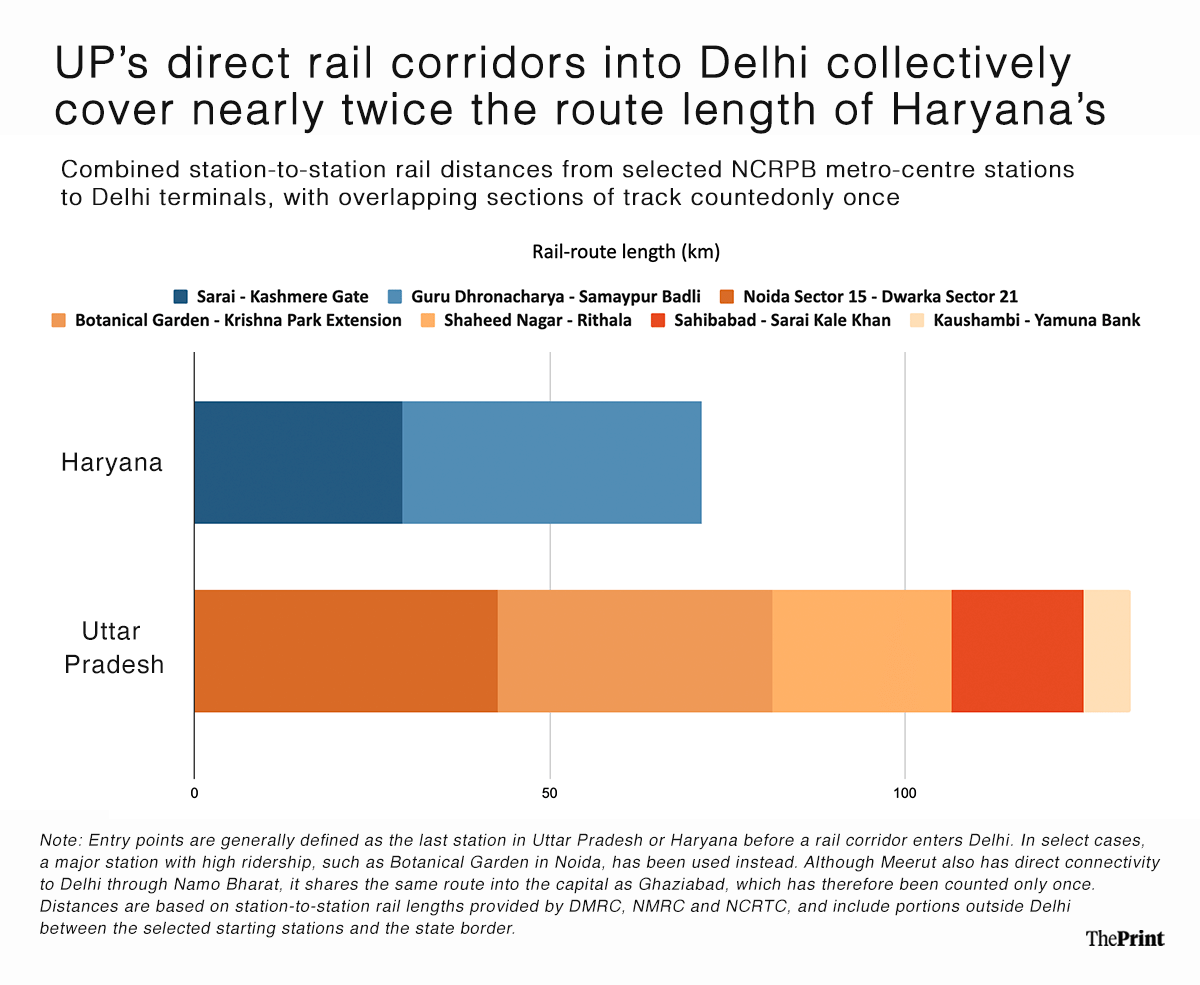
UP’s rail routes to Delhi span nearly 2x the distance of Haryana’s
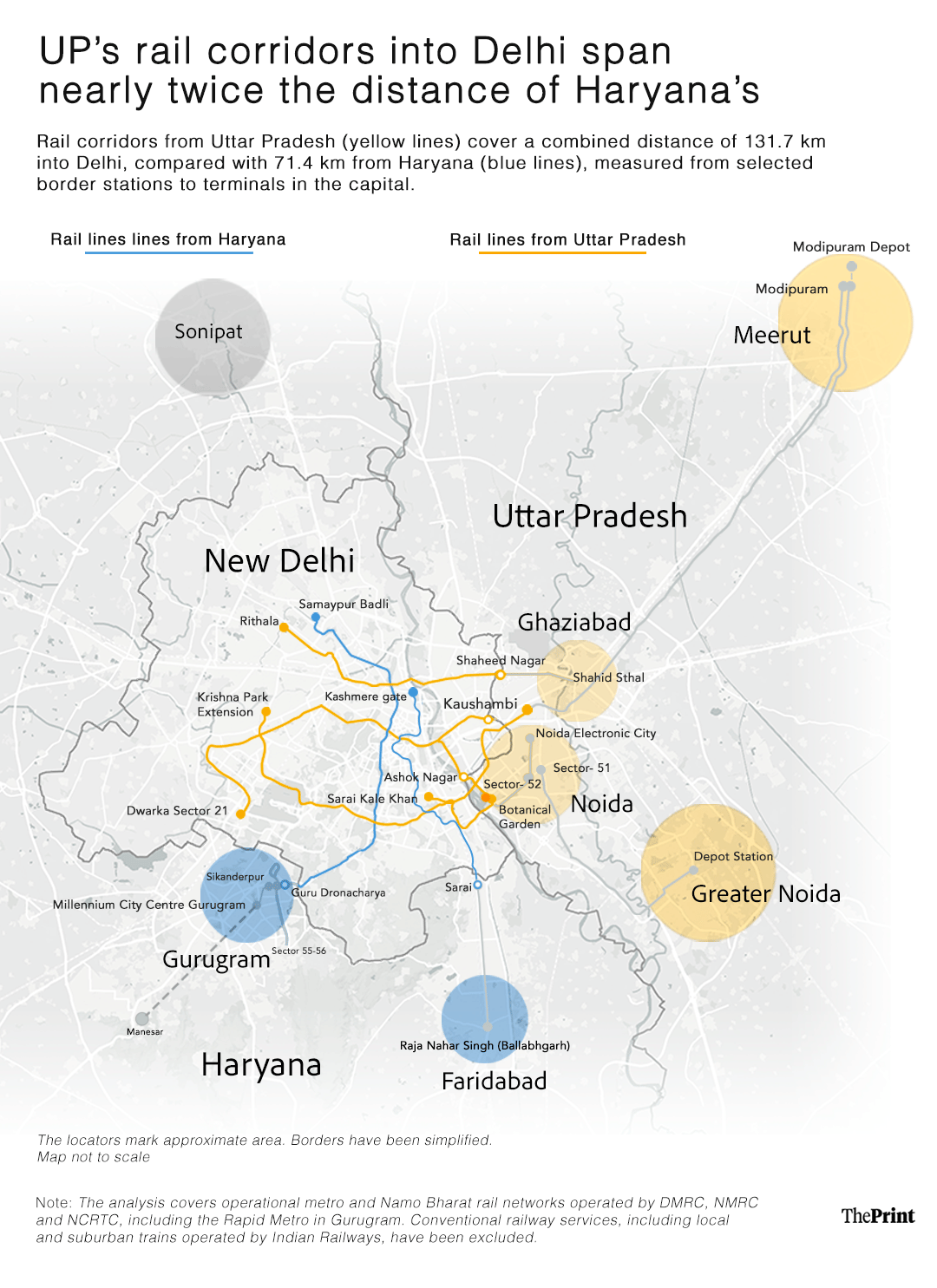
The disparity extends beyond the number of direct rail connections to how far these corridors extend into the capital.
UP’s five entry routes cover a combined distance of 131.7 km, which is nearly 85 percent more compared with 71.4 km for Haryana’s two, despite accounting for overlapping stretches of track. The figures represent the combined rail distance from selected border stations in UP and Haryana to terminals in Delhi, rather than the length of tracks located entirely within the capital.
Noida’s Blue and Magenta lines extend into western and southwestern Delhi. From Ghaziabad, the Blue Line connects Kaushambi to Yamuna Bank in eastern Delhi, while the Red Line reaches Rithala in the northwest. Namo Bharat connects Ghaziabad and Meerut to Sarai Kale Khan.
Haryana’s Yellow Line connects Gurugram to Samaypur Badli in northern Delhi, while the Violet Line connects Faridabad to Kashmere Gate in central Delhi.
Within key centres, UP’s rail network is over 3x Haryana’s
The disparity is even more pronounced within the key centres themselves. UP has a combined measured rail-route length of 110.3 km across its four centres, more than three times Haryana’s 32 km across its three.
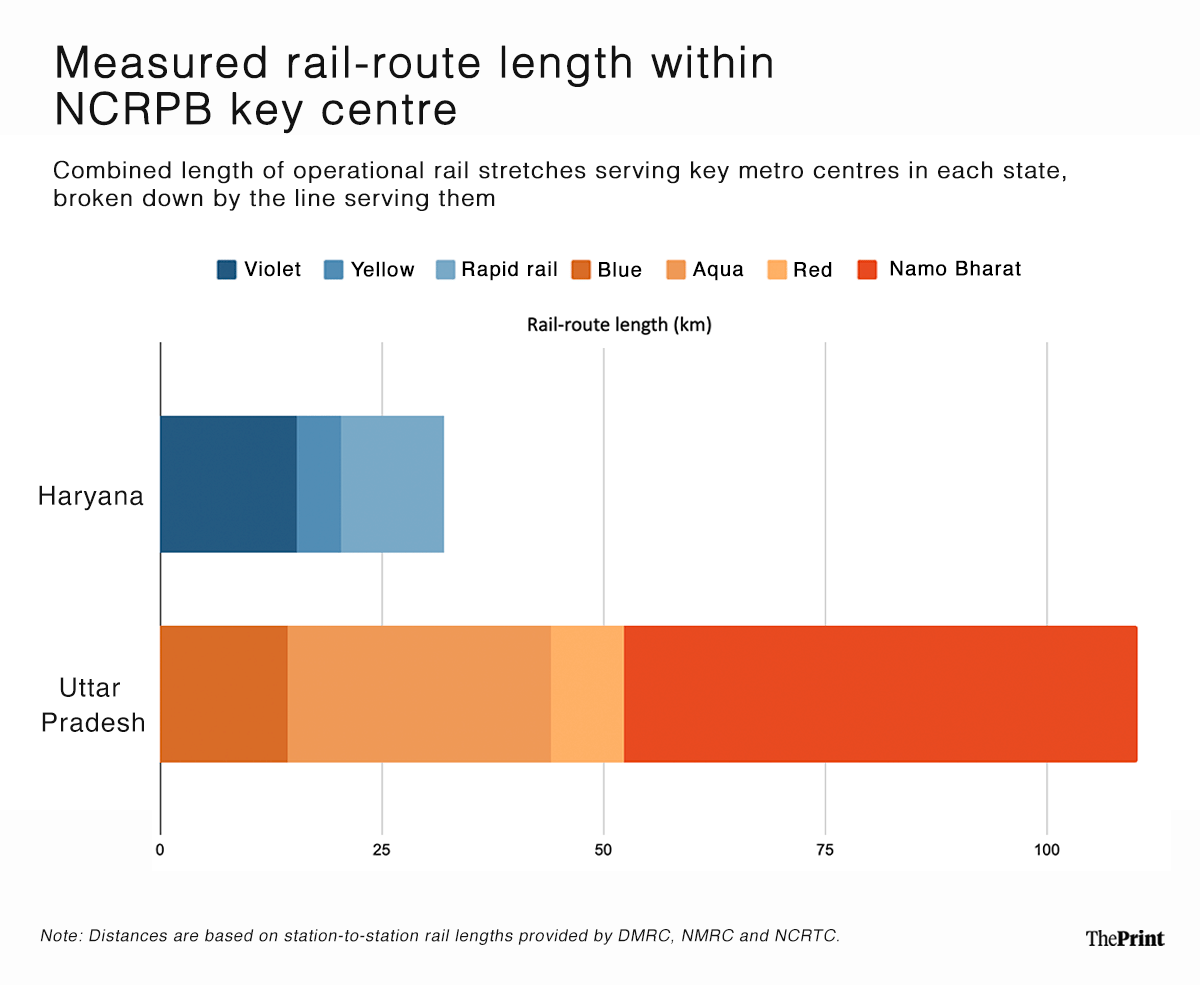
Much of UP’s lead comes from two major projects: the Delhi–Meerut Namo Bharat corridor and the Noida–Greater Noida Aqua Line. The former accounts for 58 km, or more than half of UP’s measured network, while the latter contributes another 29.7 km, or 27 per cent.
Together, the two corridors account for nearly 80 per cent of UP’s total.
Additionally, the Union Cabinet on 11 November approved an 8.449-km extension of the Aqua Line from Noida Sector 51 to Greater Noida Sector 4, with five stations. Once operational, it will take the combined active Metro network in Noida and Greater Noida to 71.878 km, according to the government.
Gupta said the Aqua Line and the Namo Bharat corridor illustrated UP’s approach to infrastructure development—creating transport capacity in anticipation of future demand, even when immediate revenue returns may not be commensurate. “Uttar Pradesh has gone ahead with supply, anticipating demand will come,” he said.
Ridership on the Aqua Line has taken time to pick up because real estate development along the corridor is yet to reach its full potential, Gupta added. He expected a similar trajectory for the Delhi–Meerut Namo Bharat corridor. NCRTC’s focus on transit-oriented development, including residential and commercial projects around stations, could generate additional travel demand over the next 10–15 years, he said.
In Gurugram, the privately developed Rapid Metro expanded intra-city connectivity in two phases between 2013 and 2017. The 11.6-km network connects Cyber City and commercial hubs with residential areas along Golf Course Road. It accounts for just over a third (36.25 per cent) of Haryana’s measured intra-state network of 32 km.
The Violet Line serving Faridabad–Ballabhgarh accounts for the largest share of Haryana’s network, at 48 per cent, while Gurugram’s Yellow Line contributes the remaining 15.9 per cent.
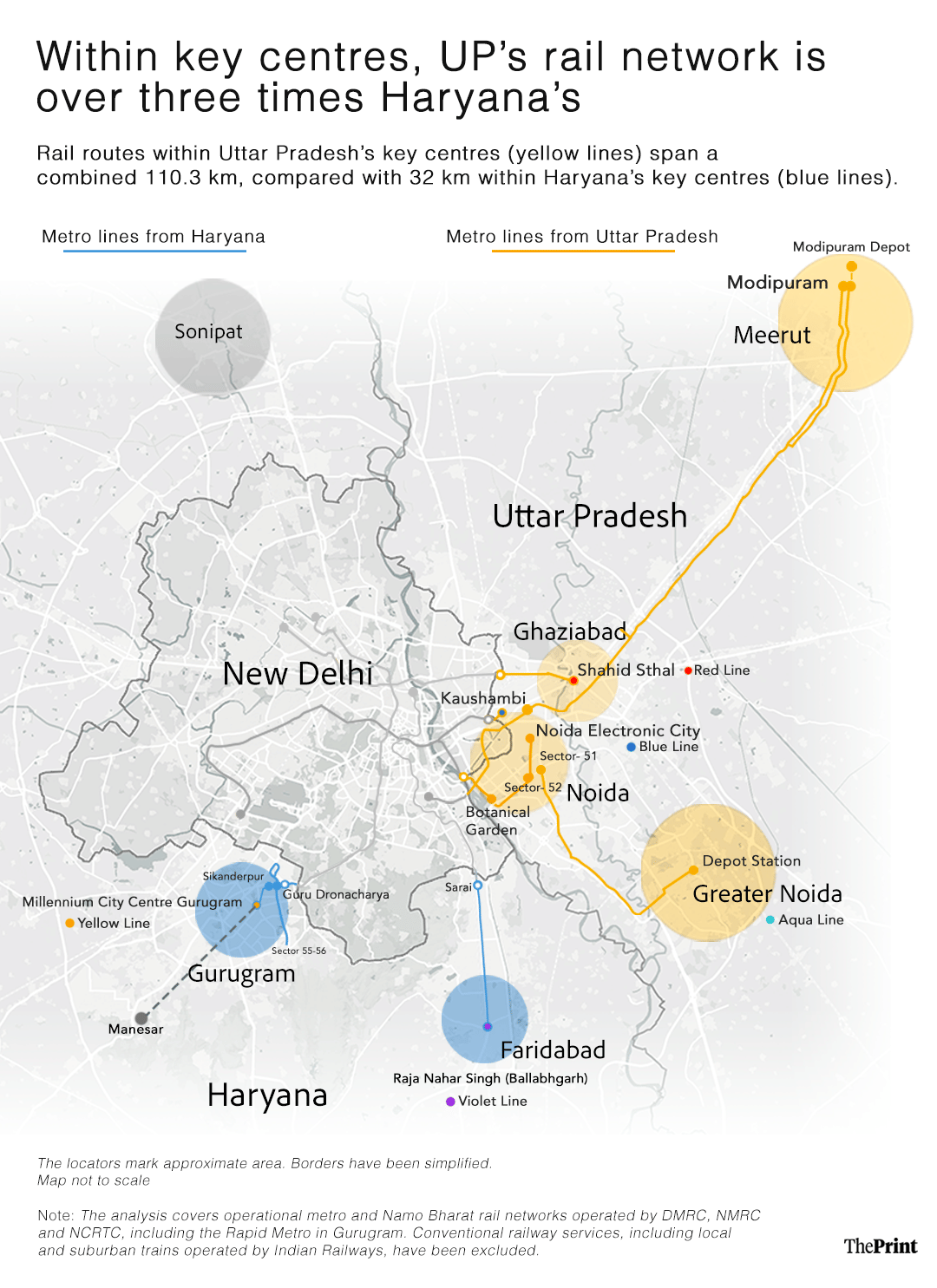
Ram also highlighted gaps in last-mile connectivity in Gurugram, which make travel within the city, particularly in its western and southern parts, difficult. Noida, by contrast, has a relatively better-connected intra-city network, he said.
The economics of rail expansion
A larger rail network does not necessarily indicate more efficient infrastructure investment, just as a smaller one does not automatically imply greater unmet travel demand, Gupta cautioned.
He described the relationship between transport infrastructure and travel demand as a “chicken and egg situation”.
“If you look at a developed society globally, they create supply first and expect demand to come eventually. In our country, because resources are scarce, we need to have a minimal critical mass of demand before we think of supply,” he said, cautioning against over-investment in capital-intensive rail infrastructure.
However, existing travel patterns and demand may themselves have been shaped by earlier infrastructure decisions. Higher land prices, an emphasis on plotted residential development by private developers and limited public transport may have encouraged settlement patterns favouring households that could afford private vehicles, Ram argued. This, in his view, partly explains Gurugram’s low dependence on public transport.
Gupta said UP had been more willing to invest ahead of demand and pursue transit-oriented development. In Haryana, he pointed to the state’s smaller size, existing urban development patterns, commuter requirements and investments in alternative transport infrastructure, including peripheral expressways, as factors influencing rail expansion.
Ram, however, cautioned that allowing urban development to outpace transport infrastructure could have long-term consequences. Persistent congestion in Gurugram, he argued, could eventually undermine the city’s attractiveness as a place to live.
“Gurugram should not wait for the population to come here. Connectivity should always come first,” he said.
(Edited by Chingkheinganbi Mayengbam)