





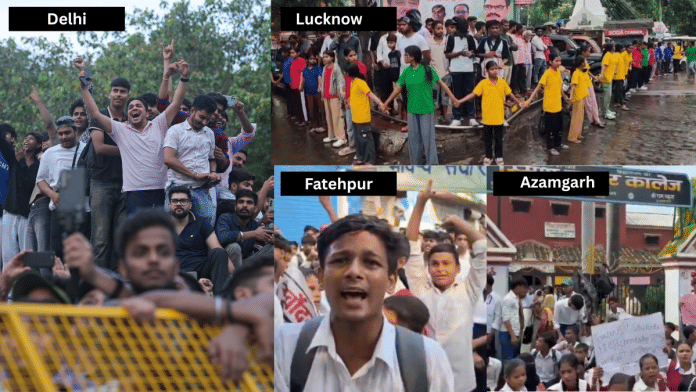

Lucknow: A series of protests by school children over poor facilities, dubbed the ‘Gen Alpha’ movement, has set off alarm bells in Uttar Pradesh, prompting the Yogi Adityanath government to direct senior officials to investigate all complaints and address them promptly.
Taking serious note of seven protests in the past 23 days, Additional Chief Secretary Partha Sarathi Sen Sharma has issued instructions to divisional commissioners and district magistrates across the state to ensure the prompt resolution of all complaints.
In cases where information or allegations are found to be false or misleading, authorities have been told to issue an immediate clarification.
The government on Wednesday further instructed officials to maintain regular communication with school students and their parents.
District-level officials will visit schools, interact directly with children and assess concerns related to the condition of schools, the quality of education, food, teaching arrangements and other basic facilities.
Officials have been asked, in some cases, to even teach classes to get a first-hand understanding of the learning environment.
ThePrint has learnt that some officials from the Chief Minister’s Office (CMO) will go to the field as nodal officers to monitor efforts to resolve students’ issues, particularly related to schools.
“This pattern of Gen Alpha is worrisome. Many of them are going to be first-time voters also. Their parents are also under their influence. If we do not address their issue, we might end up losing many of our voters. So we decided to address the issue. Communication is the only solution,” a senior CMO official told ThePrint.
The government’s intervention comes amid a visible rise in schoolchildren taking to the streets to raise issues concerning poor infrastructure, food quality, shortage of teachers and other facilities.
The recent protests have been described by some students themselves as a ‘Gen Alpha movement’, reflecting a generation increasingly willing to publicly articulate its grievances.
Impact of protests
The protests are part of a pattern that began in Fatehpur on 28 July when school students took to the streets over basic facilities and succeeded in putting pressure on the administration to address their demands.
The protest was led by Class 12 student Ankur Sonkar and three of his classmates, who had attended the Jantar Mantar movement against the alleged NEET paper leak.
Inspired by that experience, the group decided to organise a similar demonstration at their own school over long-pending issues.
After this protest, the school management got new fans and furniture for the classes.
In the last 23 days, protests have also been reported in Lucknow, Kannauj, Azamgarh, Unnao, Hamirpur and Meerut.
A protest by students of a Sarvodaya school in Lucknow over the shortage of teachers drew particular attention.
Following the protest, the Social Welfare directorate (Samaj Kalyan Nideshalay) reportedly reopened its office late at night and issued orders for the teachers whose contracts ended in June to rejoin under earlier terms and conditions.
Social media monitoring
The state government has also directed officials to monitor issues raised by students on social media and take steps to resolve genuine complaints.
At the same time, authorities in several districts, including Azamgarh and Ayodhya, have restricted YouTubers and social media influencers from entering schools without permission.
Government functionaries believe that some videos circulating on social media may be aimed at damaging the government’s image and have called for closer monitoring of such content.
(Edited by Sugita Katyal)
Also Read: Modi’s I-Day outreach to Gen Z & Gen Alpha: Free online coaching for competitive exams, talent hunt
Recall the case of a local stringer some years ago who reported that only roti and salt were being served to school children. The entire state administration came down on him like a ton of bricks.