



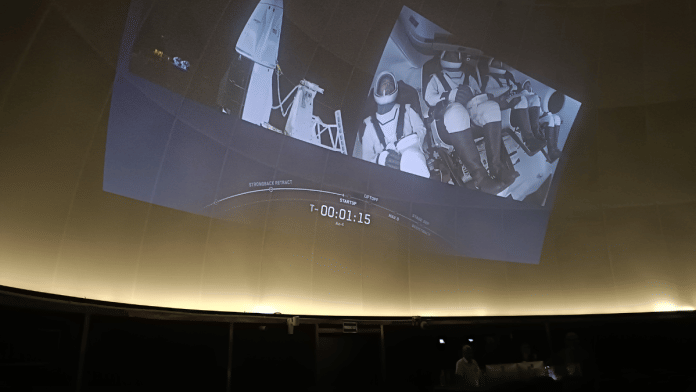

New Delhi: The Nehru Planetarium in New Delhi on Wednesday showcased another piece of Indian spaceflight history as Shubhanshu Shukla travelled to the International Space Station (ISS) aboard the Axiom-4 Mission. This is the first time an Indian astronaut is going to the ISS, and only the second Indian to go to space after Rakesh Sharma in 1984.
In the 41-year-old Planetarium’s sky theater, over 200 audience members watched mesmerised as the Axiom-4 Mission aboard the SpaceX Dragon spacecraft lifted off from Kennedy Space Centre in Florida at 12:01 PM IST on Wednesday afternoon.
“I remember in 1984 when Rakesh Sharma had gone to space in the USSR spacecraft, we had played the recording of his conversation with PM Indira Gandhi in our sky theatre,” said K.S.Balachandran, a senior technician at the Planetarium who has worked there since 1983. “From then to now, not only has Indian space technology progressed, but the Planetarium has progressed with it.”
The doors to the Nehru Planetarium’s noon show ‘Biography of the Universe’ opened as usual around 11:50 PM, but the crowd had come for the live broadcast of the Axiom Mission on the planetarium’s dome.
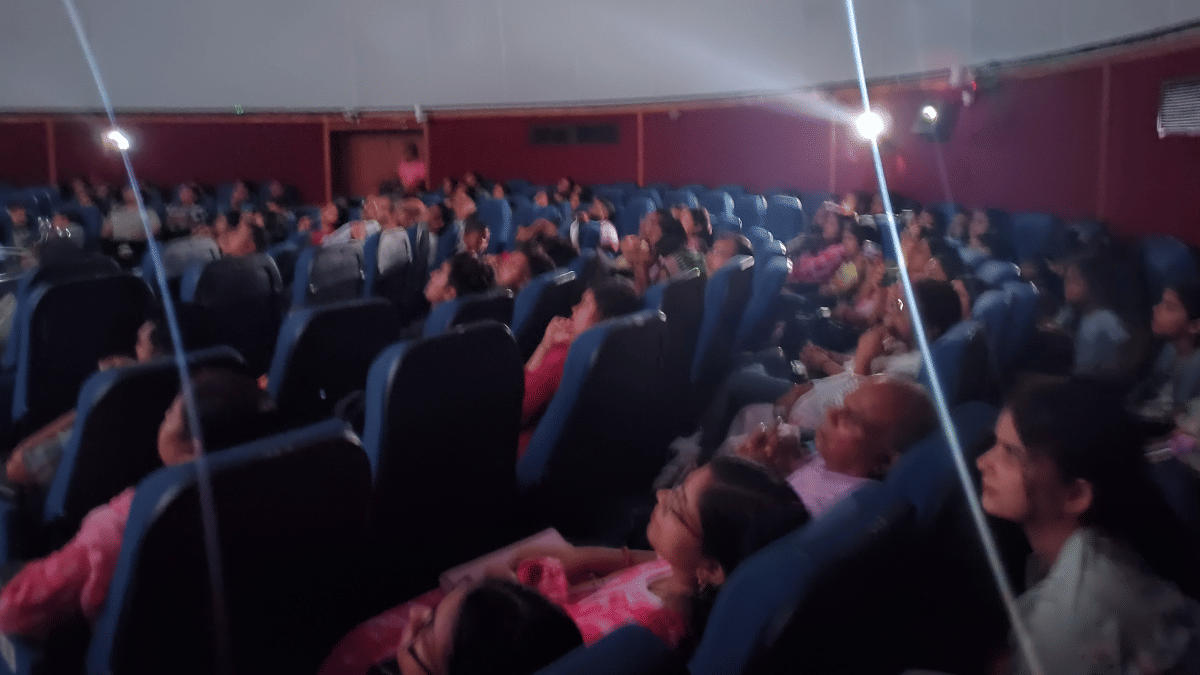
“I knew the Axiom Mission was happening at 12 and what better place to show it to my kids than Delhi’s planetarium,” said Gaurav Singh, a 42-year-old software engineer who brought his 7- and 9-years-old daughters for the live screening. “This is where I have come for the Chandrayaan and Aditya L1 mission launches too, so it was only fitting!”
Many other audience members, however, had no idea that the Axiom Mission was happening at 12:01 PM, and it was a surprise treat when they walked into the theatre.
“I haven’t really kept up with the news, but the programme manager announced that this is India’s first astronaut going to space after Rakesh Sharma, and I’m so glad I got to see this moment live at the planetarium,” said Sakshi Rana, a 24-year-old college student who had come to catch a show with her friends.
History of the Planetarium
Prerna Chandra, the Programme Director at Nehru Planetarium, talked about how the Axiom launch was especially significant given the Planetarium’s close history with India’s spaceflight missions. The Planetarium, funded by the Nehru Memorial Fund, opened its gates in February 1984 after being inaugurated by then prime minister Indira Gandhi.
“In a way, we were born with India’s first human spaceflight mission since we opened our doors in 1984, which is the year Rakesh Sharma went to space,” said Chandra.
The Planetarium also hosts in its gallery the original Soyuz-T10 capsule aboard which Rakesh Sharma went to space, as well as the original spacesuit of his back-up Ravish Malhotra.
“After his return from space, the Nehru Planetarium was one of the places Rakesh Sharma had visited to interact with students and scientists,” said Chandra. “We’re hoping that one day, we can host Shubhanshu Shukla, too.”
(Edited by Tony Rai)
Also Read: Axiom-4: IISc mentor roots for Shubhanshu Shukla. Tells him, ‘Come back safe, thesis still pending’