





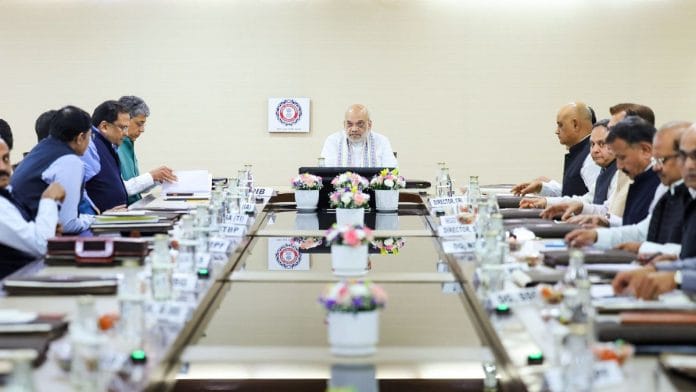

New Delhi: Using AI to analyse intelligence inputs and data available on the Multi Agency Centre (MAC), speeding up terrorism trials by bringing back fugitives and using provisions for trial-in-absentia, and need for tougher measures against infiltration were among the key issues discussed at the National Security Strategies (NSS) Conference 2026 in New Delhi.
Discussions also focused on policy framework to combat cyber-crime and proxy warfare by Pakistan, an official from the Ministry of Home Affairs said.
Over 850 people attended the conference, including Home Minister Amit Shah, Ministers of State for Home Affairs Nityanand Rai and Bandi Sanjay, the Union Home Secretary, Deputy NSAs, heads of Central Armed Police Forces, DGPs of states and Union Territories, young police officers and experts from specialised fields.
A senior official told ThePrint that the focus was on integrating AI into intelligence gathering and analysis, using specially developed software to analyse large volumes of data, intel inputs and their chronology.
“There is a need to integrate technology into intelligence analysis,” the official said.
According to the official, AI tools have been developed indigenously by the Intelligence Bureau with the help of experts. Home Minister Amit Shah has directed that the AI-based analysis of information available on the MAC platform be used to develop SOPs for countering various national security challenges.
He has also asked all agencies to take strict measures to counter infiltration.
On 26 May this year, the MHA also constituted a committee to study demographic changes arising from illegal immigration and other reasons, and to suggest measures to deal with these changes.
According to the ministry notification, the panel has to submit its report in the next one year, besides recommending an organised and permanent operational system for legal- and time-bound detention, or deportation of immigrants residing in India.
‘Effectively countering terrorism & radicalisation’
For effective tackling of terrorism and radicalisation, Shah also emphasised on training for implementation of MHA’s PRAHAAR scheme, expediting trial by bringing back fugitives and using trial-in-absentia provisions and undertaking comprehensive and integrated approach while investigating UAPA cases, according to a statement by MHA.
The scheme is India’s first comprehensive National Counter-Terrorism Policy, providing a nationwide framework for preventing and responding to terrorist activities and radicalisation.
A Mumbai court is expected to try Lashkar-e-Taiba founder Hafiz Saeed in absentia for his alleged role in the 26/11 terror attacks in the city. Moreover, on 14 July, a Jammu court had also issued a non-bailable warrant against Saeed for his alleged role in last year’s Pahalgam terror attack, after the National Investigation Agency asked the court to declare him a proclaimed offender and try him in absentia.
Section 356 of the Bharatiya Nagarik Suraksha Sanhita (BNSS) allows Indian courts to try an accused, convict and sentence them without them being present in court.
According to MHA’s statement, the second day of the conference will focus on the threat landscape from sub-aerial systems and formulating counter measures, securing the blue economy, information warfare and its implications on national security and the need for a bio-security framework.
Also Read: MHA orders deployment of 12 CRPF companies in Ladakh a year after violence during statehood protest