





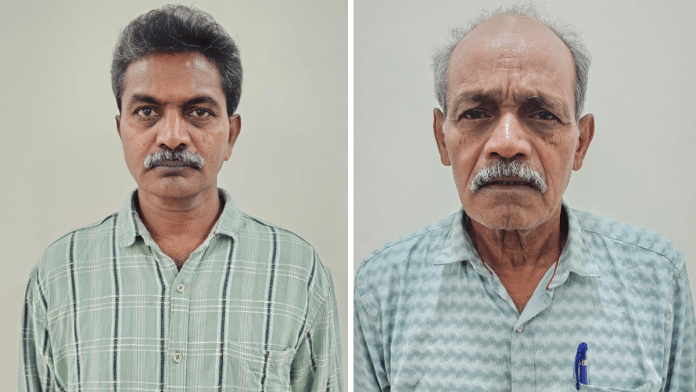



New Delhi: Amid a concerted campaign by the Andhra Pradesh government in the 1980s, the People’s War Group (PWG) began moving into the Dandakaranya region, which then included parts of Madhya Pradesh, Maharashtra and Odisha.
As part of the reorganisation and formation of a new base, the outfit’s senior leaders decided to send thousands of cadres to the then-neglected part of Madhya Pradesh. Among them were Thipiri Thirupati and Malla Raji Reddy, who were sent to the Dandkaranya region in April 1984 on the orders of Muppala Laxman Rao alias Ganapathy.
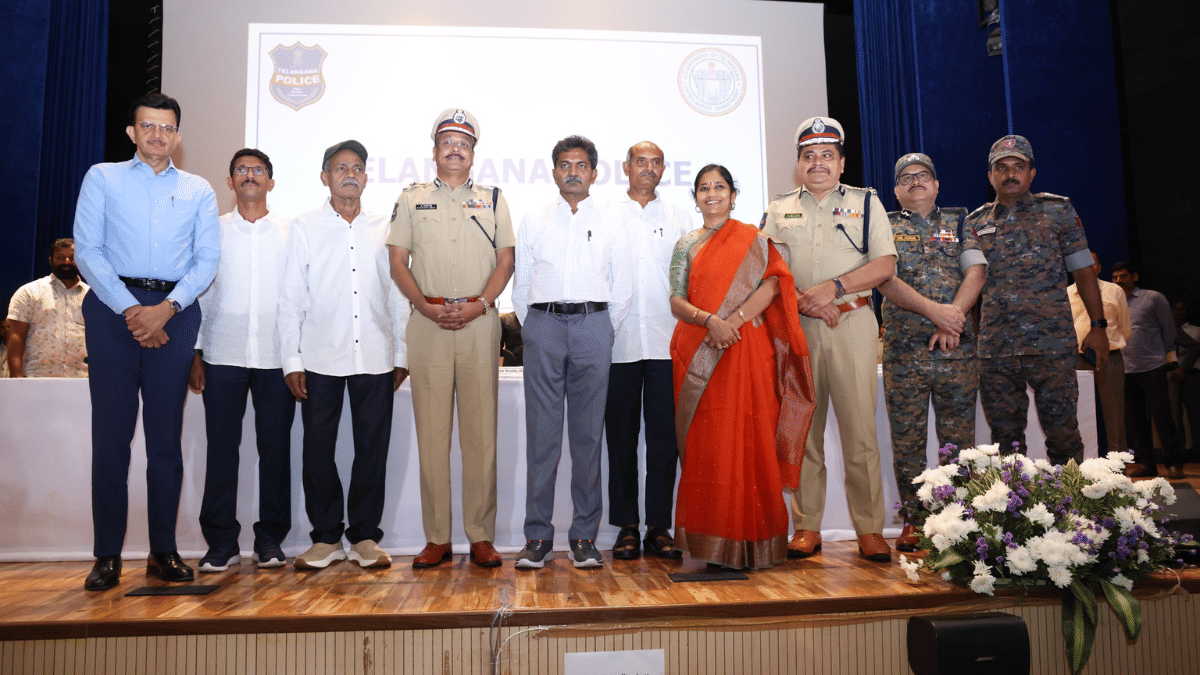
Around 40 years later, the duo of Thirupati, who acquired the popular name of Devuji, and Reddy, who came to be known as Sangram, were present in the same room with senior Telangana Police officers Tuesday in an unprecedented turn of events.
The trio of Ganapathy, Devuji, and Sangram are still relevant for India’s fight against left-wing extremism. The surrender of Devuji and Sangram is considered a major milestone in India’s fight against the violent Maoist movement. Ganapathy remains the lone senior Maoist leader still at large.
Along with Devuji and Sangram, two more senior Maoist cadres surrendered before the Telangana Police on Tuesday.
After their surrender and official reintegration into the mainstream, Telangana Director General of Police B. Shivadhar Reddy emphasised that the organisational structure of the Communist Party of India (Maoist) has started moving towards an “imminent collapse”.
He cited factors such as relentless security operations, shrinking support base and mobility, along with deepening ideological dissatisfaction among the cadres behind the accelerated collapse of the banned outfit.
Also Read: Sujatha, Abhay, Deva, now Devuji—top Maoist surrenders over the past year
Once a private school kid
Devuji was born in a poor family at the Ambedkar Nagar village in Jagtial district’s Korutla sub-division, but poverty did not come in the way of his education. According to police records, Devuji studied at a private school up to the 5th standard in Korutla before switching to a government school for his matriculation in the late 1970s.
Subsequently, he joined the government Junior College, Korutla, for Intermediate. It was at the college that he was introduced to revolutionary politics and joined the Radical Students Union.
The RSU was a front organisation of the PWG and was very active on college campuses in Andhra Pradesh at that time. He later became president of the Korutla town unit of the RSU before becoming the outfit head for the entire Karimnagar district.
According to police records, while he was with the RSU, the PWG organised the 1978 Jagitial Jaitra Yatra, which deepened his ideological alignment with the Maoist outfit, and he formally joined the PWG in January 1982.
During this time, there were a number of violent campus clashes between students aligned with the RSU or the Akhil Bharatiya Vidyarthi Parishad (ABVP), the student wing of Rashtriya Swayamsevak Sangh (RSS).
At the PWG, he quickly rose through the ranks and remained the commander of several dalams (squads) in the Dandkaranya region for nearly a decade. He was then promoted to the Divisional Committee Member (DVCM) in April 1989, and served in the Gadchiroli Divisional Committee. He was promoted further and appointed as a secretary of the North Gadchiroli Sub-Divisional Committee.
The peak Maoist violence
Devuji’s grasp of military strategy was held in such high regard by senior Maoist leaders that, when the PWG constituted the Dandakaranya Special Zonal Committee (DKSZC) in 1995, he was appointed commander of its first battalion.
In 1996, he was further inducted into the DKSZC as a member of the special zonal committee. He was shifted to Balaghat- Gondia in Maharashtra-Madhya Pradesh border region. It was in 1997 when he had planned and led an attack on the Mannpur police station, and snatched 27 weapons from the police station the same year.
Police and intelligence officials in the LWE-affected states say he was key man responsible for the formation of the People’s Liberation Guerrilla Army (PLGA), the formal armed wing of the Maoist outfit, in 2000.
However, the biggest promotion for Devuji came during the ninth Congress of the PWG, when he was inducted into the Central Committee and the Central Military Commission (CMC).
The CMC is the military wing of the banned outfit, while the Central Committee is the party’s top decision-making body on all affairs, including military.
In the same summit, Nambala Keshava Rao, alias Basavaraju, was inducted into the CPI(ML) People’s War Politburo and appointed as the in-charge of the party’s central military commission.
In a matter of three years, the Maoists carried out one of the largest robberies of arms in the country. In the attack that lasted nearly six hours at a police station in Odisha’s Koraput, the Maoists looted 1,000 advanced firearms and 1,000 other weapons worth Rs 50 crore roughly on 6 February 2004.
As the People’s War Group (PWG) and the Maoist Communist Centre of India (MCCI) merged in September 2004 to form the CPI (Maoist) the muscle and cadre strength of the outfit grew leaps and bounds.
Basavraju continued to serve as the CMC chief for nearly two decades and ordered some of the deadliest ambushes on the security forces, including the April 2010 ambush in which 76 troops of the Central Reserve Police Force were killed by the Maoists.
Having served for an equal period as an understudy to his former boss, Devuji was appointed to replace him in 2018, when Basavaraju was elevated to the topmost position in the Maoist hierarchy as the general secretary of the CPI (Maoist).
In 2021, Devuji, along with senior leaders such as Pulluri Prasad Rao alias Chabdranna, moved in South Bastar area and participated in an ambush against security forces in Tekalgudiam in the border area of Sukma and Bijapur, killing 22 CRPF personnel.
Devuji was elevated to the politburo in 2023.
After Basavaraju’s encounter with Chhattisgarh Police in May last year, Devuji was the firm favourite to replace his former boss as the chief of the outfit, along with Mallojula Venugopal Rao alias Sonu.
However, after Sonu declared a unilateral ceasefire—a proposal Devuji had dismissed before the former surrendered to the Gadchiroli police —Devuji was reportedly elevated to the post of general secretary.
However, intelligence officials cite no gathering of the central committee to elect him to the post. Additionally, the lone active member of the central committee, Misir Besra, disputed the claims about Devuji’s elevation to the top post, according to sources.
(Edited by Ajeet Tiwari)
Also Read: India’s long war with Maoists has a huge void — no number of dead bodies can fill it