





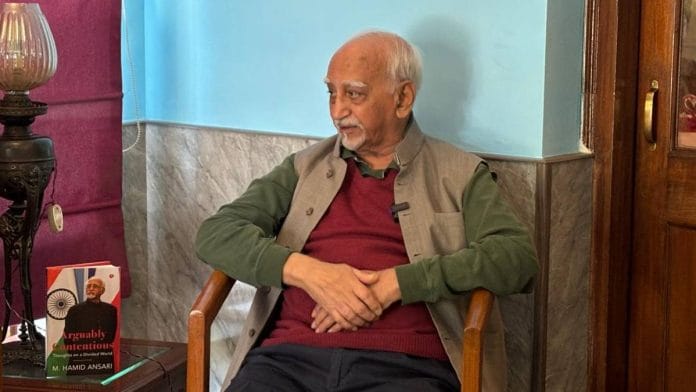



New Delhi: Emergence of Muslim parties is not a healthy trend for India, former Vice President Mohammad Hamid Ansari told ThePrint in an interview Thursday.
“Because in a democracy, you don’t function on the colour of the skin. You function on the principle that all are equal,” the former diplomat said, emphasising on “fraternity” being an important constitutional principle.
“But again, as citizens, you cannot prevent it. Just like the Sikhs can have a party. The Christians can have a party. The Hindus can have a party. The Buddhists can have a party. Muslims can have a party. Whether it is in their interest, and whether it is in the larger interest of the country (will have to be seen),” he added.
Ansari was discussing his new book Arguably Contentious: Thoughts on a Divided World.
While he did not comment specifically on the allegation of the Congress traditionally ignoring Muslim leadership, Ansari asserted: “The point is, Muslim or non-Muslim, everyone is a citizen, and if it is a citizen, they have equal right to participate in the political process, including elections, and if it is not being observed, then obviously there is a lacuna, and that lacuna is not healthy for the democracy.”
However, equal participation has not been happening lately, he said, and it is due to the “judgment of political players”, he added, accepting that parties were not fielding Muslim candidates.
On geopolitics, Ansari said it is a difficult and complex world and that “the country is doing the best it can, under the circumstances”.
Referring to India’s dealing with US President Donald Trump, he told ThePrint: “He is president of the United States of America, and therefore an important player in the global game. He has his own idiosyncrasies. We have to live with it.”
Also Read: Essential to distinguish religion from practices for Muslim women to progress
‘Opposition entitled to comment’
Ansari refused to comment on the ruckus in Parliament this week, with Lok Sabha Leader of Opposition Rahul Gandhi not allowed to speak on former Army chief General M. M. Naravane’s purported revelations on Chinese aggression in his unpublished book.
This led to eight Opposition MPs being suspended and the Lok Sabha passing the Motion of Thanks on the President’s Address without a speech by Prime Minister Narendra Modi.
However, Ansari pointed out that while Parliament used to meet 100 days a year, the figure now stands at around 50 or 60.
“In other words, the time devoted to Parliament by parliamentarians is almost half. Now, in that, how much of it is productive and how much of it is unproductive is a different matter. I won’t comment on all the day-to-day happenings,” he said.
He added that “as long as disruptions and adjournments are within certain limits”, they are, to a certain extent, part of the work of Parliament.
Without commenting on specifics, Ansari said: “The government, obviously, is the government of the day. The opposition in a democratic society has its own will, so they are free to and they should be entitled to comment on what they see as the developments of the day.”
And if the Opposition isn’t allowed to comment on issues, Ansari said “that’s not part of the practice of democracies”.
‘Utterly unfair’
On Palestine, Ansari asserted that “what has been done to Palestinians in their own land is utterly unfair”, and that “Israel is the aggressor, there are no two views about it”.
The solution, he said, remains that the Palestinians should get what is due to them, and which is their right. “Not as a bonus, but as their right, as much of a right as anybody else, anywhere in the world. They should have their rights,” he added.
According to Ansari, parliamentary democracy is a “game of hockey”.
“Both sides play. Now, if one side doesn’t play, or one side plays on reduced capacity, with intention or without intention, I don’t know. Then obviously the game is not being played,” he explained.
As Rajya Sabha Chairman too, Ansari often said he considered himself a referee in a hockey match.
“I have a whistle. I watch the game very closely because I’m close to it, but if the players play it according to rules, I don’t have to blow the whistle. If they don’t, I blow the whistle, irrespective of which side does what,” he told ThePrint.
(Edited by Nida Fatima Siddiqui)
Also Read: Hamid Ansari’s 5 big ideas for foreign policy