








Gurugram: Manika Ahuja is perplexed. A double gold medalist with a Bachelor’s and Master’s from Panjab University, the English literature student went on to pursue the LLB and LLM law degrees and made it to the merit list in both.
Before submitting her PhD thesis on ‘Synergy between Law and Literature’ this year, Manika cleared the University Grant Commission’s National Eligibility Test (UGC NET), secured a Junior Research Fellowship (JRF), and then a UGC Senior Research Fellowship (SRF) in 2020.
But her name is not among the 151 aspirants who cleared the subject knowledge test for the post of English assistant professor in Haryana colleges. Overall, 613 vacancies were up for grabs.
Manika’s is not the only case. After the Haryana Public Service Commission (HPSC) put out its results on 2 November, ThePrint came across several such candidates—gold medalists, two-time NET qualifiers and a university topper—failing to get the minimum 35 per cent marks needed for clearing the test.
Now, serious questions are being raised not only about the transparency and fairness of the selection criteria adopted by the HPSC, but Haryana’s higher education system as well.
High failure rates have repeatedly surfaced in several recruitment examinations like the subject knowledge test, as well as departmental promotional exams.
What makes the latest results alarming is that all these applicants had either cleared the highly competitive UGC-NET, or the (JRF).
Approximately 2,400 candidates, who cleared the preliminary test (basic knowledge) in June, had appeared for this round on 17 August. They had to answer 15 questions, each carrying 10 marks, for which they were given 3 hours.
In August last year, the HPSC sought applications for 2,424 posts of assistant professors (college cadre) in 26 subjects. Of the 613 vacancies for English, 312 were allotted to the general category, 120 for the Scheduled Castes, and 85 and 36 for the Backwards Classes (BC) A and B, respectively.
Later, just before the state elections, the government created two sub-categories among the SCs by equally splitting the reserved seats to accommodate Deprived SCs (DSCs) and Other SCs (OSCs).
The results showed an alarming trend across all categories–general as well as reserved.
There were 136 successful candidates from the general category. In the reserved categories, just 1 DSC candidate, two from the OSC category, five from BC A, three in BC B, and six from the Economically Weaker Sections made the cut.
Back in August, the HPSC notification had stated that twice the number of aspirants compared to the vacancies would be shortlisted for interviews—i.e., 1,226 candidates. With the final tally now at 151, it’s unlikely that even one-fourth of the total 613 posts will be filled.
Also Read: Jail manual a mystery & Hindi is Greek to Haryana prison officials. Dept exam results spark concern
Anger out on the streets
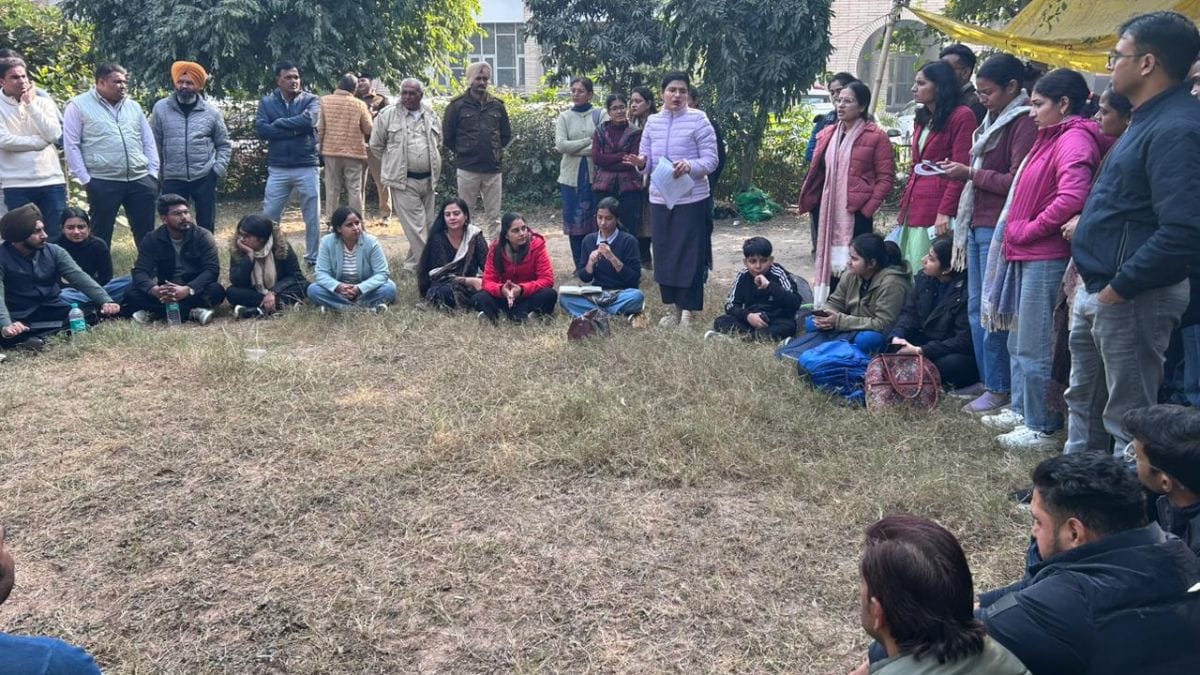
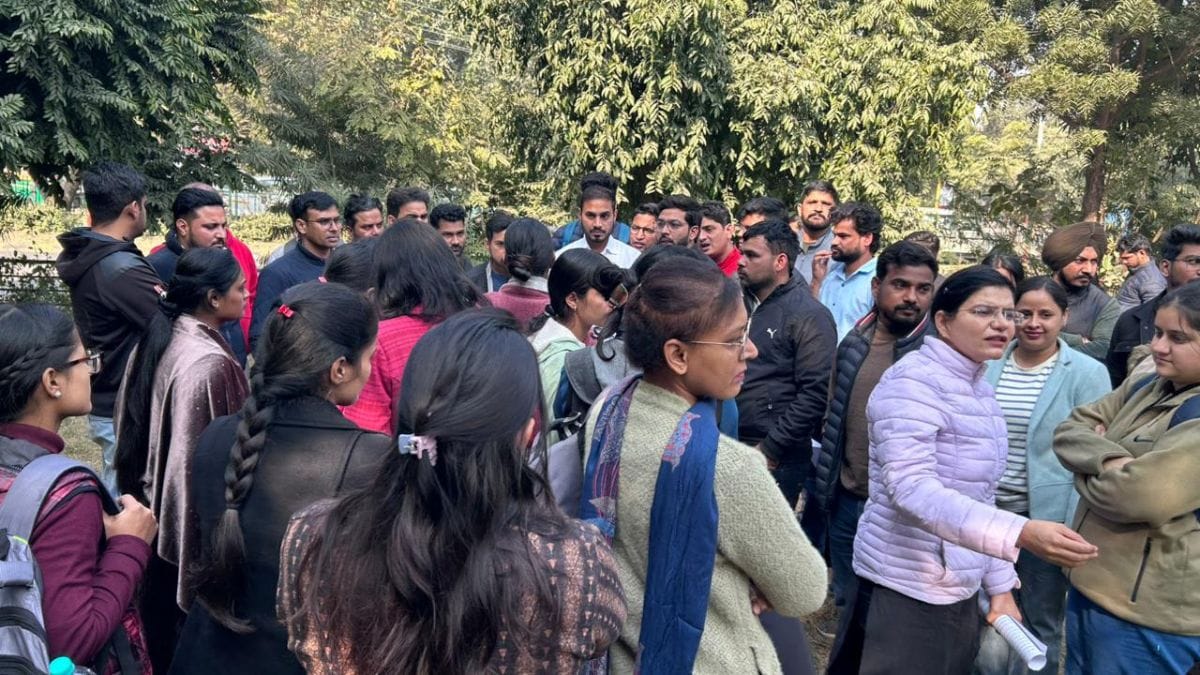
On Friday, over a hundred candidates assembled outside the HPSC office in Panchkula and protested against the results.
“We also met HPSC chairperson Alok Verma, who told us that we should come to terms with the fact that we have failed to clear the exams and should prepare for the next attempt,” Monika Bhardwaj, an aggrieved candidate, told ThePrint.
The job aspirants, she said, would move the Punjab and Haryana High Court seeking intervention.
“I did my Master’s in English Literature from Kurukshetra University with 62 per cent marks in 2012. I cleared the UGC NET with 99.84 percentile marks in 2022 and did a PhD in Cultural Materialism in 2024. I also have a Master’s degree in Education and have cleared the NET in Education. I did well in the HPSC test, but still my attempt was not enough to get 35 per cent marks,” she said, frustrated.
Monika blames the HPSC’s “faulty” evaluation system. “It’s not my case alone. Those who attained more than 90 per cent marks in the preliminary test, which was an objective type, have failed.”
Another candidate, Mamta, told ThePrint that she did a five-year integrated MA English (Honours) programme from Sonepat’s Bhagat Phool Singh Mahila Vishwavidyalaya, scoring 72 per cent marks. “I was a university topper throughout five years (ten semesters). I cleared UGC NET in 2023 and got 83.9 percent marks in the preliminary objective-type test. In the subject knowledge examination, I attempted all the 15 questions with each answer running into an average of three and a half answer sheets.”
“Do you think I am not competent enough to achieve 35 per cent marks?” she asked.
Like Monika, Manika and Mamta, there were several candidates with impressive academic credentials.
For instance, Ruchika Raj and Sharon Handa are MA gold medalists from Patna University and IP University, respectively.
Then there is Komal, a gold medallist from Chaudhary Bansi Lal University with GATE and double NET qualified; Anamika Mundra, a gold medallist from Gurugram University and two-time NET qualified; Pramila Dahiya, a topper from Maharishi Dayanand University and two-time NET qualified, Ravi Tur, all-India 117 rank in the UGC NET, and Megha Dhania, MA degree holder from Indira Gandhi University, Meerpur (Rewari), who cleared NET four times and is a National Fellowship for the Scheduled Castes (NFSC) holder.
Satish Mehra, a retired additional director from the Haryana government, told ThePrint that his daughter did Masters from Panjab University, and that she got first division throughout her studies. The UGC NET qualified candidate, however, flunked the subject knowledge test as well.
An associate professor of English in a Haryana government college conceded that several of her students approached her, dejected, in the past two days.
“Though it would be unfair to comment on the HPSC selection process without knowing what criteria they follow, it is hard to believe that such brilliant students can’t get 35 percent marks in a test having a prescribed syllabus. When they cleared UGC NET or JRF, they had to prepare exhaustively since there was no prescribed syllabus,” she said.
‘Robust system in place’
HPSC secretary Mukesh Ahuja asserted that the Commission’s examination process was robust and marks were given transparently.
“We have a system in place where the answer sheets are checked onscreen. The subject knowledge paper had 15 questions. Each of them was checked by a different faculty member. Hence, the awards for every candidate have been given by not just one single faculty member but 15,” he told ThePrint.
Once the exam is over, the answer sheets are subjected to double-blind barcoding in place of the roll numbers to maintain secrecy.
Ahuja said candidates have to answer different questions on earmarked pages in answer sheets. Once the barcode is given, the answer sheets are scanned and a command is given to split it into various sections.
Subsequently, the specific sections automatically go to the faculty member specifically assigned to check a particular question.
The Commission maintains complete secrecy in the entire process until the time the recommendations are forwarded to the government, Ahuja said. “Once the HPSC sends its recommendations to the government, the Commission allows applications from students to check answer sheets if they want after depositing a prescribed fee. They come to the HPSC office for this.”
Ahuja further said that the job aspirants for 10 subjects, including Mass Communication, Botany, and Zoology, have been allowed to see answer scripts.
Though he refrained from commenting on the high rate of failure in the subject knowledge exam, the HPSC secretary said that the current generation, in general, lacked writing skills.
“While they can get good marks in objective examinations, they fail when it comes to subjective tests. They fail to put their thoughts on sheets even when they know the answer,” he said.
The naysayers
Suraj Bhan Bhardwaj, a retired principal of a Delhi University (DU) college, said he didn’t agree to the suggestion that the poor results had anything to do with Haryana’s education system.
“A friend’s son did his MA in English with first division from Delhi’s Ramjas College. He has cleared JRF and has done a PhD, and is working in a Noida college. However, he has not been found intelligent enough to clear HPSC’s subject knowledge test,” Bhardwaj told ThePrint.
He added: “Another brilliant student of mine from DU has also failed. A professor from Maharishi Dayanand University, Rohtak, told me that even the brightest of students were unable to clear the exam.”
Comparing the results of departmental examinations with the HPSC recruitment test was not fair because the job aspirants are fresh out of institutions and well-prepared because of the high stakes involved, he said.
Those appearing in departmental exams don’t get enough time to prepare because of their job demands, the retired principal added.
Last month, a measly 7 sub-divisional engineers of the Public Works Department cleared the Departmental Professional Examination. A total of 61 such engineers had sat for the test conducted by the Haryana Institute of Public Administration (HIPA) in May.
This came close on the heels of a similar depressing outcome of the departmental examination of the animal husbandry and dairying department. Only 57 of the total 288 officers cleared the accounts exam.
Barely 79 out of 257 candidates cleared the Departmental Rules exam held in March.
Knives are out
Mahabir Jaglan, a retired professor from Kurukshetra University, described the HPSC’s selection procedure as a flawed one.
“When the candidates have cleared the UGC’s prestigious NRT or JRF test, it means they have already cleared the rigorous subject knowledge test. Now, once the UGC has given them the certificate to be employed as an assistant professor, what authority does the HPSC have to hold another test?” Jaglan asked.
On the political front, former chief minister and Leader of Opposition Bhupinder Singh Hooda and AICC secretary Kumari Selja questioned the examination criteria of the HPSC.
“When our youths can clear the Union Public Service Commission (UPSC) examination for civil services, with many of them coming among the top in the all-India ranks, how is it that they fail to clear the HPSC examination?” Hooda told ThePrint over the phone.
Demanding a probe into the results, he alleged that such alarming cases had become a trend.
In January 2023, the HPSC had announced the results for the posts of assistant development officers in the agriculture and farmers welfare department. Only 57 candidates cleared the exam as against 600 advertised posts.
Then Union minister Sanjeev Balyan, an alumnus of Haryana Agriculture University, had raised questions on the selection procedure of the HPSC.
Similarly, only 61 could reach the interview stage of the Haryana Civil Services (Executive Branch) in September 2023. More than 90,000 candidates had tried their luck for 100 vacancies.
Selja said the failure of a large number of highly educated and qualified candidates raised doubts about the difficulty level of the question paper, the evaluation criteria, and the transparency of the process.
“The fact that out of nearly 130 selected candidates in the unreserved category (for English assistant professors), more than 100 are from outside, and that only 21 candidates were selected against more than 300 reserved posts raises serious questions about the adherence to the reservation policy,” she added.
The results, she said, clearly indicate a serious lapse at some level, which is affecting the future of Haryana’s youth.
(Edited by Tony Rai)
Also Read: Why Rajasthan BJP govt is a divided house on HC’s cancellation of 2021 SI recruitment exam