



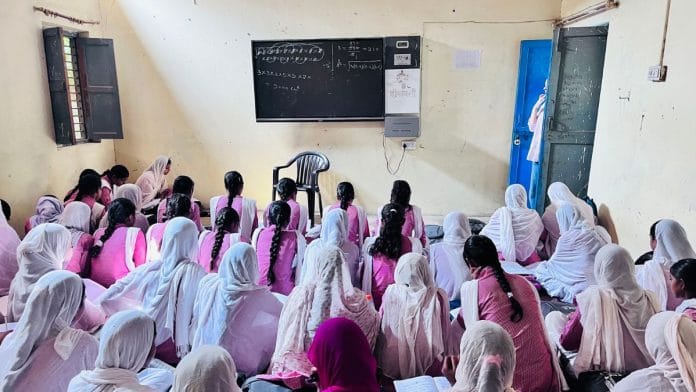
New Delhi: A parliamentary panel has flagged “drastic decline” of nearly 73 percent in student enrolment as education level progresses from primary to higher secondary level, and urged the government to upgrade existing primary and secondary schools into full-fledged higher secondary schools to ensure accessibility.
The Parliament Committee on Estimates presented its report titled ‘Budget and Policy aspects for providing Affordable and Quality Education in the Country including Review of Central Board of Secondary Education’ in Parliament Tuesday. The report highlighted the data for the academic year 2024-25.
According to the report, the government’s Unified District Information System for Education (UDISE) data shows that the number of students enrolled in primary classes is 6.18 crore, over 4 crore in upper primary classes (from 6 to 8), which reduces to 2.3 crore in secondary (9 to10), and further down to 1.6 crore in higher secondary classes (11 to 12).
Similarly it highlights that the out of the total 1 crore schools (including all government and government-aided schools), there are 91 lakh schools at primary level, over 4 lakh schools at upper primary level, over 1.6 lakh schools at secondary level, and only 90,000 schools at higher secondary level in the country.
“The committee is concerned to note this drastic decline in the number of schools and students as education levels rise. From the above information, the committee notes that out of over 1 million government schools, the vast majority are only primary schools, and nearly 73 percent students drop out before finishing higher secondary,” the report states.
The House panel further urged the Ministry of Education to prioritise upgrading existing primary and secondary schools into full higher secondary schools to ensure a high school is physically accessible to students belonging to different communities and to arrest student drop-off rate.
It also states that there is an urgent need to increase the number of schools at secondary and higher secondary levels.
“Considering that education is placed in the Concurrent List of the Constitution with most schools under the jurisdiction of the state governments and UT administration, the committee desires the ministry to impress upon all state/UT governments to take steps for setting up more secondary and higher secondary schools so as to increase the enrolment of students in the country,” the report stated.
‘Increase education expenditure to 6% of GDP’
The committee noted that one of the primary objectives of the New Education Policy 2020 is to increase public expenditure on education to 6 percent of the Gross Domestic Product (GDP).
However, it noted that the current combined spending by the Centre and states stands at only 4.1 percent of the GDP, ”…reflecting a persistent shortfall as NEP 2020 reaches its final year of implementation. The Union Budget 2026-27 provided an allocation of Rs 1,39,286 crore to the Ministry of Education, which represents an 8.27 percent increase over the previous year.”
The committee further noted that the budget share of the total budgetary allocation for the Department of School Education and Literacy (DoSEL) during the year 2024-25 was only 1.52 percent of the 4.1 percent of the GDP spending on the education sector.
“The committee feels that education forms the foundation for national growth, development; and the creation of a vast pool of literate and educated citizens is essential for the growth of the nation. The committee, therefore, desires that the budgetary allocation should be adequate to meet the multi-layered challenges of expanding infrastructure, improving educational outcomes, and strengthening the overall quality of Indian education,” the report states.
Underutilisation of NIPUN Bharat fund
The panel further highlighted the underutilisation of funds allocated to the government’s flagship National Initiative for Proficiency in Reading with Understanding and Numeracy (NIPUN) Bharat, launched in July 2021 as a national mission to ensure that every child attains foundational literacy and numeracy by the end of Grade 3 by the academic year 2026–27.
While highlighting that there have been notable achievements under the scheme, the panel observed that there is “substantial” financial underutilisation reported for Financial Year 2024-25.
It states that out of a total approved national budgetary outlay of Rs 3,02,926.82 lakh earmarked for NIPUN Bharat, the actual expenditure stands at only Rs 1,84,707.58 lakh. It means 39 percent remains unutilised.
The panel also noted that fund utilisation was very low in several states/UTs, including Assam, Delhi, Goa, Gujarat, Kerala, Lakshadweep, Sikkim, Punjab, Rajasthan, Uttar Pradesh, West Bengal and Tamil Nadu.
The committee observed that such underutilisation of funds is in direct contradiction to the “critical and urgent national priority” of NEP 2020 to improve foundational literacy and numeracy skills.
“The committee therefore, recommends the ministry to thoroughly analyse the systemic bottlenecks causing these implementation delays at the state and UT levels,” the report states.
(Edited by Viny Mishra)
Also read: Minority student enrolment in schools has risen in past 5 years, but govt has no religion-wise data